
Email Warmup Tool: 9 Compared, $0.60 to $96 Per Inbox (2026). The 2-minute walkthrough: the price spread, what actually moves deliverability, and the 4-week ramp. Watch on YouTube.
TL;DR
- Email warmup tools cost $0.60 to $96 per inbox per month for the same job. The 160x spread is real, the outcome difference is not.
- Two independent tests (EmailChaser, Postbox Services, Sean B2B's July 2024 split) found warmup either failed to improve replies or actively hurt them. The pro-warmup data is mostly tool vendors quoting their own customers.
- Authentication (SPF, DKIM, DMARC) and list verification do more for deliverability than any warmup network. A bad list burns reputation faster than warmup can build it.
- If you run 10+ inboxes, flat-fee bundled tools (Instantly, Smartlead, MailFlow with QuickMail) end up 50–100x cheaper than per-inbox tools (Folderly, Warmy, Lemwarm) for the same outcome.
- If most of your pipeline still comes from Upwork, you're choosing a warmup tool for a problem you might not have yet.
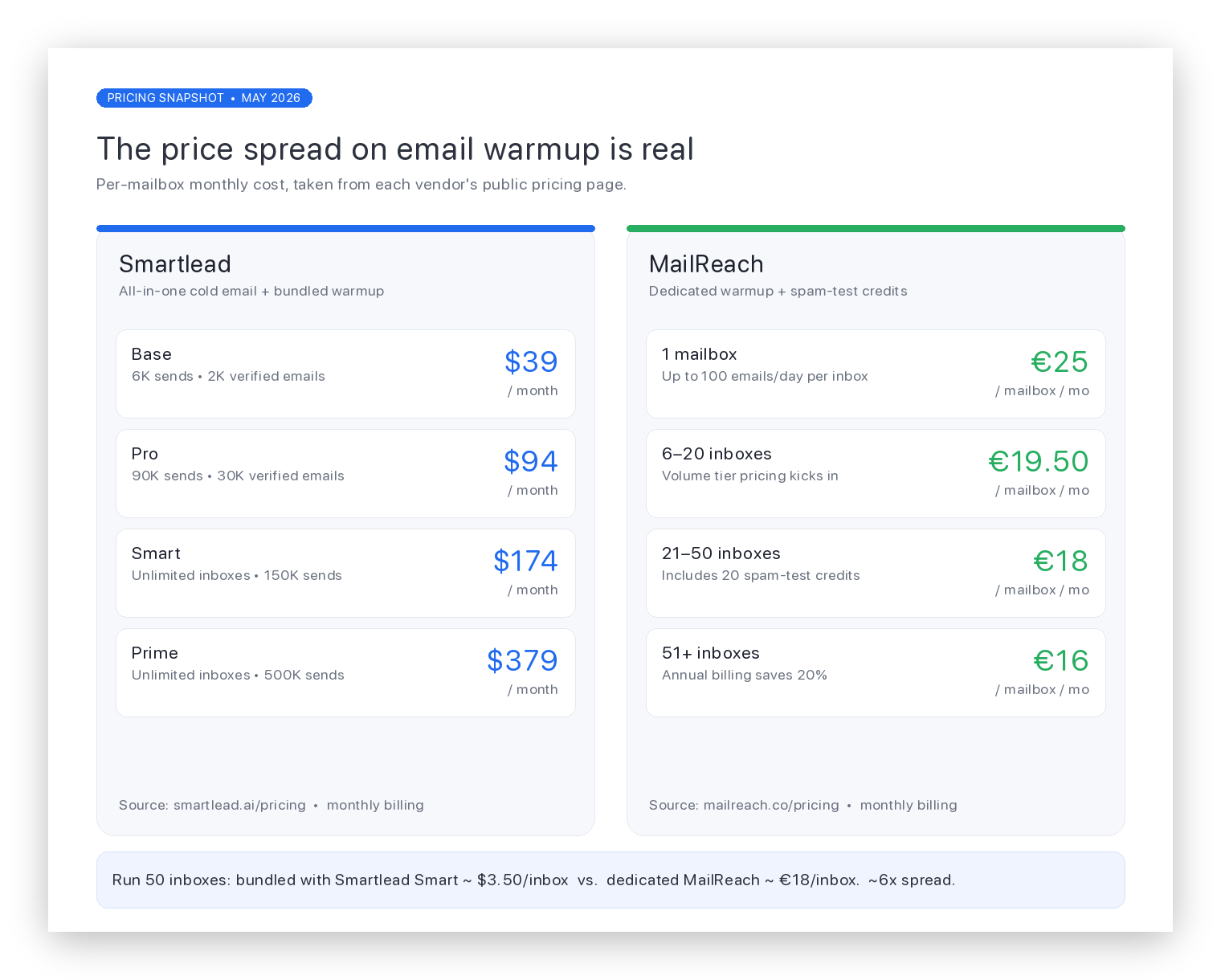
Folderly charges $96 per inbox per month. Instantly bundles unlimited warmup at every plan tier and works out to $0.60 per inbox if you run 50 mailboxes on the Growth plan. Same job. 160x price spread.
The uncomfortable part: there's a small but credible body of evidence that none of them move the needle. EmailChaser and Postbox Services have both published tests showing warmup tools don't improve inbox placement, and a popular cold-email operator tweeted in July 2024 that his reply rates went up when he stopped using warmup. The pro-warmup data is mostly tool vendors quoting their own customers.
This article does the comparison anyway. Because if you're going to spend money on warmup, you should know what you're actually paying for.
The price spread is real, and so is the doubt
Email providers tightened deliverability rules in February 2024, when Google and Yahoo started enforcing DMARC requirements for bulk senders. Since then, every cold-email vendor has redoubled the case for warmup: the rules got stricter, the argument goes, so reputation matters more.
The data is more ambivalent than the marketing. Validity's 2024 deliverability benchmark, cited by Mailreach, shows Gmail's average inbox placement actually dropped from 89.8% to 87.2% across the year. Compliant authentication didn't earn senders a higher placement floor. It just kept them in the game.
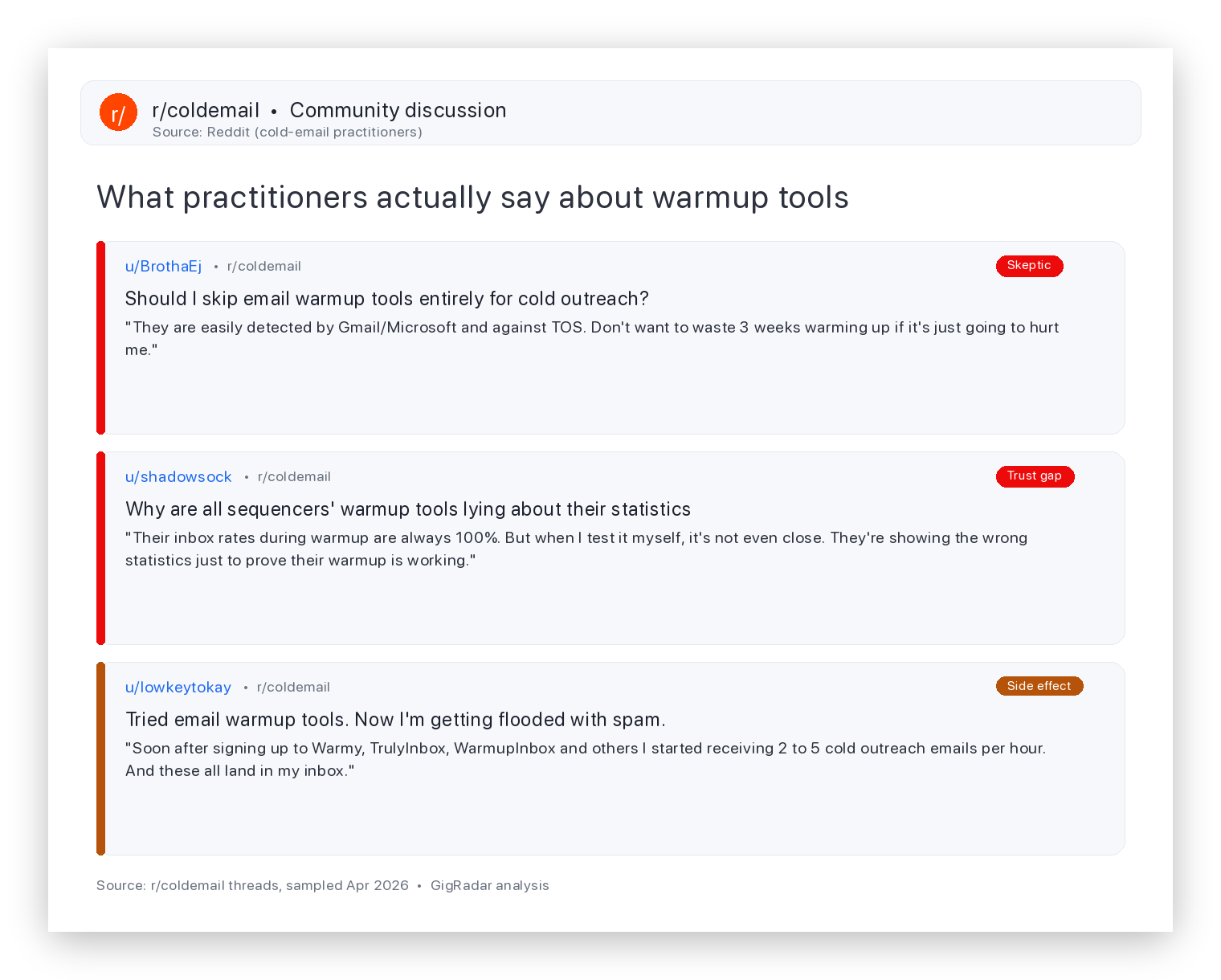
"Postbox Services tested nearly all major warmup tools and found none demonstrated meaningful improvements in deliverability or reputation. Users reported no measurable improvement in open rates, and Google Postmaster Tools showed no significant lift in domain or IP reputation."
Prospeo, Automated Email Warmup: Honest Guide for 2026Folderly's own founder, who runs a deliverability company that sells warmup, has said on video that warmup tools don't work. When the person selling the thing tells you it doesn't work, that's worth a few minutes of attention.
Calculator: what would you actually pay?
Interactive Tool
Email Warmup Cost Calculator
Pick your inbox count. See what each of the 9 tools would cost per month at that scale.
Pricing reflects published 2026 list prices on annual billing where applicable. Add-ons (SmartServers, Inbox Insights, white-label workspaces) excluded (that's a separate line in the table further down.
Drag the inbox count to 50. Watch the spread go from "annoying" to "comically wrong." The bundled platforms barely move because warmup is a side feature of their sequencing platform. The standalone per-inbox tools punish growth linearly. Folderly at 50 inboxes costs $4,800 a month, more than most agencies spend on their entire sales tech stack.
The 9 warmup tools, ranked by total cost of ownership
Below is the comparison most blog posts skip. Network size and AI personalization are easy to brag about. The real differentiator at agency scale is whether the per-inbox tax bankrupts you before you scale.
| Tool | Model | Cost @ 10 inboxes | Cost @ 50 inboxes | Best for |
|---|---|---|---|---|
| Instantly | Bundled flat | $30/mo | $30/mo | Agencies that want one bill, no per-inbox math |
| Smartlead | Bundled flat | $33/mo | $33/mo | API-first teams, white-label client workspaces |
| MailFlow (QuickMail) | Bundled, free with QuickMail | $9–99/mo | $9–299/mo | QuickMail users, peer-to-peer warmup network |
| Warmbox | $15/inbox standalone | $150/mo | $750/mo | Small teams already using a separate ESP |
| Mailreach | $25/inbox standalone | $250/mo | $1,250/mo | Pure B2B sellers; best monitoring dashboard |
| Lemwarm Essential | $24/inbox (free with Lemlist) | $240/mo (or free) | $1,200/mo | Existing Lemlist users only |
| Lemwarm Smart | $40/inbox | $400/mo | $2,000/mo | Hard to justify outside Lemlist |
| Warmy.io | $49/inbox starter | $490/mo | $2,450/mo | Single-inbox owners obsessed with diagnostics |
| Allegrow | $99 + $40/extra inbox | $459/mo | $2,059/mo | Teams who need bundled catch-all verification |
| Folderly | $96/inbox | $960/mo | $4,800/mo | Enterprise compliance budgets, not bootstrappers |
Instantly: the default, until your client demands white-label
Instantly bundles unlimited warmup into every plan. For agencies that connect 10–50 inboxes, this is the cheapest path to "warmup is happening" by an order of magnitude. The warmup runs against a private 4.2M-account network with read-emulation that opens, scrolls and marks-as-important the simulated threads.
The catch: white-label client workspaces aren't standard. If your client wants to log into a branded portal, you're either negotiating custom pricing or moving to Smartlead.
Smartlead: the agency answer when white-label matters
Smartlead trades a higher base price for white-label client workspaces and an exposed warmup-pool tier system, which it documents in its help center. Each mailbox starts in the Foundation Pool and gets promoted as it earns reputation, sending volume, and ESP diversity.
For a 5-client agency on Unlimited Smart with SmartServers, monthly spend lands around $533. Still cheaper than Mailreach at the same inbox count, with the bonus of bundled sequencing.
Warmbox: the cheapest standalone, with a real domain-suspension risk
Warmbox's inbox network includes 30,000–35,000 business mailboxes aged between 1 month and 15 years across 100+ countries. Setup takes 10 minutes via IMAP/SMTP.
The known landmine: Warmbox's default daily volumes are aggressive enough to trigger Google Workspace and Outlook suspensions on domains under 6 months old. Multiple users report needing to manually crank defaults down to ~5 emails per day on fresh domains. If you're frequently spinning up new domains, that override is non-optional.
Mailreach: the only one I'd buy purely for the dashboard
Mailreach built its 30,000+ inbox network specifically from Google Workspace and Office 365 accounts. Most warmup pools are mixed consumer+business; Mailreach's is overwhelmingly the kind of inbox you're actually emailing in B2B outbound.
Where it earns the per-inbox tax: the daily spam-score and inbox-score readings, and the multi-inbox dashboard built explicitly for agencies. If something breaks, you see it before your campaigns notice.
At 25 inboxes that visibility costs $625/mo. Either a luxury or a survival kit, depending on how much of your pipeline depends on outbound.
Lemwarm: free if you're already on Lemlist, brutal if you're not
If you already pay for Lemlist, lemwarm Essential comes free at the Email Pro tier and above, per Lemlist's bundle help docs. Anyone else pays $24–40 per inbox per month for what is essentially a feature of a competing platform.
The honest read: Lemwarm exists to retain Lemlist customers. If you're not one, the same money buys you Mailreach with a better dashboard, or Instantly with the warmup bundled into your sequencer.
Folderly + Warmy + Allegrow: enterprise pricing, niche use cases
These three play in the $50–96 per inbox per month range. Folderly's pitch is heavy diagnostics and DNS hand-holding. Warmy's is AI-personalized warmup behavior and an aggressive monitoring dashboard. Allegrow bundles catch-all verification, which is genuinely useful because bad data burns reputation faster than warmup builds it.
The shared problem: at 10+ inboxes the math falls apart. Folderly at 50 inboxes is $4,800/mo before the $79 Inbox Insights add-on.
The same compliance posture is achievable with Instantly + a separate ZeroBounce verification subscription for under $200/mo. The premium is paid for hand-holding and dashboards, not for measurably better deliverability.
Choose by your operating model, not the leaderboard
The "best" warmup tool depends entirely on what your stack already looks like. Four common archetypes and what to actually pick:
Solo founder, 1–3 inboxes
Warmbox or QuickMail
Cheapest standalone is Warmbox at $15/mo. If you want sequencing too, QuickMail bundles MailFlow warmup free at $9/mo Starter.
Agency, 10–20 inboxes, no white-label needed
Instantly Growth
$37/mo flat. The next-cheapest option (Warmbox) costs 4–5x more at this scale and you don't gain much.
Agency, 10+ inboxes, client white-label needed
Smartlead Unlimited Smart
$174/mo + $29 per client workspace. Real client-facing portals, white-label deliverability dashboards.
Already paying for Lemlist or QuickMail
Use the bundled warmup
Lemwarm Essential is free on Email Pro+. MailFlow is free with QuickMail. Don't double-pay.
B2B-only, deliverability is your KPI
Mailreach
The B2B-weighted network and daily score dashboard are worth the per-inbox premium if outbound is 50%+ of pipeline.
Enterprise compliance team
Folderly or Allegrow
You're not buying warmup. You're buying a vendor name on a SOC-2 questionnaire and a dedicated CSM.
What actually moves deliverability (and warmup is fourth on the list)
Practitioners who run cold-email tests routinely find the same hierarchy: authentication setup matters more than list quality, list quality matters more than send-volume discipline, send-volume discipline matters more than warmup tool choice. Multiple independent guides converge on this.
1) DNS records (SPF, DKIM, DMARC published and aligned) → 2) List verification (bounce rate under 2%) → 3) Send pace (gradual 4-week ramp) → 4) Warmup tool. Skip any of the first three and no warmup tool can save you.
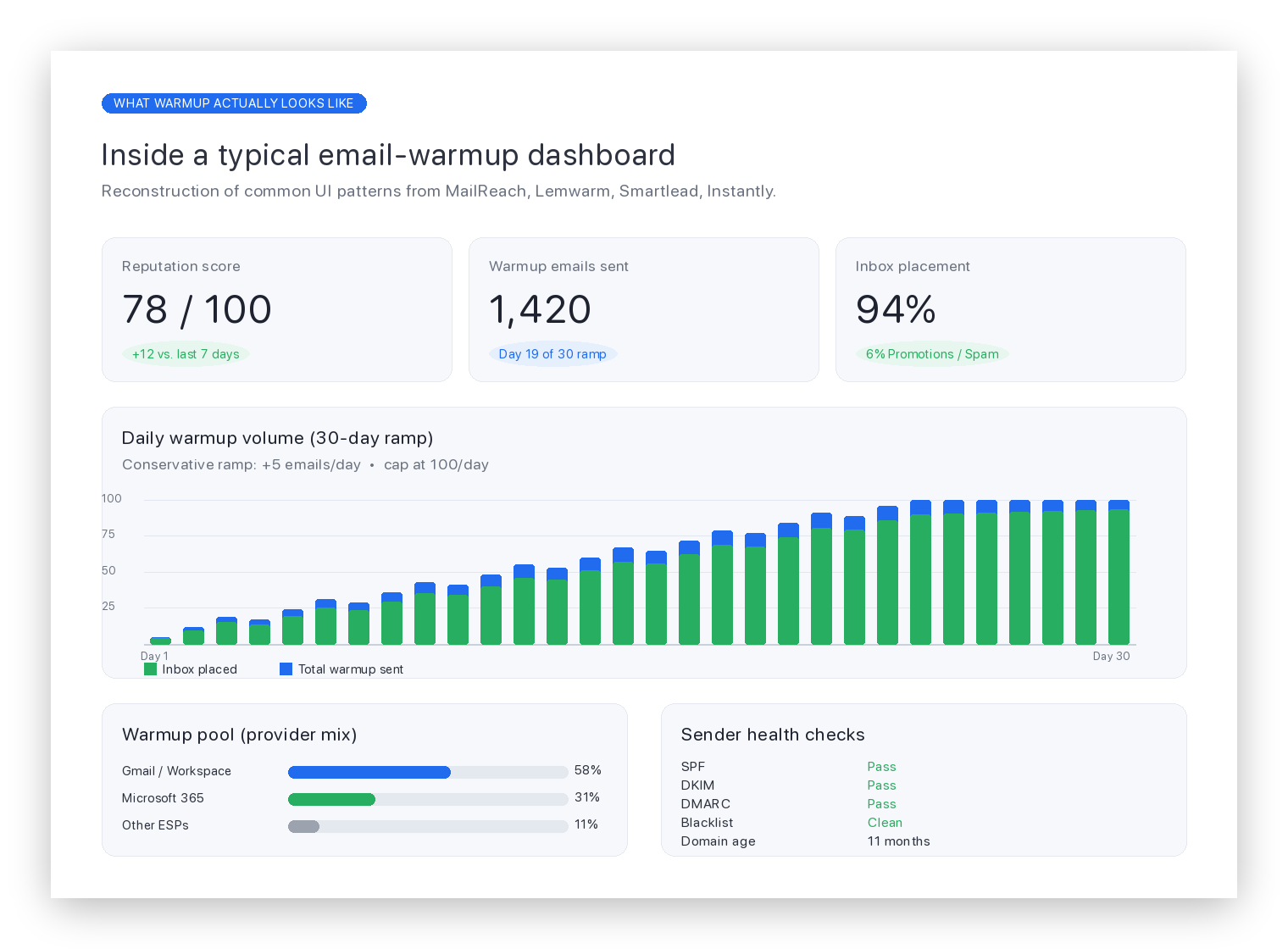
The 4-week ramp that actually works
Tiny volume, all to verified addresses. Watch bounce rate. If it climbs above 2%, the list is bad and warmup won't fix it.
5–10/dayDouble the volume. Track inbox placement with a mail-tester.com seed test. Below 8/10 score and you stop, fix, retest.
15–25/dayReal send volume now. Spam complaint rate must stay under 0.3%. If it spikes, your subject lines or list segment broke and the ramp pauses.
30–50/dayApproach your real daily target. Keep the warmup running in the background indefinitely. Reputation decays without consistent positive signals.
target volumeThe single biggest source of failed warmup is starting at 50+ emails per day on day one because "the tool's default said it's safe." Most defaults are calibrated for established domains. New domains need the slower ramp regardless of what the warmup tool dashboard recommends.
The Upwork-first agency framework: do you even need this yet?
Most agencies that ask "which warmup tool" have it backwards. The actual question is whether cold email is large enough in your pipeline to justify a separate sending domain at all.
If you run a digital, marketing, or development agency on Upwork, your inbound channel is already producing high-intent leads where the prospect has actively posted a job. Reply rates on Upwork proposals consistently outperform cold email, and we've covered the B2B lead-gen mechanics on Upwork in detail. The channel-mix math is in this CPL breakdown and the 7-channels-ranked piece.
The decision tree we use for our own agency clients:
- If >70% of pipeline is Upwork: don't add cold email infrastructure yet. Fix proposal reply rate first. Templates that hit 15%+ beat any deliverability tool.
- If 30–70% of pipeline is Upwork: cold email is a real channel for you. Bundle warmup with whatever sending tool you already use (Instantly or Smartlead). Don't pay $250/mo for a standalone tool.
- If <30% is Upwork: outbound is your real motion. This is the only segment where Mailreach's per-inbox dashboard or Allegrow's verification bundle pays off.
The reverse failure mode is more common: agencies under-invest in fixing the Upwork proposals they already send, then over-invest in deliverability tools for a cold-email motion they can't yet support. Better subject lines on a smaller list will move the needle further than upgrading from Warmbox to Folderly.
Built for Upwork agencies
Before you spend on warmup tools, fix your inbound
We run an Upwork Business Manager that bids for your agency under our supervision. Real human review on every proposal. No browser automation, no scraping, no ToS-risk. Most agencies we onboard reach the inbound volume where cold email becomes optional.
Get Your Free Agency Audit →Frequently asked questions
Do email warmup tools actually work in 2026?
The independent evidence is mixed. EmailChaser and Postbox Services both published tests showing no measurable improvement, and the supporting data mostly comes from tool vendors quoting their own customers.
Authentication setup, list verification, and a disciplined 4-week ramp matter more than which tool you pick. If your authentication is broken, no warmup tool will save you.
What's the cheapest email warmup tool for an agency running 10+ inboxes?
Bundled flat-fee platforms (Instantly at $30–37/mo Growth or Smartlead at $33/mo Base) both come out under $1 per inbox at 50 mailboxes. Standalone per-inbox tools like Mailreach ($25/inbox) or Folderly ($96/inbox) are 50–160x more expensive at agency scale for similar warmup outcomes.
How long does email warmup take for a new domain?
Plan for 2–4 weeks before you launch real campaigns. Week 1: 5–10 emails per inbox per day. Week 2: 15–25/day. Week 3: 30–50/day. Week 4: ramp to target volume while keeping warmup running indefinitely as maintenance. Skipping the ramp is the most common cause of fresh-domain suspensions on Google Workspace and Outlook.
Can a warmup tool actually hurt my deliverability?
Yes, in two ways. First, cheap warmup pools generate engagement patterns that ESPs can detect as fake (small networks doing high-frequency open/reply cycles look more like bot activity than authentic interaction).
Second, when you stop a warmup tool and engagement drops off a cliff, that sudden decline becomes a negative signal to inbox providers. If you start, plan to keep it running.
Is Mailreach worth the per-inbox premium over Instantly?
Only if outbound is more than 50% of your pipeline and you need daily inbox-score and spam-score visibility per inbox. The B2B-weighted network is real and the agency dashboard is the cleanest in the category. Below 50% outbound dependency, Instantly's bundled warmup at flat fee delivers the same deliverability outcomes for a tenth of the cost.
Do I need a warmup tool if I'm only sending Upwork proposals?
No. Upwork proposals don't go through your sending domain. They route through Upwork's platform and bypass the deliverability layer entirely. Warmup tools are for off-platform cold email only. Fix your Upwork proposal reply rate first. Most agencies see bigger pipeline lifts from that than from any deliverability tool.
What's the difference between Lemwarm Essential and Lemwarm Smart?
Essential caps daily warmup at 40 emails and includes basic deliverability reports. Smart removes the cap, adds personalized warmup emails, real-template warmup, custom alerts, and industry-specific clusters.
Essential is free for Lemlist Email Pro and above; Smart costs $40/inbox/month annual. Outside the Lemlist ecosystem, neither version is competitive on price.