
b2b lead generation upwork: how agencies win clients at 1/10th the cost of cold email
B2B Lead Generation on Upwork: $50 CAC vs $1,500 Cold Email — Why Upwork produces signed B2B clients at 1/10th the cost of cold outreach. Watch on YouTube
TL;DR
- Upwork's cost-per-signed-client runs $50 to $200 for agencies. LinkedIn outreach: $800 to $2,500. Cold email: $500 to $1,500. Source
- The difference: Upwork buyers already have budget approval and a defined project. Cold outreach targets people who haven't decided to buy yet.
- Agencies that treat Upwork as a structured B2B channel (not a gig board) close their first client in 1 to 2 weeks, not 3 to 6 months.
- The "no agencies" bias on Upwork is a competitive moat, not a barrier. It filters out 80% of agency competitors who don't know how to reframe the objection.
- Portfolio-driven positioning + case-study bidding produces 12 to 20% reply rates on Upwork vs. 5 to 10% on LinkedIn (with 70% of those being brush-offs).
GigRadar data across 3,000+ agency accounts shows something that contradicts every B2B lead generation playbook published in the last three years: Upwork produces signed clients at $50 to $200 CAC. Cold email costs $500 to $1,500 per signed client. LinkedIn ads run $800 to $2,500.
The entire B2B lead generation industry has convinced agencies that cold outreach is the "serious" play and Upwork is where you go when you're starting out. That framing is backwards.
Upwork is the only B2B channel where buyers show up with an approved budget, .article-body a defined project scope, and a willingness to hire this week. Every other channel requires you to create demand.
Upwork just requires you to capture it.
This article breaks down the exact B2B lead generation playbook that agencies running $5K to $50K/month on Upwork use to win clients consistently. Not theory.
Not "optimize your profile" advice you've read fifty times. The specific system that turns Upwork from a reactive job board into a predictable B2B pipeline.
Why Upwork beats cold email for B2B agencies under $100K/year
Cold email has become the default B2B lead generation strategy. Every agency growth guide says the same thing: buy a list, set up 5 domains, warm them for 2 weeks, send 500 emails/day, follow up 4 times. The real cost of a 1,000-contact cold email campaign runs about $2,200 in-house.
At a 0.5% close rate, that gives you 5 clients from 1,000 contacts. Sounds reasonable until you realize those 5 clients took 3 to 6 months of nurturing, and most of them came in at price points 30 to 40% below your Upwork contracts because cold outreach attracts price-shoppers, not urgent buyers.
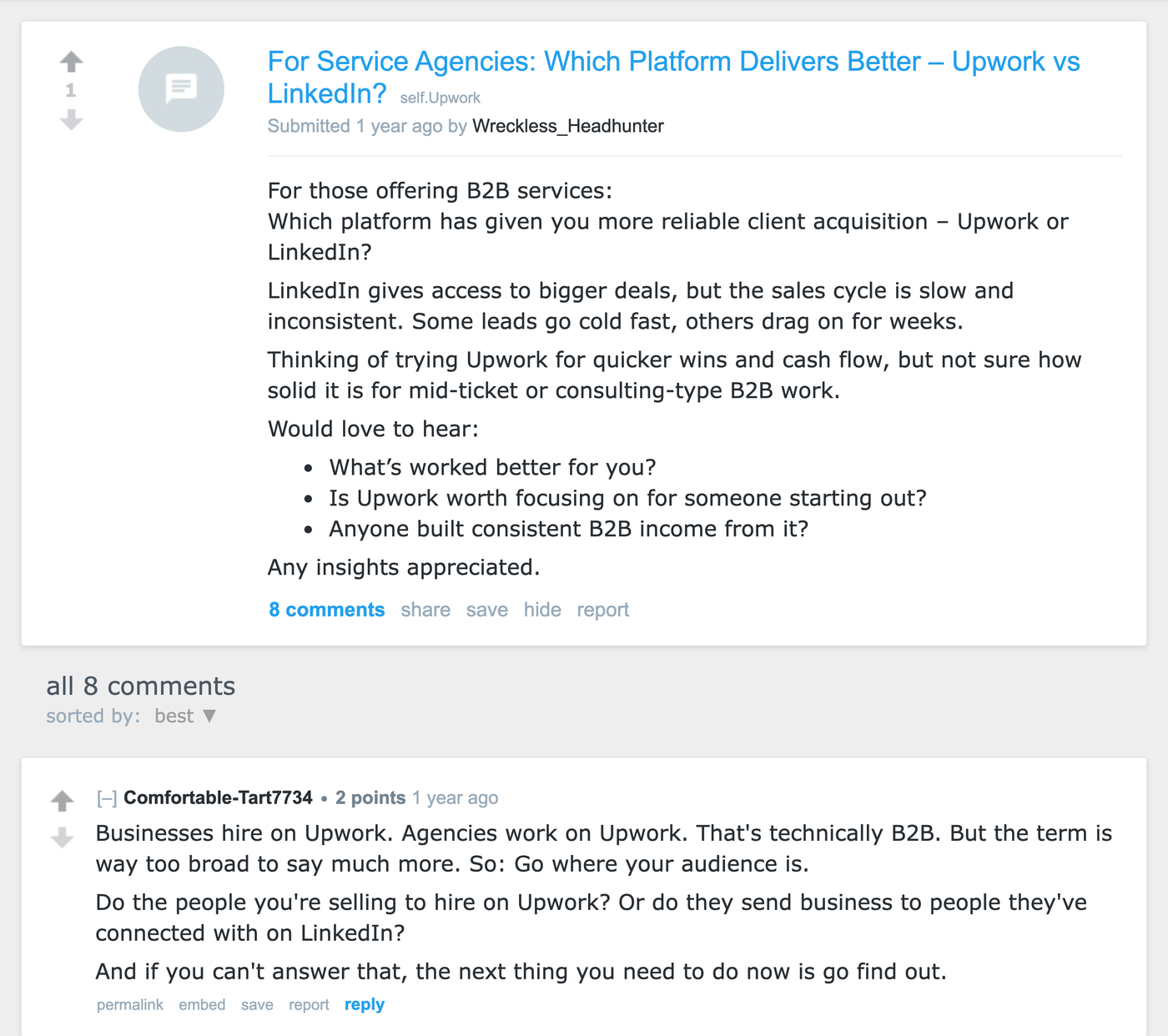
A B2B agency owner weighing Upwork against slow outbound, and the reply that reframes it (r/Upwork, July 2025). On Upwork the buyer has already decided to hire.
Upwork flips this model. When a B2B buyer posts a project on Upwork, they've already done three things cold outreach prospects haven't: identified the problem, secured budget approval, and decided to hire external help.
You're not creating demand. You're responding to demand that already exists.
Sources: Sopro 2025 CPL Benchmarks, Zeliq B2B CPL Report, GigRadar internal data across 3,000+ agencies
Reply rate is a vanity metric. The number that matters is cost per signed client.
Upwork proposal reply rates of 12 to 20% come from buyers actively trying to hire. LinkedIn DM reply rates of 5 to 10% sound comparable, but 70% of those replies are polite brush-offs with zero purchase intent.
B2B lead generation cost calculator: Upwork vs. cold email vs. LinkedIn
Stop guessing which channel is cheapest for your agency. Plug in your actual numbers and see the math.
Interactive Tool
B2B Lead Gen Channel Cost Calculator
Compare your real cost-per-signed-client across Upwork, cold email, and LinkedIn.
Upwork
Cold Email
LinkedIn Ads
The positioning mistake that makes Upwork feel like a race to the bottom
Most agencies that complain about Upwork being "a race to the bottom" are running the same playbook that makes cold email fail: spraying generic proposals at every job that vaguely matches their skills. They bid on 30+ jobs per week with copy-paste templates, wonder why their reply rate is 3%, and conclude the platform is broken.
The platform isn't broken. Their positioning is.
Read your Upwork agency overview out loud. Could it describe any of the 50 agencies that bid on the same job as you?
If yes, you have a positioning problem, not a platform problem. "We do web development with 10+ years of experience" describes 40,000 agencies on Upwork.
Agencies that win B2B clients on Upwork position around outcomes, not services. The difference is the gap between "We offer UI/UX design services" and "We help SaaS companies reduce churn through UX-led product redesigns.
" The first competes on price. The second competes on relevance.
B2B Positioning Formula for Upwork Agencies
Real example from a GigRadar agency:
"Full-stack development agency with 8 years of experience"
"We build high-converting e-commerce websites for DTC brands that increase average order value by 15%"
In GigRadar's agency growth course, Vadym walks through exactly how to structure this positioning for your scanners so automated proposals still sound human and outcome-focused, not generic:
🎥 From GigRadar's Agency Success Course: Scanners That Sell
Case-study-based bidding: the B2B lead generation strategy that produces 15%+ reply rates
The single highest-impact move for B2B lead generation on Upwork is changing what you put in the first 3 lines of your proposal. Most agencies lead with credentials ("We have 10 years of experience, 500+ projects completed, 98% JSS...
"). B2B buyers don't care about your resume.
They care about whether you've solved their specific problem before.
Case-study-based bidding means your proposal opens with a mini case study that mirrors the buyer's situation. Not a link to your portfolio.
Not a list of technologies. A 2 to 3 sentence story about a similar client, .article-body a similar problem, and a specific result.
The key insight from GigRadar's Personalize Cover Letters lesson: your first line needs to be so specific that the client knows you actually read their job post. "I noticed you need a Shopify migration for 12,000 SKUs with custom filters" beats "I have extensive experience in e-commerce development" every time.
"I switched from 'here's my portfolio' openers to 'here's what happened when we solved this exact problem for [company]' openers. Reply rate went from 6% to 19% in three weeks.
Same jobs, same niche, just different first line."
Agency owner in GigRadar community, Shopify dev niche
Why the "no agencies" bias is your competitive moat, not your obstacle
Every agency on Upwork has hit this wall: a perfect B2B project, ideal budget, payment-verified client, and the posting says "no agencies." Most agencies skip these jobs. That's exactly why you shouldn't.
When a client writes "no agencies," they're expressing one of three fears (from GigRadar's Bypass "no agencies" course lesson):
Reframe: one project manager gives you a single contact while finding every designer or developer you need. You still talk to one person.
That person handles planning and keeps small details off your plate.
A freelancer on $5K/month never gives the full 170 hours. Part of those hours go to taxes, sales calls, and hunting the next gig.
With an agency, each billed hour is pure work. Hour for hour, you pay less and get more skills without extra search or management.
Lead with a specific case study from a skeptical client who had the same fear. Show the communication cadence you used.
Show the project management structure. Make the process visible before they commit.
Why "No Agencies" = Less Competition
The 7-day B2B lead generation pipeline setup (from zero to first client)
Here's the exact sequence we see high-performing agencies run when they start treating Upwork as a structured B2B lead generation channel. This isn't a 90-day plan.
It's 7 days to your first qualified B2B lead on Upwork.
Rewrite your agency overview around ONE outcome
Pick the one B2B problem you solve best. Rewrite your headline and first paragraph to name the industry, the problem, and the result.
"We help SaaS companies reduce churn through UX-led redesigns" not "Full-stack agency."
Update your top 3 portfolio items to show before/after metrics for that specific outcome. Full profile optimization guide.
Build your job filter stack and saved searches
Set up 3 to 5 saved searches filtered by: minimum budget ($1K+ for fixed, $30+/hr for hourly), payment verified, client hire rate above 50%, and your niche keywords. This eliminates 80% of noise.
Use Connects strategically: spend 4 to 6 Connects on jobs matching all filters, skip anything that doesn't. Set up RSS alerts for real-time notifications.
Write 3 case-study proposal templates
Create one template per buyer persona (e.g., SaaS founder, e-commerce director, marketing VP). Each template opens with a different case study. See the proposal template that gets 3x more replies.
The first line is custom for every job. The case study, structure, and CTA stay consistent.
This cuts proposal writing from 15 minutes to 5.
Send 10 to 12 targeted proposals per day
Not 30. Not 5. Upwork's algorithm rewards agencies that bid on well-matched jobs consistently over agencies that spray 50 proposals at random. 10 to 12 proposals on filtered jobs outperforms 30+ scatter-shot bids.
Speed matters: agencies using Upwork automation tools that bid within the first 15 minutes see 2x higher view rates.
Reply to every client message within 60 minutes
The sale starts when they reply, not when you get on a call. If you bid in 10 minutes (using GigRadar) but take 24 hours to respond to their message, you've killed the momentum.
Fast proposal + slow follow-up signals automation and lowers trust.
Set up mobile notifications for Upwork messages. The right tools make this effortless.
First qualified lead, first discovery call booked
At 10 proposals/day with a 15% reply rate, you'll have 7 to 10 interested buyers by day 7. With a 20% close rate on those conversations, that's 1 to 2 signed clients in your first week.
Compare that to cold email (first positive reply after 2 to 3 weeks of warming domains) or LinkedIn content (first inbound lead after 3+ months of posting).
Portfolio-driven positioning: your silent B2B salesperson that works 24/7
Your Upwork portfolio is the most underused B2B lead generation asset in your agency. Most agencies dump their "best work" into the portfolio tab and forget about it.
The agencies winning $10K+ B2B contracts treat their portfolio as a conversion tool with the same rigor they'd apply to a landing page.
From GigRadar's Portfolios That Sell course lesson: your portfolio has to work in two ways. It must look visually professional at first glance (because B2B buyers skim), and if the client clicks deeper, it must tell a clear story of results.
B2B Portfolio Audit Checklist
Free for Upwork agencies
Stop paying $800+ per B2B client when Upwork delivers them at $50
GigRadar automates your Upwork job scanning and proposal targeting so you bid on the right B2B projects within minutes of posting. No browser extensions, no login sharing, no ban risk.
Get Your Free Agency Audit →The 3-layer B2B lead generation stack for agencies under 20 people
Upwork should be Layer 1, not your entire strategy. But the order matters.
Agencies that start with cold email or LinkedIn and "add Upwork later" burn 3 to 6 months of runway before seeing revenue. Agencies that start with Upwork and layer channels on top of initial cash flow build sustainably.
The key insight: your Upwork wins become the fuel for every other channel. A case study from a successful Upwork B2B project is the most credible cold email asset you can have, more credible than a testimonial page because it shows the exact problem, process, and result. Research from Built for B2B shows omnichannel campaigns produce 40% higher engagement when they lead with project-based case studies rather than generic capability decks.
Don't add Layer 2 or Layer 3 until Layer 1 is generating at least 2 to 3 signed clients per month. Spreading across channels before Upwork is producing consistent results dilutes your effort and slows everything down.
Master one channel, then expand.
Speed kills (your competition): why the first 15 minutes decide everything
Upwork's own data shows that replying within 10 to 20 minutes of a job posting gives you a measurable edge over proposals that come in hours later. For B2B projects (which attract 20 to 50 proposals in the first 24 hours), being in the first 5 proposals means the client reads yours before decision fatigue sets in.
GigRadar agencies that bid within the first 15 minutes consistently report 2x higher profile view rates compared to the same proposals sent 4+ hours after posting. The content of the proposal matters, but timing determines whether it gets read at all.
Profile View Rate by Response Time
PVR = Profile View Rate. Based on GigRadar data across agencies sending 10+ proposals/week in B2B categories.
This is where automation becomes non-negotiable for B2B lead generation on Upwork. You can't manually monitor job feeds 18 hours a day.
GigRadar scans continuously and sends targeted proposals within minutes of a matching job posting. No browser extensions, no scraping, no ban risk. Your agency bids while you sleep, and every proposal is personalized based on your scanner templates.
After the reply: converting Upwork leads into $5K+ B2B contracts
Getting a reply is not closing a deal. The gap between "interested" and "signed contract" is where most agencies lose B2B clients on Upwork.
They get the reply, send a massive scope document, and then wonder why the client ghosted.
The winning sequence from GigRadar's Win in 5 Minutes and Always Close the Deal course modules:
A face talking through their specific problem converts faster than any written message. "Hi [Name], I watched your brief and here's my initial take on [specific detail]" with a 60-second screen share beats a 500-word response every time.
Frame it as "15 minutes to understand your situation and see if we're the right fit." B2B buyers don't want a demo.
They want to know if you understand their problem well enough to solve it. Cover letter templates that set up this call.
A $2K pilot project with a 2-week timeline gets approved faster than a $15K retainer. Once the pilot delivers results, the retainer conversation is easy. Agency scaling strategies for converting pilots to retainers.
Most agencies send "Just checking in" as a follow-up. Each message should deliver something new: a relevant article, .article-body a quick insight about their industry, .article-body a benchmark from a similar project.
If they don't respond after 4 value-adds, send a clean breakup message.
The B2B lead generation metrics that actually predict revenue on Upwork
Most agencies track the wrong numbers. They obsess over total proposals sent and overall reply rate when the metrics that predict revenue are more specific.
Track your Profile View Rate (PVR) separately from reply rate. If PVR is high but reply rate is low, your profile converts but your proposals don't.
If PVR is low, clients aren't even clicking through to see your work. These are different problems with different fixes.
B2B lead generation on Upwork is a system, not a side hustle
The agencies making $20K+/month on Upwork didn't get there by being the cheapest or the most prolific bidders. They got there by treating Upwork as a structured B2B lead generation channel with the same rigor they'd apply to any sales pipeline: targeted positioning, filtered opportunity selection, case-study-driven proposals, speed on follow-up, and a clear conversion path from reply to signed contract.
Every other B2B lead generation channel (cold email, LinkedIn, Google Ads) requires you to create demand from scratch. Upwork gives you buyers who already have budget, scope, and urgency.
The only question is whether your agency is positioned to capture that demand or whether you're blending into the noise with 50 other agencies sending generic proposals.
Ready to build your B2B pipeline on Upwork?
GigRadar automates the scanning and targeting so you can focus on closing. 3,000+ agencies trust it. No browser extensions, no ban risk.
Start Your Free Agency Audit →