In 2025, a distributed development agency called Updevision had their accounts suspended. All five of them. Simultaneously.
They had Top Rated Plus status and had earned over $1 million on the platform over eight years. Upwork froze $12,267 in their balance and canceled $10,000 in completed milestones without warning. The reason given: "irregular activity." The meaning of that phrase: never explained.
So is Upwork legit? Yes, completely. And that answer is almost entirely beside the point when you are running a $20K-$50K/month agency and your entire acquisition pipeline runs through it.
The platform moves $4 billion a year. That is not your real question.
Every article on the first page of Google for "is Upwork legit" answers the same question: will I get paid? For individual freelancers evaluating the platform for the first time, that is a reasonable concern. It is not the question a serious agency owner should be asking.
Upwork reported $788 million in full-year 2025 revenue, up from $769 million in 2024. The company processed over $4 billion in gross services volume. There are 785,000 active clients on the platform, and the average client spent $5,129 in Q4 2025 alone, up 7% year over year.
Upwork has been publicly traded on NASDAQ since 2018. Payments go into escrow. Hourly contracts have time-tracking. Dispute resolution is documented.
Over 30% of Fortune 100 companies use the platform. Upwork is not a scam. It is one of the most regulated, well-documented work marketplaces in the world.
The question that actually matters: is Upwork profitable for your specific agency, at your niche, at your pricing tier? That is a question with a real, calculable answer. And it is not obvious.
What agencies actually earn on Upwork (the numbers most articles skip)
The first thing I look at when an agency owner tells me Upwork is not working for them is their proposal targeting and pricing data. Nine times out of ten, the platform is not the problem.
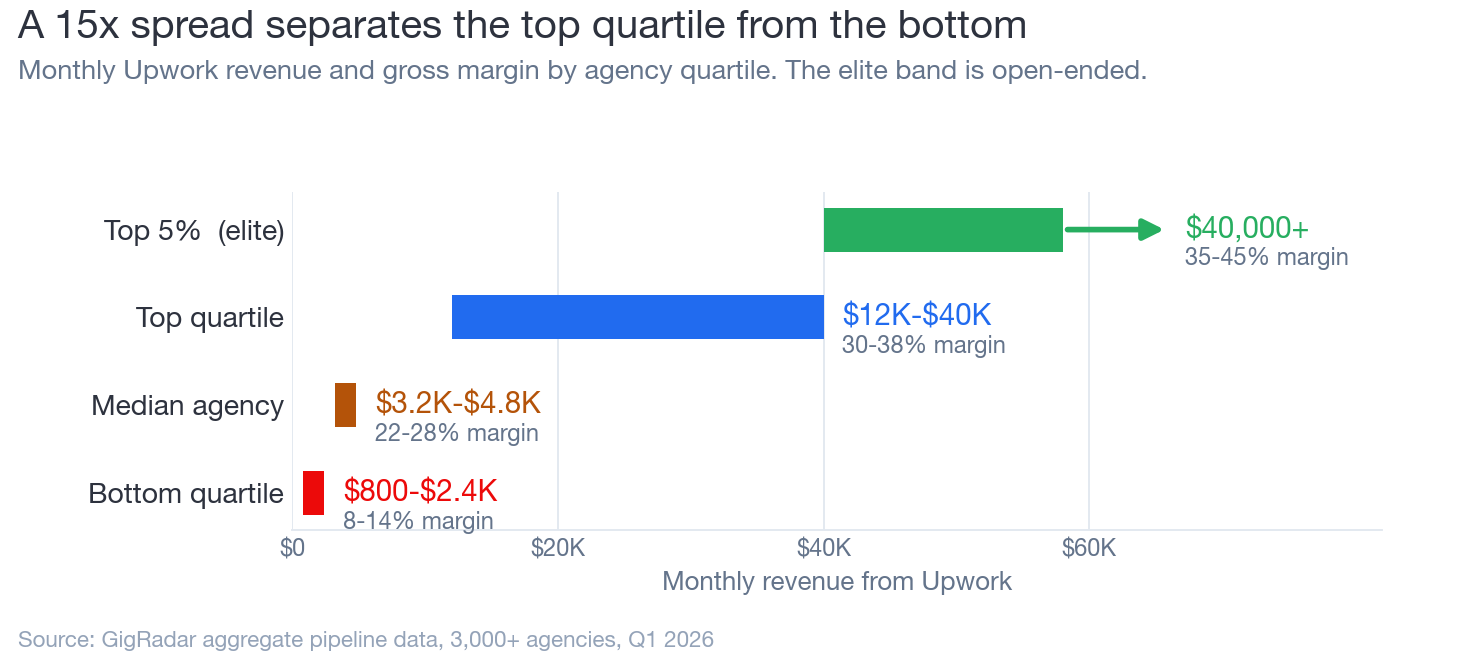
GigRadar data across 3,000+ agencies actively using Upwork shows a distribution worth understanding before you make any decisions about the channel. The median active agency earns $3,200-$4,800 per month from Upwork at a 22-28% gross margin. The top quartile earns $12,000+ per month. The difference is almost never skill. It is pricing discipline and proposal targeting.
The top quartile agencies share three operational patterns. They target payment-verified clients with a minimum $1,000 historical platform spend. They submit fewer than 12 proposals per day, all targeted to specific niche categories where they have demonstrated results. They respond to job posts within two hours of posting.
The bottom quartile does the opposite. Thirty to forty proposals daily, across broad categories, to any client regardless of payment status or spend history. At a 2% reply rate, the cost-per-hire through Connects alone makes the channel nearly unprofitable before you factor in proposal writing time and onboarding overhead.
Upwork rewards targeting over volume. This is not advice. It is a structural feature of how the algorithm works.
Scammers exist. Your filter determines your experience, not theirs.
The BBB complaint file for Upwork is worth reading before you dismiss scam concerns. Failed escrow disputes, identity theft attempts, fake job posts from unverified clients -- all of it is real and documented. But the agencies that consistently report scam exposure are operating without the basic filtering criteria that separate low-quality from high-quality client flow.
The five signals that predict client quality with reliable accuracy:
• Payment verification. Non-negotiable. Clients without a verified payment method close at a fraction of the rate of verified clients and generate the majority of dispute and scam reports. This single filter eliminates most exposure. Every job evaluation starts here.
• Total historical spend. A client who has spent $5,000+ on Upwork has a track record of funded contracts. They know how the platform works. Clients with zero or minimal spend history are disproportionately likely to waste your time or attempt to move the relationship off-platform.
• Job post quality and scope clarity. A well-written post with a specific deliverable, a clear budget, and a defined timeline signals a client who knows what they want. Vague posts signal a client who will also be vague about deliverables, approvals, and success criteria.
• No off-platform contact in the post. Any Telegram handle, WhatsApp number, or personal email address in a job posting before a contract is signed is a direct policy violation and a reliable scam signal. Close the tab immediately.
• Hire rate and time-to-hire. Clients with a history of actually hiring -- not just interviewing thirty candidates and disappearing -- are decisive buyers. A 0% hire rate on an account with twenty open jobs is a client who is either extremely selective or not serious about contracting at all.
Run these five checks before spending a single Upwork Connect. The jobs that clear all five are worth a tailored proposal. The ones that fail two or more are noise, not pipeline.
The real risk no "is Upwork legit" article mentions
Here is the question that matters more than platform legitimacy: is your agency operating in a way that Upwork considers legitimate?
This is where the Updevision story becomes instructive. Not as a horror story about a corrupt platform. As a case study about what happens when a seven-figure operation is built on a foundation that was never stress-tested against the rules it is operating under.
Updevision had team members distributed across four countries. Multiple accounts, multiple geographies, devices logging in from different IP ranges. To an automated enforcement system scanning for behavioral signals, distributed multi-account activity looks identical to account-sharing schemes that Upwork explicitly prohibits. Did they violate the terms? The founders say no. Upwork never said. That ambiguity is exactly the risk.
The behaviors that flag Upwork's trust-and-safety systems are more predictable than the "random ban" narrative suggests. There are three main categories worth knowing:
• Credential and account sharing. Multiple team members logging into the same Upwork account from different devices and IP addresses generates the same signal as account-sharing-as-a-service. Every team member needs their own verified profile. Upwork's agency team management feature is the correct structure for managing multiple freelancers under one agency.
• Browser automation tools. Anything that submits proposals faster than a human could, or logs into Upwork from a headless browser, generates behavioral signals that register as bot activity. This is the most common path to suspension for agencies using third-party bidding tools.
• Off-platform payment suggestions. A single message to a client proposing payment outside Upwork gives the platform grounds for immediate action. Review Upwork's Terms of Service on this point specifically. It is permanent termination territory, not a warning zone.
The agencies that lose accounts are not, for the most part, running deliberate scams. They are running operationally careless businesses that have never read the Terms of Service in full, or have allowed edge-case tools into their workflow without understanding the signals those tools send to enforcement systems at scale.
Not all automation carries the same compliance risk
Most Upwork automation tools work by controlling your browser, logging in with your credentials, and submitting proposals at speeds a human working alone could not replicate. This is the exact behavioral profile that triggers trust-and-safety systems. Agencies flagged for "irregular activity" are often running exactly this kind of tooling, even when they did not understand the risk going in.
GigRadar works differently. It connects to Upwork the way Upwork intends for agency management: by adding a dedicated business manager to your agency account through the platform's official structure. No browser automation, no credential sharing, no scraping. Every proposal drafted goes through human review before submission. All activity stays within the behavioral envelope Upwork's system expects to see from a legitimate agency.
Across 3,000+ agencies running this setup, zero account bans have been attributed to the tool. That is not a guarantee of anything. It is the operational difference between building on a compliant foundation and building on one that looks like fraud at scale.
For a detailed breakdown of what separates compliant Upwork automation from the kind that gets accounts flagged, see how Upwork automation actually works in 2026.
The agencies doing $30K+ consistently on Upwork treat the platform like a liquor license. One perceived violation stops the whole operation. Build your agency like that from day one.
Use this self-audit to see where your agency's compliance risk sits
The audit question most agency owners skip: if Upwork's trust-and-safety team reviewed your account activity for the past 90 days, what would they see?
Agencies with multiple team members sharing one login, proposals sent at machine speed, and no verifiable human review process look like coordinated fraud to an automated system. Agencies with individual verified profiles, proposals submitted within normal human time windows, and a proper agency structure look like what they are: a real services business.
Use the tool below to get a fast assessment of where your current setup sits on Upwork's risk spectrum, and what to address first.
GigRadar is built on Upwork's official agency management structure -- no browser automation, no shared credentials, human review on every proposal. Used by 3,000+ agencies without a single tool-attributable ban.
Get Your Free Agency Audit →Is Upwork legit? Yes. Is your agency operating legitimately on it?
The platform is legitimate. The payment system is real. The clients are real. The $4 billion in annual gross services volume is audited and public.
The enforcement system is also real, and it is algorithmic, opaque, and very difficult to appeal once triggered. The question that determines whether Upwork actually works for your agency is not whether the platform is trustworthy. It is whether you are operating the way a compliant, long-term Upwork agency operates.
If your team shares one login, you are in a risk zone. If you are using automation tools that control your browser or submit proposals without human review, you are in a risk zone. If 90% of your revenue runs through Upwork with no backup acquisition channel, you are in a different kind of risk zone -- one that has nothing to do with ToS violations and everything to do with business concentration.
The agencies we see doing $30K-$60K/month consistently use Upwork as their primary acquisition channel, not their only one. They have direct contracts or referral relationships that would keep the business alive if their Upwork account went offline tomorrow. That is not pessimism about the platform. That is how you build a services business that survives longer than one policy cycle.
If you want to see how the highest-performing Upwork agencies structure their outreach from day one, the proposal approach that consistently drives reply rates above 15% is where the foundation begins. And the profile optimization signals that actually move your JSS determine how many of those clients find you in the first place.
Upwork is legitimate. The enforcement system is real. The scammers are predictable. The only variable that determines whether this channel works for your agency is how you operate inside it.
Upwork is legit. The question is whether your operation is too.