
These 12 fill-in-the-blank Upwork proposal templates are calibrated to what actually wins replies in each category, scored against 133,872 real proposals. Jump straight to your niche below, then copy the template into Upwork.
2-minute walkthrough of the 12 templates and the four-phrase stack that lifts reply rate by ten percentage points. Watch on YouTube
TL;DR
- Across 133,872 GigRadar customer proposals (Dec 2025–Feb 2026), the platform-wide reply rate was 7.45%. The single phrase "happy to answer any questions you may have" lifts that by +5.89pp on its own. The rest of this article is the same kind of math, applied to twelve fill-in-the-blank templates.
- The advice you've been given is wrong on length: 100–149-word cover letters reply at 6.7%, while sub-50-word and 700+-word ones reply at 9.4% and 18.5%. The middle is dead.
- Hand-written templates beat GPT-4o auto-bidder by 17% in five of seven categories. Templates win when the category is repeatable and the freelancer has tuned them.
- Every template below is calibrated to its category's optimal length, opener, and proof artifact, plus the phrases that lift reply rate (Loom offer, "answer any questions", first-name greeting) and the ones that tank it (Calendly URL, "would you be open to a discovery call", "best regards").
- Pair these with the right job-targeting and bid speed and you should expect +10 to +15pp reply-rate lift over a stock template. The "Proposal Strength Scorer" below estimates the lift on your current template.
The reason most templates underperform is that they pile up neutral filler ("tailored to your needs", "best regards") and skip the few phrases that actually move the number.
The 30-second base template below stacks nine of the highest-lift features into ~50 words. Every template after it is a category-specific variant of this base.
The 30-second base template +10pp expected
Use this when you have nothing else. It works in every category we measured except Engineering & Architecture (which needs a longer spec).
Hi {{ClientName}},

{{Specific question about their project, 8 to 10 words}}?

I recently completed a similar project. Happy to send a 1-minute Loom with my approach. Can confidently guarantee {{specific outcome}} within {{X}} days.

Happy to answer any questions you may have.

{{FirstName}}
Lift breakdown: "Hi [Name]" +1.3pp · question opener +3.1pp · 1-minute Loom +4.3pp · "can confidently guarantee" +5.4pp · "answer any questions" +5.9pp · first-name signoff +1.5pp. Realistic stacked lift after damping: ~+10pp.
What follows is twelve fill-in-the-blank Upwork proposal templates, one per category, calibrated to the recipe that actually wins replies in that category. Below each one is the lift breakdown so you can see exactly where the reply rate comes from.
The 12 fill-in-the-blank templates
Each template below is calibrated to its category's optimal length and opener, drawn from a 7-category × 4-length-bin × 3-opener-archetype cross-tab. The recipe line under the title tells you the target reply rate range and why the recipe wins in that category.
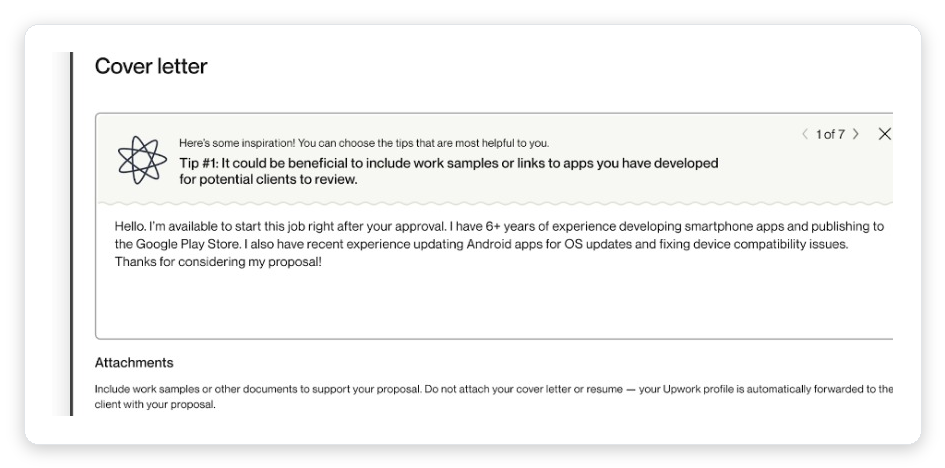
{{like_this}} with one specific detail from the job post. If you can't fill a field with a specific answer ("we cut their CAC from $48 to $19"), don't use a generic placeholder ("we got great results"). Skip the line.
1. Web Development (general)
Web dev fill-in template 100–199 words · target 14.6%
Web Dev is the only major category where 100–199 words wins outright. Lead with "I can deliver" plus a concrete acceptance criterion the client wrote in their post.
Hi {{ClientName}},

Quick question on {{specific_acceptance_criterion}}: is {{your_assumption}} the right read of it?

I can deliver {{feature_or_outcome}} in {{tech_stack}} with {{testing_strategy}}. Recently shipped {{similar_project}} for {{client_industry}}, cutting {{metric}} from {{baseline}} to {{result}} in {{timeframe}}.

Plan for the first {{hours}}:
- Confirm {{acceptance_criteria}} and dependencies.
- Build {{component}} with {{testing_strategy}}.
- Ship v1 by {{date}}, address feedback within {{revision_window}}.

Can confidently guarantee a working {{milestone}} by {{date}}. Happy to send a 1-minute Loom of how I'd structure it.

Happy to answer any questions you may have.

{{FirstName}}
Why this works: "I can deliver" beats "I have experience with" by 2.4pp in Web Dev specifically. Naming the acceptance criterion exactly as the client phrased it signals you read the post (Insight 02). Avoid React/Vue/Next.js name-drops, each tanks reply rate by 2.6 to 3.4pp.
2. WordPress & Elementor
WordPress fill-in template 50–99 words · target 9–11%
WordPress clients scan for speed, security, and Lighthouse. Open with the metric, prove it once, offer a Loom. Don't list plugins.
Hi {{ClientName}},

Saw {{specific_issue_from_post}}. What's your current Lighthouse mobile score?

Last similar build: improved mobile Lighthouse from {{baseline}} to {{result}} for {{site_name}}, dropping bounce rate by {{percent}}. 1-minute Loom of the audit available.

Can confidently guarantee {{Lighthouse_target}} on the live URL within {{days}} days. Phase 1 fixed at {{price}}.

Happy to answer any questions you may have.

{{FirstName}}
Why this works: Specific metric in the opener and the close. WordPress jobs cluster in the small-to-mid spend bracket, where mid-tier clients ($1k–$5k spend) reply at 8.15% vs 3.85% for whales (Insight 07).
3. Shopify & E-commerce
Shopify fill-in template 50–99 words · target 10–13%
E-com clients hire for revenue, not code. Lead with a revenue or conversion delta from a comparable store, never with a tech-stack list.
Hi {{ClientName}},

What's your current cart-to-checkout drop-off rate on {{specific_product_page_or_funnel}}?

Recently lifted {{store_name}}'s checkout conversion from {{baseline}}% to {{result}}% in {{weeks}} weeks by {{specific_change_made}}. Happy to send a 1-minute Loom of the before/after.

First sprint: {{deliverable_1}}, {{deliverable_2}}, fixed at {{price}}.

Can confidently guarantee a measurable lift on {{specific_KPI}} within {{days}} days, or scope a no-charge revision.

Happy to answer any questions you may have.

{{FirstName}}
Why this works: "From X to Y" growth framing lifts reply rate by 4.04pp on its own (Insight 40). E-com buyers are decision-fast and weekend-active; combine this with a Sunday morning UTC bid for a 50% reply premium (Insight 06).
4. UI/UX Design
UI/UX fill-in template <100 words · target 16–20%
Design & Creative replies at 20.2% with sub-100-word letters that offer a video. Critical: Vimeo, not Behance. Vimeo plays inline in the proposal preview; Behance kicks the client off-platform and tanks reply rate by 1.86pp.
Hi {{ClientName}},

What's the deadline for the {{deliverable}}?

Recently shipped {{similar_screen_or_flow}} for {{client_or_industry}}. Happy to send a 1-minute Vimeo walkthrough showing the design rationale.

Showreel: {{vimeo_showreel_url}}.

Could we schedule a quick {{15_minute}} chat to align on direction?

{{FirstName}}
Why this works: Vimeo URL lifts reply rate by 7.85pp, the highest single-link lift in our dataset (Insight 75). Avoid "Figma" mention in the cover letter, it loses 3.06pp in design CLs specifically (Insight 34).
5. Content Writing & Blogging
Writing fill-in template 100–199 words · target 11%
Writing has the highest reply-to-hire conversion of any category in our data (5.62%). Reply rate matters less than tonal match. Mirror the client's voice in your first sentence.
Hi {{ClientName}},

{{Mirror_their_tone: if their post is casual, open casual; if formal, open formal}}.

You mentioned {{specific_audience}} and {{specific_goal}}. Recently wrote {{N_articles}} for {{similar_audience_publication}}, with {{specific_metric_outcome (pageviews, conversions, or rankings)}}.

For your project: I'd lead with {{angle_specific_to_their_post}}, hit {{word_count}}, and target {{specific_keyword_or_topic}}. Drafts in your inbox within {{days}} days. Two free revisions.

Sample directly relevant to your brief: {{Notion_or_Dropbox_link}}.

Happy to answer any questions you may have.

{{FirstName}}
Why this works: Notion link lifts +4.06pp; Dropbox lifts +8.77pp (Insight 75). A writer pasting Behance or GitHub URLs into a writing CL loses on both. Hire-given-reply in Writing is 5.62%, vs 1.05% in Sales & Marketing. These clients sign contracts.
6. SEO Audit & Implementation
SEO fill-in template 50–99 words · target 12–15%
Lead with one specific finding from their site, not a generic "I do SEO." Strip every framework name from the body. "Ahrefs", "SEMrush", "Screaming Frog" all read as canvassing.
Hi {{ClientName}},

Quick read of {{their_domain}}: {{specific_finding, e.g. "your top 5 commercial pages are missing internal links from your blog"}}. Is that the priority for this engagement?

Recently lifted {{client}}'s organic traffic from {{baseline}} to {{result}} in {{months}} months by {{specific_intervention}}.

1-minute Loom of the audit available. Can confidently guarantee {{specific_KPI}} within {{days}} days.

Happy to answer any questions you may have.

{{FirstName}}
Why this works: "Based on what I see" framing lifts reply rate by 3.43pp (Insight 15). The site-specific finding signals you actually opened their domain. Pair with the cluster guide on Upwork profile SEO.
7. Google Ads / PPC
PPC fill-in template 50–99 words · target 9–11%
Sales & Marketing replies at 17.9% with sub-100-word letters and a Loom offer. Critical exception: do NOT open with a question in S&M; confident-claim openers win there (Insight 32).
Hi {{ClientName}},

I'm confident I can cut your {{platform (Google or Meta)}} CPA on {{specific_campaign_or_funnel}} by at least {{percent}}% in {{days}} days. Recently took {{client}} from {{baseline_CPA}} to {{result_CPA}} on {{specific_lever}}.

1-minute Loom of the account audit ready. Discount available on the first month if we move this week.

Happy to answer any questions you may have.

{{FirstName}}
Why this works: "I'm a perfect fit" / confident-claim openers lift S&M reply rate by 5.7pp (Insight 40). Discount mention adds another 2.59pp, and lifts hire-given-reply too (Insight 74). Skip "Klaviyo", it tanks 3.32pp in S&M.
8. Data Analysis & Dashboards
Data fill-in template <50 words · target 14%
Data Science is the one category where ultra-short letters win. Question opener and "recently completed similar." Mention SQL/Tableau/Looker if relevant. Don't mention "AI", "ML", or "Python" in the cover letter, they all underperform (Insight 41).
Hi {{ClientName}},

Are you measuring {{specific_metric}} daily or weekly?

Recently built {{similar_dashboard}} in {{Tableau/Looker/Metabase}} pulling from {{their_data_source_if_named}}. 1-minute Loom of the dashboard available.

{{FirstName}}
Why this works: Question opener is the highest-leverage single feature in our 30-feature multivariate model (+3.08pp marginal). Sub-50-word letters reply at 9.4% baseline; pair with the question opener and Loom for low-double-digit reply rate.
9. Mobile Apps (iOS / Android / Flutter)
Mobile fill-in template 100–199 words · target 12–14%
Mobile clients want to see the binary, not your tech stack. Lead with a TestFlight/Firebase build link to a similar app, not "I have experience with React Native."
Hi {{ClientName}},

Are you targeting {{iOS_only / cross-platform}}, and do you already have a backend, or do I scope that too?

Last shipped: {{app_name}}, {{store_link}}, {{number}} downloads, {{rating}} on the App Store. Built solo in {{weeks}} weeks.

For your project I'd:
- {{Phase_1_milestone}} by {{date}}.
- {{Phase_2_milestone}} by {{date}}.
- TestFlight/internal track every Friday.

Can confidently guarantee a working build at the end of phase 1, plus a 1-minute Loom of the architecture decisions for your specific use case.

Happy to answer any questions you may have.

{{FirstName}}
Why this works: Strip framework names from the cover letter ("React Native" tanks 3.43pp as a trigram per Insight 84). Move the stack list to the portfolio. Concrete download numbers in the proof slot read as evidence, not claim.
10. SaaS / React Dashboards
SaaS fill-in template 100–199 words · target 11–13%
SaaS founders read for cost-per-feature and time-to-ship. Open with a numeric guarantee, attach a video walkthrough of a similar dashboard. Skip "modern stack" language.
Hi {{ClientName}},

What's the smallest feature you'd ship in week one to validate user demand?

Recently built {{similar_SaaS_or_dashboard}} for {{client_or_industry}}, took {{baseline_state}} to {{result_state}} in {{timeframe}}. 1-minute Loom of the dashboard available, plus a {{Notion_or_Dropbox}} link to the spec.

For your project, week 1: {{specific_feature}}. Week 2: {{specific_feature}}. Fixed at {{price}} per phase.

Can confidently guarantee a working {{key_user_action}} live behind a feature flag by {{date}}.

Happy to answer any questions you may have.

{{FirstName}}
Why this works: "From X to Y" growth framing + Notion or Dropbox links + Loom offer compound. Target $1k–$5k spend clients (8.15% reply) over $500K+ whales (3.85% reply), per Insight 07.
11. Virtual Assistant / Ops
VA fill-in template 50–99 words · target 8–9%
Admin Support has a hard reply ceiling around 6–8% across recipes (Insight 10). Beat it with a one-line audit of their existing process, not a list of tools.
Hi {{ClientName}},

Quick scan of your post. Looks like {{specific_workflow_pain}} is the bottleneck. Is that the priority for the first 30 days?

Currently support {{number}} clients across {{specific_tools}}, average response time under {{minutes}} minutes during your timezone window.

Available {{hours_per_week}} starting {{date}}. Can send a 1-minute Loom of how I'd set up your first week.

Happy to answer any questions you may have.

{{FirstName}}
Why this works: Naming the workflow pain back to them lifts reply rate via the "based on what I see" pattern (+3.43pp, Insight 15). Avoid "tailored to your needs" (-1.15pp) and any 1.0 to 1.2× hourly bid relative to their stated max. That band is the worst zone (Insight 48).
12. Translation / Localization
Translation fill-in template 50–99 words · target 9–11%
Translation clients hire for native fluency and turnaround. Lead with where you live and the exact language pair, then a single delivered sample. Translation has the second-highest reply-to-hire conversion in our data after Writing.
Hi {{ClientName}},

Native {{target_language}} from {{country}}. Specialise in {{domain (legal, medical, or marketing)}} for {{client_industry}}.

Most recent: translated {{N_words}} of {{document_type}} for {{similar_client}}, delivered in {{timeframe}} with {{specific_QA_step (back-translation, glossary build, or native review)}}.

For your file: I'd hit {{words_per_day}} with the first batch in your inbox within {{hours}} hours. Glossary built before the first delivery.

Happy to answer any questions you may have.

{{FirstName}}
Why this works: "From [country]" location framing lifts reply rate by 3.25pp (Insight 96). Naming a specific QA step (back-translation, glossary build) signals professional rigor in a category where most freelancers paste a CV.
Free download · No demo required
Get all 13 templates as a copy-paste swipe file
The base template plus all 12 category templates in one PDF you can keep open next to Upwork's cover-letter box — with the per-category reply-rate targets and the 3 fill-in rules that move the number.
- 13 fill-in-the-blank templates, formatted for fast copy-paste
- Per-category length and opener calibrated on 133,872 real proposals
- The 3 rules most proposals quietly break
Please enter a valid email address.
We'll send you the PDF and the occasional Upwork agency teardown. Unsubscribe anytime.
✓ Your swipe file is ready.
Download the swipe file (PDF) →Free agency audit
Not sure which of these 12 templates fits your niche?
Send us your category and your last week of Upwork replies. We'll tell you which template above to start from and which two phrases to cut first, scored against the 133,872-proposal dataset behind this article.
Score my proposals free →Interactive · Proposal Strength Scorer
Score your current template against the 133K-proposal dataset
Tick the features your current template has. The score predicts your reply rate vs the 7.45% platform baseline.
Predicted reply rate
I run a tool that watches Upwork all day and submits proposals on behalf of agencies. Last quarter we pulled 133,872 outbound proposals from our pipeline, tagged every cover letter against 26 structural features, and ranked the lift each one gives.
The data killed most of what Upwork coaches teach. "Match the budget" tanks reply rate.
"150-word sweet spot" is the worst length you can pick. "Best regards" loses 0.55pp every time you use it.

What 133,872 proposals actually say about templates
Most "best Upwork proposal" articles cite anecdotes from one freelancer's inbox. We wired up our pipeline data and re-ran the question on a real dataset.
Source: GigRadar pipeline data, Dec 2025–Feb 2026, 133,872 outbound proposals.
The per-category recipe cheat sheet
Every template above is calibrated to one row of this table. If your category isn't on the list, find the closest match and adopt that recipe.
| Category | Best length | Best opener | Best add-on | Reply rate ceiling |
|---|---|---|---|---|
| Web, Mobile & SW Dev | 100–199 words | "I can deliver" | Loom + acceptance criterion | 14.6% |
| Sales & Marketing | <100 words | Confident claim | Loom (skip question) | 17.9% |
| Design & Creative | <100 words | "Hey, what's the deadline?" | Vimeo (NOT Behance) | 20.2% |
| Data Science & Analytics | <50 words | Question opener | SQL / Tableau / Looker | 14.2% |
| IT & Networking | 100–199 words | "Hi [Name]" personal | Custom phrasing | 10.7% |
| Engineering & Architecture | 300–499 words | Spec-detailed | "Perfect fit" claim | 9.5% |
| Admin Support | 100–199 words | Custom (process audit) | Workflow-specific | 6.1% |
GigRadar pipeline data, Dec 2025–Feb 2026, n = 133,872. Reply rate = client opened a chat or assigned the proposal to a hiring room.
The phrases to add and the phrases to delete
Templates compound from individual phrase choices. The list below is the marginal lift each phrase contributes, ranked by magnitude. Add the green ones, strip the red ones.
| Phrase or pattern | Lift / drag | n | Where to use |
|---|---|---|---|
| Vimeo URL | +7.85pp | 846 | Design, Video, Animation |
| "Top 1% of freelancers" (verified) | +6.15pp | 811 | Only if Top Rated Plus |
| "Answer any questions you may have" | +5.89pp | 630 | Every category, replace "Best regards" |
| "Can confidently guarantee that..." | +5.46pp | 960 | Every category |
| "I'm a perfect fit" | +5.70pp | 671 | Sales & Marketing |
| 1-minute video framing | +4.26pp | 573 | All categories except Education |
| "From $X to $Y" growth claim | +4.04pp | 1,688 | Marketing, SaaS, E-commerce |
| "Send a Loom" pattern | +3.70pp | 1,892 | All except Education |
| Question opener (8–10 words) | +3.08pp | multivariate | All except Sales & Marketing |
| "Hi [ClientName]," opener | +1.33pp | 23,594 | Every category |
| "Best regards" / "Kind regards" | −0.55pp | 15,997 | Delete from every template |
| "Tailored to your needs" | −1.15pp | 2,908 | Delete |
| "Discovery call" / "intro call" | −2.17pp | 1,378 | Replace with "answer any questions" |
| "Would you be open to..." | −2.74pp | 1,268 | Delete |
| "I have experience with..." | −3.67pp | 422 | Delete, replace with "I recently completed" |
| Calendly URL | −6.08pp | 218 | Delete from every template |
| Sign with company name | −10pp+ | varies | Replace with first name |
Lifts are univariate vs the 7.45% baseline. n = number of cover letters in our sample containing the phrase. Source: GigRadar pipeline data, Dec 2025–Feb 2026.
The thing every template above gets wrong by default
Most fill-in-the-blank templates ship with placeholder client names: {{ClientName}}, {{name}}, "Hi there." That last one replies at 6.88%.
Hey [actual first name] replies at 8.50%. Same word count, +1.62pp on the same opener.
Personalization is the only field you cannot skip. If the client's name isn't in the post, scrape their company website or LinkedIn before submitting.
The five seconds it costs you is worth more than half a percentage point of reply rate.
From GigRadar's Agency Success Course, the Personalize Cover Letters lesson walks through how to extract a usable first line from a vague post.
The "150-word rule" is the worst length you can pick
Every Upwork coach says aim for 100–150 words. The data says that bin replies at 6.7%, which is below the 7.45% baseline.
The reply-rate curve on cover letter length is U-shaped. Sub-50-word letters reply at 9.4%, and 700+-word letters reply at 18.5%.
Both extremes win. The "safe middle" loses.
Pick a side. Each template above is sized to its category's winning extreme: design and data win short, web dev wins mid-long, hire-priority engineering wins at 300–499 words.
How to A/B-test a template you can't kill
One template is fragile. The agencies that hit 12%+ reply rate run two or three templates in rotation per scanner, kill the bottom performer at 50 sends, and replace it with a fresh variant.
Pick the template above for your primary category. Don't mix recipes across categories. Web Dev's "I can deliver" opener kills you in Design; Design's "what's the deadline" kills you in S&M.
Reply rate stabilizes around send 50 in our cohort data (Insight 09). Anything below that is noise.
Upwork's "view rate" tells you whether the title and bid surfaced; reply rate (a chat opens) tells you whether the cover letter worked. They're different problems.
Swap "Best regards" for "Happy to answer any questions you may have" and hold everything else constant. After 50 sends, look at the delta. If it's flat, change the next phrase.
Speed adds another 1–2pp on top of the template lift. Each 30-second slip past 4 minutes costs ~1pp reply rate (Insight 06). Templates and speed compound; one without the other is a fraction of the win.
The watch-outs every fill-in template skips
The 12 templates above all assume the job is real. Before you fill in a single placeholder, scan the post for the patterns that destroy reply rate even with a perfect template.
$500K+ "whale" clients reply at 3.85%. Mid-tier clients ($1k–$5k spend) reply at 8.15%. Filter for whales and you halve your reply rate. (Insight 07.)
Sub-3.5-star clients reply at 13.1%, top-rated clients at 6.5%. The "5-star clients only" filter most coaches teach misses the highest-conversion segment.
Read how to spot and avoid Upwork scams before you respond to any job that fails the verification checks.
Where templates fit in the rest of your bidding stack
A template is one of three independent levers. The others compound on top of it.
Sub-5-minute bid = +43% reply lift. If your scanner doesn't surface jobs in the first 5 minutes, no template saves you. Most agencies have rebuilt the alert layer since Upwork killed RSS, see what to use instead of the RSS feed.
The freelancer profile is a 5× lever. Within multi-freelancer teams, the same template gets 4× different reply rates depending on which freelancer's profile is attached. Run the profile SEO checklist before you ship templates from a weak profile.
Switch hourly bids to fixed-price where allowed (+2.3pp). Bid under 50% of budget or 200 to 500% of budget. Upwork's own proposal guide tells freelancers to "match the budget"; the data says match the budget and you're throwing replies away.
Speed, profile, and bid only matter if your proposal lands in the first batch the client reads. How Upwork's algorithm ranks proposals drives that placement — winning the read but losing the ranking still costs you the reply.
Free agency audit
We'll grade your current template against the 133K-proposal dataset
Send us your current cover letter and your last week of replies. We'll show you exactly which phrases are dragging your reply rate down and which to add, with the per-category lift values from this article applied to your data.
Get my free agency audit →How to actually ship this
Templates work when they're sent fast on the right jobs. The agencies pulling 12%+ reply rates aren't writing better proposals than the median.
They're writing the same calibrated template, but submitting it inside the first 5 minutes, only on jobs that match their scanner's category recipe, only to clients in the $1k–$5k spend bracket.
If your team can do all three by hand, run them by hand. If you can't, that's the gap GigRadar fills.
For the full bidding economics behind this article (boost ROI, day-of-week premiums, bid-amount math), the data piece on what 133K cover letters reveal goes deeper. The Upwork API tutorial shows what fully-automated submission looks like end-to-end, and our explainer on Upwork automation covers the compliance question every agency owner asks first. For a category-specific deep dive, the winning SEO & content proposals playbook applies these rules to the highest-converting niche in our pipeline.