
TL;DR
- The first PM hire makes economic sense at 4+ concurrent paid projects averaging $5K+, not before. Below that, you're paying for coordination that doesn't exist.
- Mid-level US PM costs roughly $115K–$130K all-in; LATAM mid-senior costs $30K–$45K. Same role, $80K/year delta.
- The ratio that actually holds is 1 PM per 5 freelancers, not 1:8. WGS scaled to 60 engineers and learned this the painful way.
- An Upwork agency PM does five things a generic agency PM doesn't: Work Diary review, milestone funding mediation, Connects budget oversight, agency-level JSS protection, and async coordination across 4–6 timezones.
- Most agencies should hire a "second-version-of-you" first (a senior delivery operator), then a half-time ops VA, and only then a PM.
Most Upwork agencies hire their first project manager 18 months too early and bleed roughly $40K of margin before the math actually starts working. The owner feels overwhelmed, posts a "Project Manager wanted, $20/hr" ad on Upwork, hires the friendliest applicant, and then spends the next six months wondering why the agency feels heavier instead of lighter.
I run GigRadar. I've watched hundreds of Upwork agencies make this exact hire.
The pattern repeats: 2 active contracts, no operational system, one PM who has to invent the system on the fly while also managing the contracts. The agency slows down because the PM is now the bottleneck the owner used to be.

The decision isn't "do I need a PM yet?" The decision is "does my project mix and margin actually support the role?"
There's a math test for that. Below it, you're delegating chaos. Above it, you're scaling.
when the upwork project manager hire actually pays for itself
The break-even is straightforward. A PM costs you somewhere between $30K (LATAM mid-level remote) and $130K (US mid-level fully loaded) per year, all-in. To recover that cost without touching agency net margin, the PM has to either free up enough of your billable time to recover the salary, or unlock revenue you couldn't run alone.
The Agency Huddle 4-trigger framework is the closest thing to a clean signal. Their threshold is "3–4 concurrent projects, owner not shipping work, team waiting on owner, projects slipping." For Upwork agencies specifically, the cleaner cutoff is 4 concurrent paid contracts averaging $5K+ in monthly billings. Below that, the project mix can't support the overhead.
If your hire-justification rule is "this person should bill out at 1.8× their all-in cost within 45 days, or sustain 2× in contract value," a PM with no projects in flight fails day one. The role recovers cost through capacity, not direct billing.
pm hire readiness calculator (run this before posting any job)
Plug in your current numbers. The output is a green/amber/red read on whether your project mix and owner billable rate actually support the hire.
Interactive Tool
PM Hire Readiness Score
Calculates your monthly PM ROI based on concurrent projects, owner-time recovered, and chosen PM tier. Anything under 1.0 is a red light.
the 4-trigger test, tuned for upwork agencies
Generic agency PM-hire frameworks miss what's specific about running freelancers on Upwork. Each trigger below is a binary signal. You need at least three of four firing simultaneously before the hire works.
Below this volume, the PM has too few projects to specialize the workflow on. They become an inbox-checker.
If you're still coding, designing, or writing for clients on most weeks, your bottleneck is delivery capacity, not coordination. Hire a senior IC first.
One slipped milestone is bad luck. Two in a month means coordination is broken, not the freelancers. Per TMetric's agency benchmarks, scope creep alone burns 5–15% of margin per project.
Reviewing Work Diary entries is one of the four hidden Upwork-specific PM duties. If it never gets done, you're risking JSS hits and unbilled hours.
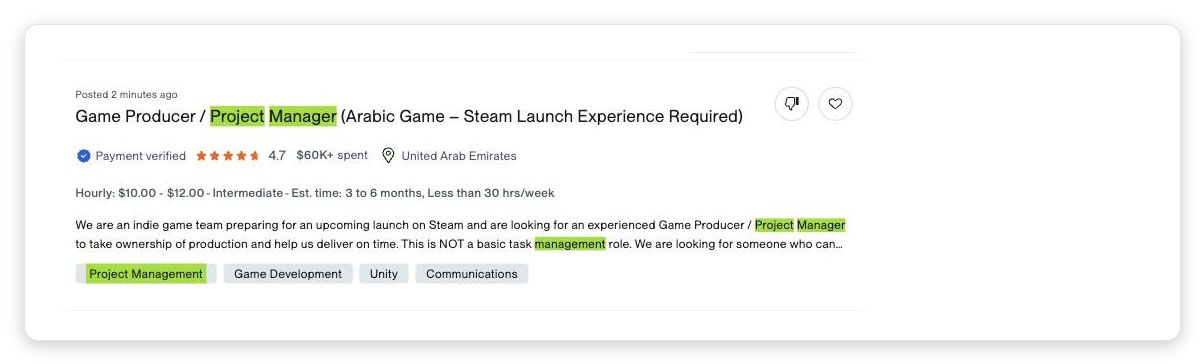
how the upwork pm role looks in real listings
The market for Upwork-experienced project managers is its own niche. Real listings show the budget compression: the same skill set posts at $15–$35/hr in LATAM/EU and $45–$75/hr in the US. Hourly rate aggregators agree.

five things an upwork agency pm does that a generic agency pm doesn't
If the candidate has only run in-house teams, they'll spend three months learning these the hard way. Pre-screen for them.
Verify the freelancer's Time Tracker screenshots, memos, and activity counts before the client does. Flag anomalies. One unjustified 8-hour block can cost you the contract and the JSS.
Stage every SOW into 3–5 funded milestones, push the client to fund the next one before the freelancer starts, and run point if a released payment gets challenged. Generic PMs don't know that Upwork's mediation process has hard 5-day reply windows.
An agency burning 1,000+ Connects a month at $0.15 each is spending $150 just to bid. The PM owns proposal triage so freelancers don't drain Connects on bad-fit jobs. Numbers we covered in the Upwork Connects strategy guide.
Close stalled contracts diplomatically, request reviews within 48 hours of completion, manage the closeout discipline. One bad review tanks agency-level JSS harder than solo profile JSS because the score averages across the agency's contracts. Our breakdown is in the feedback-to-client templates piece.
No daily standup. Loom-first updates, single-day client weekly summary, async Slack threads. Upwork freelancers aren't on payroll for synchronous time and won't behave like W2 staff if you try to force in-house meeting culture.
the pm-to-freelancer ratio that actually works
The internet repeats "1 PM per 8 developers" as gospel. The teams that actually scale say it's wrong.
WGS, a 60-engineer dev firm, documented their attempt at 1:8: PMs were drowning, projects slipping, status updates shallow. They moved to 1:4 with assistant managers underneath. Echometer's analysis of PM-to-engineer ratios lands at the same conclusion: 1:7 is the upper edge of "still functional."
For Upwork agencies, the working ratio is even tighter: 1 PM per 5 freelancers. The friction comes from contractors not being on a single payroll calendar, working in different timezones, on different milestone structures. A US in-house team can absorb a lighter PM ratio because everyone's in the same Slack at the same time. An Upwork team can't.
pm salary tiers in 2026: the $80K geographic delta
The same Upwork-experienced PM costs roughly 4× less in LATAM than in the US. Live data, sourced from current rate aggregators and salary studies.
| Region & seniority | Base salary / monthly all-in | Hourly equivalent | Source |
|---|---|---|---|
| US mid-level (employee) | $100,750 base (~$10K/mo all-in) | $48–$52 | WowRemoteTeams 2026 |
| US senior (employee) | ~$130K all-in | $60–$75 | Sengi rate calculator |
| EU mid-level remote | $5K–$7K/mo | $30–$45 | Upwork rate aggregator |
| LATAM mid-level remote | $2,000–$2,600/mo | $15–$25 | Simera 2026 study |
| LATAM senior remote | $2,600–$3,500/mo | $22–$35 | HireTalent.LAT 2026 |
| Philippines mid-senior | $1,800–$3,400/mo | $12–$22 | Plane 2026 |
The straight read: a US senior PM at $130K can be a LATAM senior PM at $42K. Same Upwork experience, same Trello board fluency, same English. The $88K delta covers the entire fixed-cost increase of opening the role for a small agency.
"4× cheaper" only holds when you screen for actual Upwork-experienced candidates, not generic remote PMs. The right filter is "has run at least 5 Upwork client engagements as the agency-side coordinator," not "has a PMP cert." Most certifications cover Gantt charts, not milestone disputes.
why "pm first" is usually the wrong hire
The contrarian read is that most agencies should not hire a PM as their first non-IC role. The first hire that actually changes the math is what GigRadar's agency-building playbook calls a "second-version-of-you": a senior delivery operator who can do client calls, scope projects, run a kickoff, ship the first 30 days, and only escalate hard calls back to you.
That hire frees the owner from being the operational bottleneck on every single contract. A PM hired before this person exists is a PM with no senior IC to actually back them up.
They become a glorified status-meeting host. The fix is the order our Upwork team-management playbook walks through: build the senior IC bench first, then layer coordination on top.
The order that works for most Upwork agencies under $50K MRR:
- Second-version-of-you. Senior IC + delivery lead at $4K–$8K/mo. Handles client calls, owns delivery on 2 of your 4 active contracts.
- Half-time ops VA. $1.2K–$1.8K/mo. Handles inbox triage, scheduling, invoicing, light Work Diary review. Etcetera's 8-year retrospective notes this is the highest-leverage hire for solo operators.
- Project manager. Only after the first two are in place AND the 4-trigger test fires. Now there's a senior IC for them to escalate to and a VA to delegate scheduling work to.
For Upwork agencies running 5+ freelancers
Outsource the proposal-pipeline grind, not the delivery.
We operate a real Upwork Business Manager account. Your agency invites our BM through Upwork's official invitation flow. Proposals submit from our BM under our team's supervision. Your freelancer account is never touched.
Get Your Free Agency Audit →the 90-day pm onboarding plan that doesn't waste the salary
Half of the PM hires that "didn't work out" failed because the owner didn't onboard them. The PM showed up, asked "what should I do," and the owner answered "you tell me." Six weeks later the role got cut.
The plan below assumes a competent hire and a small agency (4–8 freelancers). Each phase is structured around what the owner has to delegate, not what the PM has to learn.
Shadow + document. No project ownership yet.
PM joins every client call, every freelancer 1:1, every scope review. Writes the SOP doc as they go. Owner still owns every milestone and dispute. This phase exists to surface assumptions you didn't know you had, like "the freelancer always sends Friday updates" (no, they don't, you just remind them).
Take 2 contracts. Owner reviews weekly.
PM owns delivery, milestones, Work Diary review, and weekly client check-ins on 2 of the 4 active contracts. Owner stays on the other 2 and runs a Friday review of everything the PM did. Mistakes get caught here without the client noticing.
Take all contracts. Owner moves to weekly summary only.
PM owns all active contracts. Owner gets a Monday summary email and a Friday risk-flag list. Owner stops attending standing client calls except for renewal conversations or escalations. This is where the freed-up billable time materializes.
Decision point: keep, level up, or cut.
90-day review. PM should be running 4+ contracts cleanly, JSS holding above 4.8, no slipped milestones in the last 30 days. If yes, level up scope (proposal triage, Connects budget, freelancer sourcing). If no, cut now: the salary you saved by acting at day 90 funds a better hire.
your pm hire readiness checklist (save this)
Print this. Tape it next to the calculator output. Don't post the job until every box is checked.
- ☐ 4+ concurrent paid contracts averaging $5K+ monthly billings
- ☐ Owner is doing zero billable IC delivery work most weeks
- ☐ Calculator shows ROI ≥ 1.5× at the chosen PM tier
- ☐ Senior IC delivery lead already in place
- ☐ Half-time ops VA already in place
- ☐ PM:freelancer ratio at hire stays at or below 1:5
- ☐ Candidate has run 5+ Upwork client engagements as agency-side coordinator
- ☐ Candidate can describe Upwork milestone dispute mediation in the interview
- ☐ 90-day onboarding plan ready, with explicit week-by-week ownership transfer
- ☐ Day-90 cut-or-keep gate written down before they start
bottom line
Most Upwork agencies feel the PM-hire pull at month 6, when the owner first realises they're the operational bottleneck. The hire that works happens at month 18, when the project mix can absorb the overhead.
Hiring early eats $30K–$50K of margin and slows the agency down because the new PM has nothing systematized to inherit.
Run the calculator. If the ROI lands above 1.5× and the 4-trigger test fires, hire.
If not, the cheapest fix is one more concurrent paid contract, not a new role. For the Upwork-side of the pipeline that gets you those contracts in the first place, our agency account vs freelancer breakdown covers the structural moves that compound before you ever need a PM.