
Upwork Hourly Rate Calculator — the $3/hour average is a myth, and your rate is really two numbers fighting. Watch on YouTube.
TL;DR
- The "$3/hour average" you keep reading is real and useless. It averages one-off micro-gigs with senior contracts. Ignore it.
- Your Upwork rate is two numbers fighting each other: what the market pays for your skill, and what your income goal requires. The calculator below shows both and tells you which one wins.
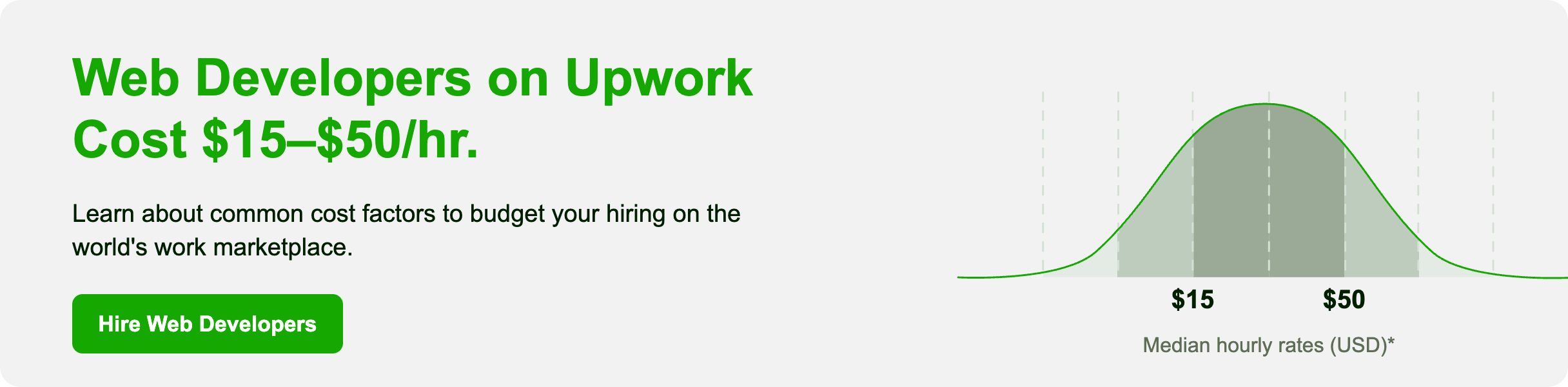
- Upwork's own cost pages put web developers at a $30 median ($15–$50 typical), data analysts at $30, AI/ML engineers at $100+, and virtual assistants at $13.
- Region moves the number more than experience does: a US/UK seat clears roughly 2x a South Asia seat for the same skill.
- The variable 0–15% Upwork freelancer fee means your sticker rate is not your take-home. Gross up by the fee or you quietly work for less.
A web developer on Upwork has a median rate of exactly $30/hour. Upwork publishes that number itself, on its own cost-to-hire page, next to a typical band of $15 to $50.
So why does every "Upwork hourly rate" article open with a scary $3 figure? Because that number averages every hourly contract on the platform, including the data-entry task that paid $4 to rename 200 files.
It tells you nothing about what a skilled professional charges, and it fuels the tired "is Upwork even worth it" doubt we tackle in our honest take on whether Upwork is legit.
Here is the part nobody frames correctly. Your rate is not a fact you look up, it is a decision.
That decision has two inputs that usually disagree: the market rate for your skill, and the rate your income goal demands. Set the calculator below and it tells you which of the two you are actually bound by.
Free Interactive Tool
Upwork Hourly Rate Calculator
Pick your skill, level, and region for the market band. Add your income goal to see which number you are really bound by, and what you keep after Upwork's fee.
Bands derived from Upwork cost-to-hire medians, Clockify regional data, and GigRadar's 2026 rate analysis. Directional only: specialization, reviews, and negotiation move the real number.
What the calculator just did, and why the median is a floor not a ceiling
The tool starts from Upwork's published median for your skill, then applies two multipliers: experience and region. This mirrors the backward method Upwork itself recommends in its guide to setting a freelance rate.
Expert positioning roughly doubles a beginner band. A US or Western European seat clears about 1.2x the global median, while a South Asia seat sits near 0.6x.
Then it does the part most freelancers skip. It takes your income goal, divides by your real billable hours, and grosses up for the fee to find your personal floor.
If that floor lands above the market's 75th percentile, no wishful pricing fixes it. You need premium positioning or more hours, not a bigger sticker number.
Here is the same data the calculator pulls from, by category. These are Upwork's own platform medians and typical ranges, cross-checked against Clockify's hourly-rate dataset.
The category medians come straight from Upwork's cost-to-hire pages: data analysts at $30, UX designers at $27, and virtual assistants at $13.
| Skill category | Low (~p25) | Median | High (~p75) |
|---|---|---|---|
| AI & machine learning | $50 | $100 | $200 |
| Data science | $35 | $50 | $150 |
| Web development | $15 | $30 | $50 |
| Mobile app development | $18 | $27 | $39 |
| UX / UI design | $25 | $30 | $45 |
| Data analytics | $20 | $30 | $50 |
| Video editing | $10 | $35 | $60 |
| Writing & content | $15 | $25 | $40 |
| Digital marketing / SEO | $15 | $25 | $45 |
| Graphic design | $15 | $25 | $35 |
| Sales & lead generation | $13 | $20 | $45 |
| Virtual assistant / admin | $10 | $13 | $20 |
Notice the spread inside a single category. AI and machine learning runs from $50 to $200 depending purely on positioning, per Upwork's machine-learning cost page.
That gap is your real lever, and it is wider than the gap between categories.
Why experience moves your rate less than you think
Most freelancers assume years on the platform is the dial. It is not.
Two people with identical tenure can sit $40 apart, because one positions as a specialist and one as a generalist.
The pattern Upwork's own tier breakdowns show is roughly this: a beginner band, an intermediate band at about 1.5x the beginner, and an expert band near 2.5x to 3x. The jump from intermediate to expert is where the money is, and it is bought with proof, not time.
GigRadar's own 2026 rate analysis puts the very top of the US market even higher: senior AI and machine-learning work at $100 to $300, and top-tier strategy or advisory engagements at $200 to $500-plus.
Those are not typos. They are what positioning as the outcome, not the task, unlocks.
Before you raise your public rate, test the higher number in new proposals only. If reply rate holds on $1,000-plus jobs with strong client history you are underpriced, and a sharp profile (see what actually moves your JSS) lets you move it platform-wide.
Region is the multiplier nobody wants to say out loud
The same skill clears very different rates depending on where the freelancer is. This is uncomfortable, but pretending it is not true just leaves money on the table or prices you out of a job you could win.
Clockify's regional medians make the gap concrete. North America sits near $95, Western Europe near $85, Eastern Europe near $45, Latin America near $35, and South or Southeast Asia near $25.
Cross-industry median freelance rates by region. Source: Clockify.
The lesson is not to race to the bottom. Clients on Upwork pay a quality premium even in lower-cost regions, so the play is to anchor a half-step above your regional median and let proof carry you up.
The calculator already bakes a conservative version of this into its region multiplier.
Your sticker rate is not your take-home, thanks to the Upwork fee
Since the 2025 change, Upwork's freelancer service fee is variable, from 0% to 15%, set per contract and fixed when you send the offer. Most skilled contracts land near the middle of that band.
That means a $50 sticker rate at a 10% fee nets you $45. Price to an income goal without grossing up for the fee, and you quietly miss your target every month.
The math also compounds with Upwork's client-side marketplace fee, a separate charge the client pays on top. Connects spend is the other quiet drag on your effective rate, and our guide to saving on connects keeps it low.
To net $50/hr at a 10% fee, your sticker rate is $50 ÷ 0.90 = $56, not $55. That gap looks tiny until you multiply it across 1,200 billable hours a year (full breakdown in our Upwork fees guide).
This is why the calculator shows both the sticker band and the post-fee take-home. Read the second number when you plan your income, not the first.
How to raise your rate without losing the clients you have
Clients accept higher rates when the increase is tied to a visible win, not a surprise. The sequence below is the one that holds reply rates instead of triggering churn.
Add 20–30% to your rate on new bids only, aimed at expert-level jobs with budgets above $1,000 and recent hiring history. Watch the reply rate before you move it platform-wide.
"Since launch, conversions are up 22%. From next month my rate moves to $60/hr to reflect the ongoing value." A win makes the number feel earned.
Name a date and offer to finish current tasks at the old rate before it. Respect plus a clear timeline keeps the relationship intact.
A higher number repels bargain hunters and attracts clients who respect expertise. The ones who leave over price were never your margin.
None of this matters if you are not in front of the right jobs in the first place. The expert-level, high-budget contracts that justify a premium rate get crowded fast, and being late means competing on price instead of fit.
That is the exact gap the strongest proposals close, and our proposal templates that convert show how the top of the market writes them.
Free for Upwork agencies
A premium rate only holds if you are first to the right jobs
GigRadar surfaces high-fit, high-budget Upwork jobs the moment they post, and submits proposals through our staffed Business Manager account invited via Upwork's official flow. Your account is never touched, so you stay early, and early is what sustains a premium rate.
Get Your Free Agency Audit →Upwork hourly rate FAQs
What is a good hourly rate on Upwork in 2026?
It depends on skill, level, and region, but Upwork's own medians are a solid anchor: web development $30, data analytics $30, UX design $27, content writing $25, AI/ML $100. Intermediate professionals across most categories cluster between $25 and $75.
Is the $3/hour Upwork average real?
It comes from averaging every hourly contract, including tiny micro-tasks, so it is technically real and practically useless. Skilled professionals routinely charge $25 to $100-plus, and Upwork's category pages confirm it.
How do I calculate my Upwork hourly rate?
Take your target monthly income, divide by realistic billable hours, then gross up for the Upwork fee to find your floor. Compare that floor against the market band for your skill and region, which is exactly what the calculator at the top of this page does.
How much does Upwork take from my hourly rate?
Since 2025 the freelancer service fee is variable from 0% to 15%, set per contract and fixed at the offer. Most skilled contracts land near 10%, so a $50 rate nets roughly $45 (see our Upwork fees breakdown).
Should beginners start with a low Upwork rate?
Start slightly below your regional median to win the first three to five reviews, then raise quickly. Staying at a beginner rate after a year of strong reviews leaves real money on the table and attracts the wrong clients.