
TL;DR
- Of the four Clay alternatives we tested, QuickEnrich came closest: on the same random 178 companies it found a decision-maker email at 42% of them, and Clay at 44%. A paired test can't separate the two.
- QuickEnrich returned 74 decision-maker emails per 100 companies, against 48 for Clay, because it often finds two or three people per company.
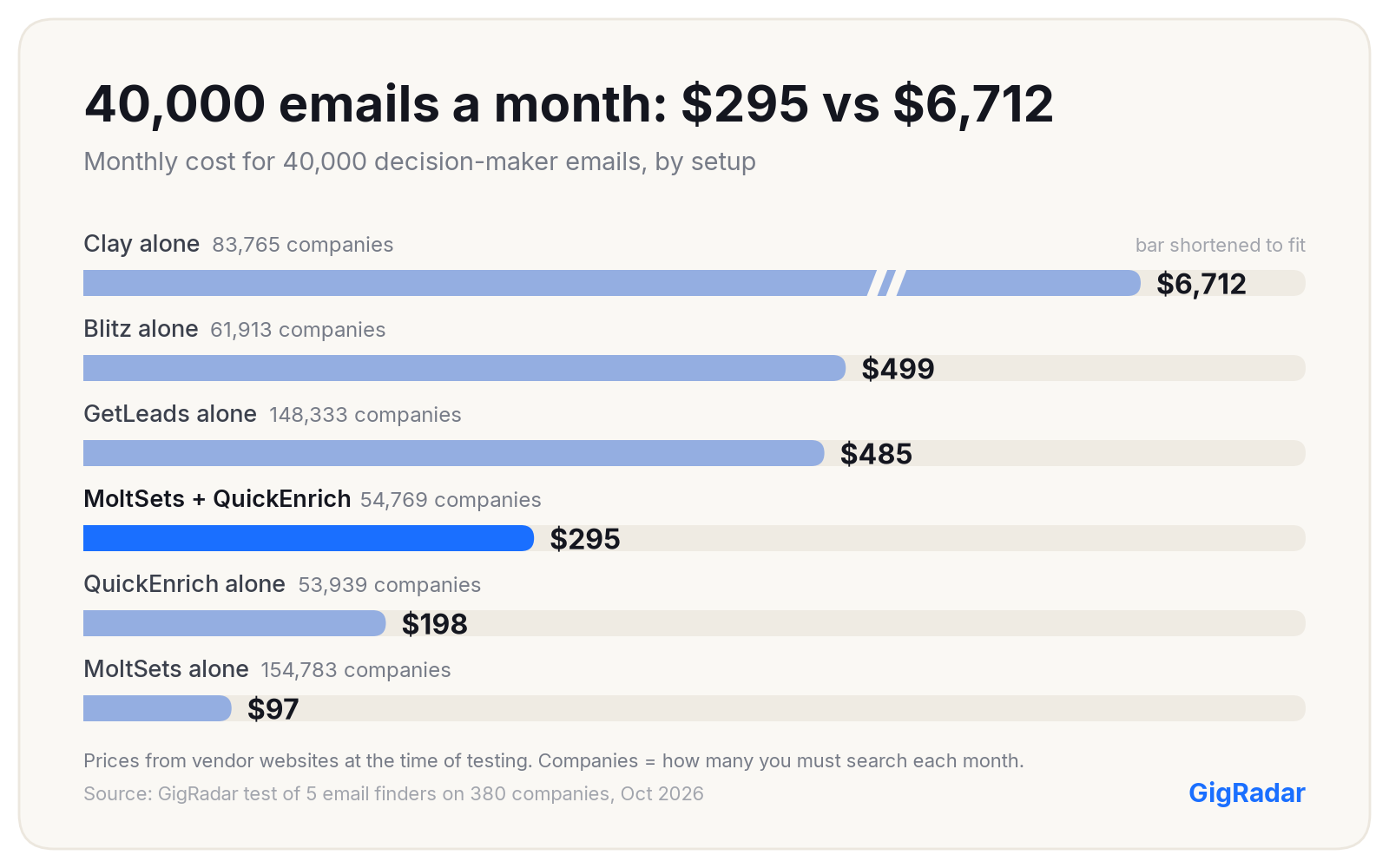
- 40,000 decision-maker emails a month would cost about $6,700 on our Clay setup and about $295 with MoltSets first and two $99 QuickEnrich accounts on its misses (prices at the time of testing).
- An independent verifier marked about half of every tool's emails valid. Clay's list had the most invalid addresses (13.6%).
- What we're buying: MoltSets at $97 a month, QuickEnrich Growth ($99 per 25,000-credit account) on what MoltSets misses, and a verifier before anything gets sent.
Our Clay setup cost us about 17 cents for every decision-maker lead it found. In October we ran four Clay alternatives against it on the same 380 companies, and one of them matched Clay's hit rate for about half a cent per email.
Then we ran every email through an independent verifier, and only about half of each tool's emails came back valid, Clay's included. Clay's list also had the most invalid addresses of the five.
We were shopping for one narrow thing: a working email for an owner, CEO, VP or director at a company we had already picked. If you want a Clay replacement for whole research workflows, our guide to data enrichment tools covers that wider list.
I'm Vadym, and I run GigRadar. We help agencies win clients on Upwork, and we run our own outbound too, so we buy contact data the same way you do.
Which Clay alternatives found the most decision-maker emails?
- Clay: an orchestration platform that runs lookups across many data providers, plus AI and CRM steps (pricing).
- QuickEnrich: a contact finder with an API where searching a domain is free and each revealed email costs a credit (pricing).
- Blitz: an API-only B2B data service that goes from a company's LinkedIn page to its people to their emails (pricing).
- MoltSets: an API-only contact data service with flat monthly plans and no dashboard (pricing).
- GetLeads: a B2B contact database you query over an API or from an AI agent (pricing).
Each tool got the same input: a company name and domain. It could return up to 3 people per company, and a person only counted if they held a decision-maker title at the right company and came with an email.
| Tool | Found a decision-maker | ...with an email | Decision-maker emails per 100 companies | Wrong company (of 380) | Price at the time of testing |
|---|---|---|---|---|---|
| Clay (our setup) | 44% | 44% | 48 | 0% | Pay per use, about $0.17 per lead |
| QuickEnrich | 42% | 42% | 74 | 0.3% | $29 to $399 a month |
| Blitz | 60% | 40% | 65 | 2.1% | $499 a month for email |
| MoltSets | 33% | 20% | 26 | 0% | $97 a month |
| GetLeads | 16% | 16% | 27 | 0% | $97 per 10,000 credits, or $497 a month |
Out of the same 178 randomly chosen companies, except the wrong-company column. QuickEnrich and GetLeads only return people who have an email, so their first two columns match by design.
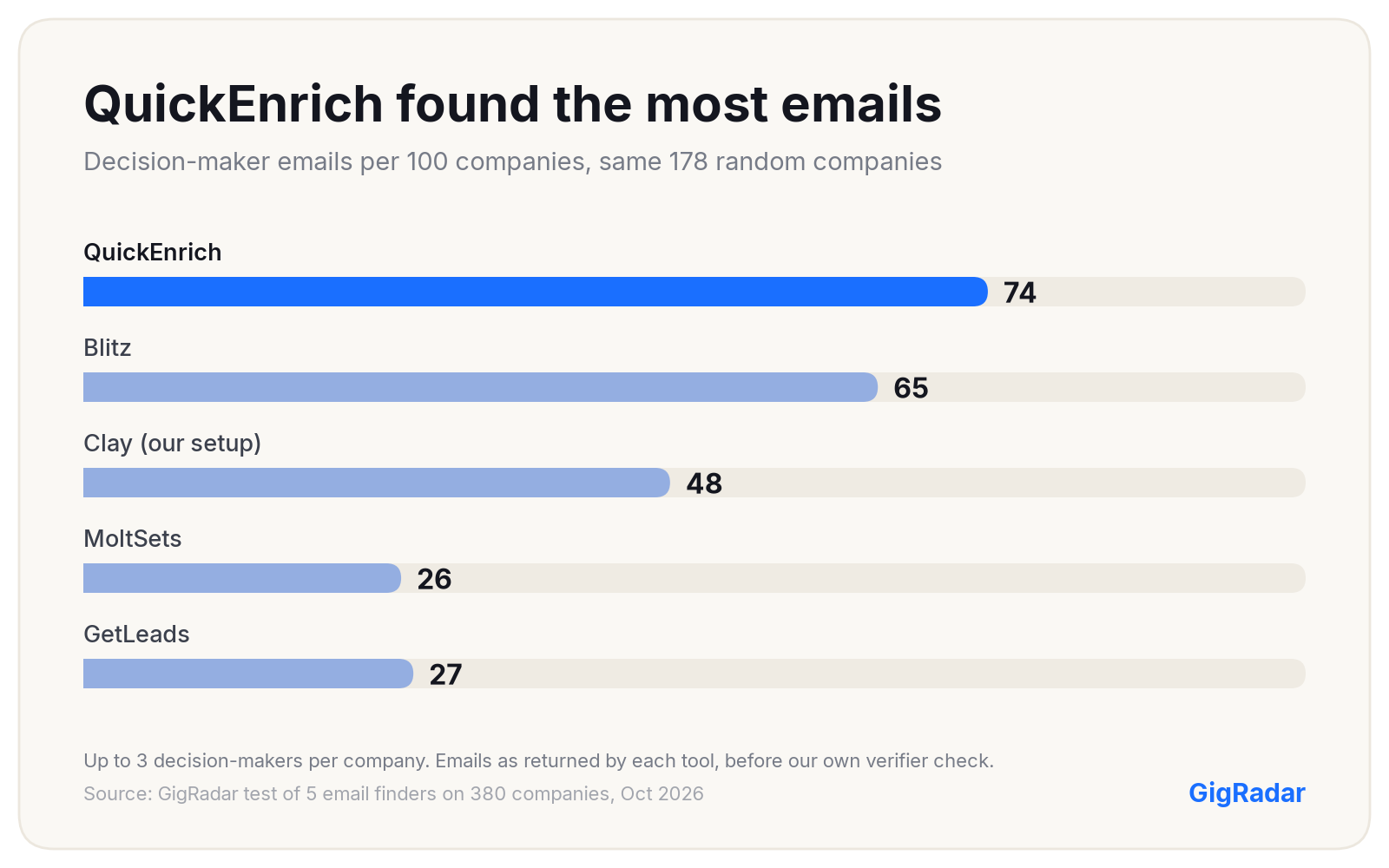
Clay and QuickEnrich tie on hit rate. On the 178 companies, Clay found 43 that QuickEnrich missed and QuickEnrich found 39 that Clay missed, a gap too small to mean anything at this sample size.
Clay gave us one contact at 75 of the 79 companies it found, while QuickEnrich came back with three decision-makers at 23 of its 75, so it lands 74 emails per 100 companies to Clay's 48.
Blitz found the most decision-makers (60% of companies) but returned an email for only about 6 in 10 of the individual decision-makers it found. It also attached people from the wrong company on 8 of 380 domains: two were clearly wrong (a Google Sites page and a hosting subdomain), and most of the rest looked like rebrands or second domains.
Blitz also needs a company's LinkedIn URL before it can search for people, so starting from a domain costs one extra lookup per company (Blitz API docs).
GetLeads found the fewest decision-makers in our test (16% of companies) and about as many emails per 100 companies as MoltSets, and it found nothing on the hard companies that QuickEnrich or Blitz hadn't already found.
Clay pricing vs a $295 stack: what 40,000 emails a month costs
Clay's paid plans start at $185 a month for 2,500 data credits (Launch) and $495 a month for 6,000 (Growth), with data credits from $0.05 each on Clay's pricing page. Our own Clay usage worked out to about $0.168 per lead, and that per-lead number is what decides the bill at volume.
So we modeled a month that produces 40,000 decision-maker emails, at most 3 per company, using the rates from the test. The first limit we hit was list size: every setup except Clay stays under $500 a month, but they need 54,000 to 155,000 companies to search.
| Setup | Companies to search per month | Monthly cost | Cost per email |
|---|---|---|---|
| Clay alone (our setup) | 83,765 | $6,712 | $0.17 |
| Blitz alone | 61,913 | $499 | $0.012 |
| GetLeads alone | 148,333 | $485 (5 credit packs) | $0.012 |
| MoltSets first, QuickEnrich on its misses | 54,769 | $295 | $0.007 |
| QuickEnrich alone | 53,939 | $198 (2 accounts at $99) | $0.005 |
| MoltSets alone | 154,783 | $97 | $0.002 |
Prices from vendor websites at the time of testing, not confirmed with the vendors.
MoltSets alone is the cheapest line, but it needs about 155,000 companies a month, nearly three times what the stack needs. QuickEnrich alone costs less than the stack, yet it misses 3.9% of companies that MoltSets gets, and we already pay the $97 for MoltSets.
Blitz's pricing page now lists a $99 Start plan with every endpoint and a fair-use limit of 200,000 records a month, plus a $499 Scale plan. Our 40,000-email model used about 180,000 Blitz records, so on paper it fits the $99 plan.
We haven't tested that plan, and Blitz's wrong-company rate stays the same.
Calculator
What would your email volume cost?
Uses the hit rates from our test and prices at the time of testing. Rough planning numbers, not quotes.
| Setup | Companies to search | Monthly cost | Per email |
|---|
Where Clay and MoltSets both came up empty, two tools still found 1 in 4
We pulled every company where neither Clay nor MoltSets had produced a decision-maker email: 282 of them, 203 of which are marketing or advertising agencies. Any email a second tool finds here is one our current stack didn't have.
QuickEnrich and Blitz overlap only in part: together they covered 99 of the 282. GetLeads added nothing either of them missed.
On the random 178, QuickEnrich found a decision-maker email at 25.8% of companies where MoltSets didn't, and MoltSets found one at 3.9% where QuickEnrich didn't. MoltSets is a flat $97, so running it first keeps that 3.9% and shrinks what QuickEnrich has to search.
| Second tool | Finds where MoltSets doesn't | MoltSets finds, it doesn't |
|---|---|---|
| QuickEnrich | 25.8% | 3.9% |
| Blitz | 25.8% | 5.6% |
| GetLeads | 9.6% | 13.5% |
Percent of the random 178 companies, decision-maker with an email.
Half the emails came back "valid" when we checked them ourselves
After the find step we ran every returned email through QuickEmailVerification, an independent checker. About half came back valid for every tool, and most of the rest were accept-all: the company's mail server accepts any address, so no checker can confirm the mailbox exists.
| Tool | Emails checked | Valid | Accept-all | Invalid |
|---|---|---|---|---|
| Clay | 132 | 52.3% | 33.3% | 13.6% |
| QuickEnrich | 223 | 52.0% | 45.3% | 1.3% |
| Blitz | 203 | 56.2% | 38.4% | 4.4% |
| MoltSets | 106 | 50.0% | 45.3% | 0.9% |
| GetLeads | 93 | 59.1% | 34.4% | 3.2% |
Every distinct email each tool returned on the 380 companies. The small remainder came back unknown.
Counting only valid emails, the top three kept their order: QuickEnrich 37 valid decision-maker emails per 100 companies, Blitz 34, Clay 24, GetLeads 16 and MoltSets 13. Per company with a verified decision-maker email, our Clay cost rose to about $0.32 and QuickEnrich's to between 1.5 and 1.8 cents.
"Verified" in a vendor's export means the vendor checked it. Put your own verifier between the finder and your sequencer, and decide before the first send what happens to accept-all addresses.
We covered how this plays out in Apollo exports in our Clay vs Apollo comparison.
Clay's list had the highest invalid share, 13.6%, even though those emails had already passed Clay's own validator. At that rate, 40,000 emails a month would include about 5,400 invalid addresses, and our email warmup tool guide covers protecting the domain they'd bounce off.
The waterfall we're buying
It's a flat price with high limits, and it found a decision-maker email at about 1 in 5 companies (20%). The cheapest source goes first; our data enrichment tools guide explains why.
Search is free and you pay 1 credit per revealed email; our test used 231 credits for 222 decision-maker emails.
Valid addresses go to your main sequence. Accept-all addresses go to a smaller, separate one or get dropped.
Keep it only if your team uses it for research workflows that go beyond finding an email.
40,000 emails a month needs roughly 26,000 to 41,000 QuickEnrich credits, which is more than one $99 account. Two $99 accounts cover it, and that's the $295 setup. Its $399 unlimited API plan also works and puts the stack at $496 a month.
Adding Blitz as a third step lifted coverage of the random 178 from 46% to 54%, for another $499 a month at the prices we tested.
For an agency running a few thousand emails a month, the same stack fits one $99 QuickEnrich account with room to spare. The QuickEnrich pricing page lists the Starter plan at $29 for 6,000 credits, and MoltSets' pricing page lists the $97 Pro plan we use.
When Clay is still worth $185 a month
Clay is an orchestration tool: it routes lookups through 150+ data partners, charges nothing when a lookup finds nothing, and lets you chain AI research and CRM steps after the email. If your team builds those workflows every week, the email column is a small part of what you pay for.
Keep Clay if
- You run multi-step research per account (AI columns, scoring, CRM pushes)
- Someone on your team owns and maintains the tables
- Volume is low enough that $0.17 a lead doesn't matter
Switch to a cheaper email finder if
- You mainly need "decision-maker email for this domain"
- Nobody has time to maintain Clay workflows
- You need tens of thousands of emails a month
The two tools also found different companies (only 36 of the 178 in both), so dropping Clay costs some coverage. For the plain lookup we still take that trade, at $295 a month instead of about $6,700.
The Clay vs Apollo breakdown goes deeper on Clay's plan structure if you're deciding which tier to keep.
How we tested, and what we don't know yet
The 380 companies came from our own outbound lists, mostly marketing, design and software agencies. For the head-to-head we drew a random 178 with a fixed seed; the other 202 are companies where Clay and MoltSets had both failed, added on purpose to test the second step.
- All five tools ran on free trials or our existing plans, with the same input (company name and domain) and the same cap of 3 people per company.
- A decision-maker meant founder, owner, CEO, president, managing director, partner, C-level, VP, head or director. A person at the wrong company was a failure.
- The find rates above use the email each vendor returned. The verifier results are a separate pass, and we have almost no send data on these addresses yet.
- 178 companies is a small sample: QuickEnrich's 42% has a likely range of 35% to 50%.
- Our earlier list had 62 companies where Clay and MoltSets both found a lead, and only 17 of them made it into this test, so the easy end of the list is thin.
- Prices come from vendor websites, not quotes. Blitz has changed its plans since, and we haven't confirmed QuickEnrich's price with the company.
- The 40,000-email model assumes our test rates hold at volume. We haven't tested rate limits or fair-use rules at that scale.
Take it with you
The full benchmark table as a CSV
Hit rates, emails per 100 companies, verifier results and prices at the time of testing, for all five tools.
If you run outbound beyond Upwork, see our cost per lead by channel numbers for where a cheaper email changes the math, and the outbound channels guide for lead-gen agencies for what to do with the list.
Outbound beyond Upwork? Keep Upwork running too.
GigRadar helps agencies win clients on Upwork: it bids from a Business Manager seat you invite to your agency team, so your own freelancer account is never touched.
Book a demo