

From “Bouncing Months” to Full Capacity: How Bassel Increased Upwork Replies ~50% and Paid Back GigRadar in Month One
Bassel, a solo Facebook Ads specialist, used GigRadar to stay consistently visible on Upwork while busy with delivery—sending proposals within ~15 minutes, lifting replies from ~9 to 13–15 (≈ +50%), landing 3 jobs in month one and 2 in month two, and hitting capacity so fast he paused the tool simply because he couldn’t take more work.

Client Overview
Bassel has been on Upwork for ~5–6 years. He started in motion graphics, then pivoted into Facebook Ads management (lead-gen focused). He’s effectively a solo operator who occasionally brings in freelance support (designer/editor) only when needed.
“I apply for 100 jobs in a month… next month I am busy… so I have no time to apply… I was bouncing between months.”
Starting Point
Before GigRadar, Bassel’s pipeline depended on one fragile habit: manual applications.
- He’d apply aggressively when free (e.g., ~100 jobs/month), land projects, then disappear from the marketplace while fulfilling delivery.
- Result: unstable workflow — some months overloaded, some months underloaded.
- He tried delegating job applications to a hired helper, but it didn’t solve the real problem: coverage and consistency (not being online and scanning opportunities continuously).
The Challenge
Bassel didn’t need “more leads.” He needed continuity.
Upwork rewards two things that are hard for solo operators:
- Consistency (show up every day)
- Speed (be early in the applicant stack)
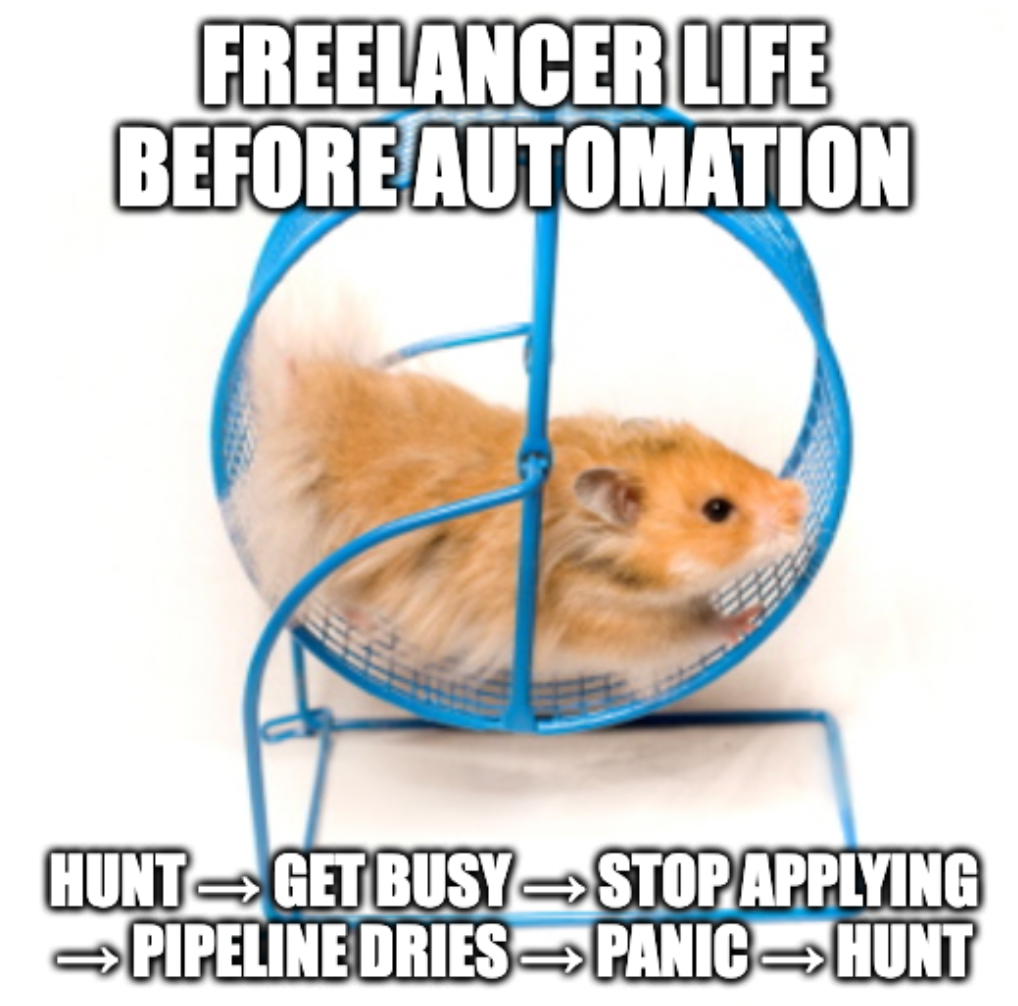
Without a system, he was forced into the classic freelancer cycle:
- hunt → get busy → stop hunting → pipeline dries out → hunt again
Why GigRadar
Bassel found GigRadar through a YouTube video about Upwork automation and decided to trial it after a product walkthrough with sales. The decision logic was simple: If automation keeps him visible while he’s delivering work, it solves the entire “bouncing months” problem.
“I said, okay, that’s good. I have to try it.”
Implementation
Bassel ran a focused 3-month test (January–March).
1) Automate the “always-on” layer
Instead of relying on “when I have time, I’ll apply,” he made applying a background process — so he wouldn’t miss strong opportunities during delivery-heavy weeks.
2) Compete on speed (15 minutes)
Bassel’s new operating advantage was being early.
“I am now sending the proposal in about 15 minutes once the job is posted… I am one of them mostly.”
3) Keep it simple (solo-friendly execution)
No team rebuild, no complicated workflows. Just one outcome: stable pipeline without daily manual grind.
Results
More replies, better momentum
Bassel saw a clear lift in responses:
- Before: ~9 replies on average
- After GigRadar: ~13–15 replies
That’s roughly +50% improvement in this core metric — and it matches the speed advantage of being among the first applicants.
More projects — fast
Within the trial period:
- Month 1: ~3 jobs
- Month 2: ~2 jobs
…and he reached full capacity on top of existing clients.
A new signal: inbound invites
The biggest qualitative shift: clients started messaging him first.
“Some people are sending messages for me to apply. This has never happened to me before.”
ROI
Bassel’s ROI story is unusually clean because it’s tied to projects won early in the trial. He states he recovered the investment in the first month, and his longer-term model is to start small with new clients, then expand scope once trust is built.
“Yes, correct… the new clients got me back a big part of the money.”
And the ultimate “ROI proof” for a solo operator: he paused GigRadar not because it didn’t work, but because he hit capacity.
Takeaway
Bassel didn’t “increase hustle.” He installed a system that removed the most expensive bottleneck for a solo freelancer: inconsistent presence. When you can be among the first applicants consistently, replies rise, projects close faster, and the pipeline stops depending on your free time.



