
Upwork vs Freelancer.com for Agencies (2:19 video walkthrough). The bid-volume gap, the Agency Plus advantage, and the real fee math. Watch on YouTube.
TL;DR
- Freelancer.com averages 41 bids per project. Upwork averages 10–15. The bid-volume gap is the single biggest reason agencies lose money on Freelancer.com. You're competing against 30+ accounts willing to bid $5 just to win the job.
- Upwork has a real Agency Plus account ($19.99/mo) with shared Connects, agency profiles, and Business Manager invitations. Freelancer.com has Enterprise hiring tools for buyers but no equivalent multi-freelancer agency product.
- Roughly 32% of Upwork jobs are $1,000+; on Freelancer.com that share is much smaller and skews to one-off design contests and $50 logo gigs.
- Freelancer.com wins on one thing: lower client-side fees (3% vs Upwork's 5%+). If you're an individual freelancer chasing one-off micro-projects, that math works. For agencies billing retainers, it doesn't.
- The honest answer for service agencies in 2026: build on Upwork, treat Freelancer.com as marketing experiment territory. Same hour of bidding produces dramatically different revenue on each platform.
Freelancer.com has 86 million registered users vs Upwork's 18 million. Almost five times the headcount. That is the only data point Freelancer.com leads on that matters for an agency, and even that one cuts the wrong way once you do the math.
An "agency" on Upwork means a multi-freelancer team account with a shared profile, a Business Manager role, and pooled Connects. An "agency" on Freelancer.com means you, the individual, with a Premier membership and a stack of $119.95 monthly invoices.
The two platforms look like direct substitutes. They aren't. This piece is the version of the comparison I wish I'd had when GigRadar started measuring proposal-level economics across both. Written for agencies running 2–20 freelancers, not for a solo freelancer in a tutorial.
Interactive · 60 seconds
Upwork or Freelancer.com. Which Should YOUR Agency Bid On?
Answer five questions. Get a platform recommendation with reasoning. No email required.
The 41 vs 12 problem
Freelancer.com's own published platform data says the average project receives 41 bids, and 67% of projects get their first bid within 60 seconds of posting. Upwork's average sits at 10–15 proposals per job. Itself not low, but a different planet.
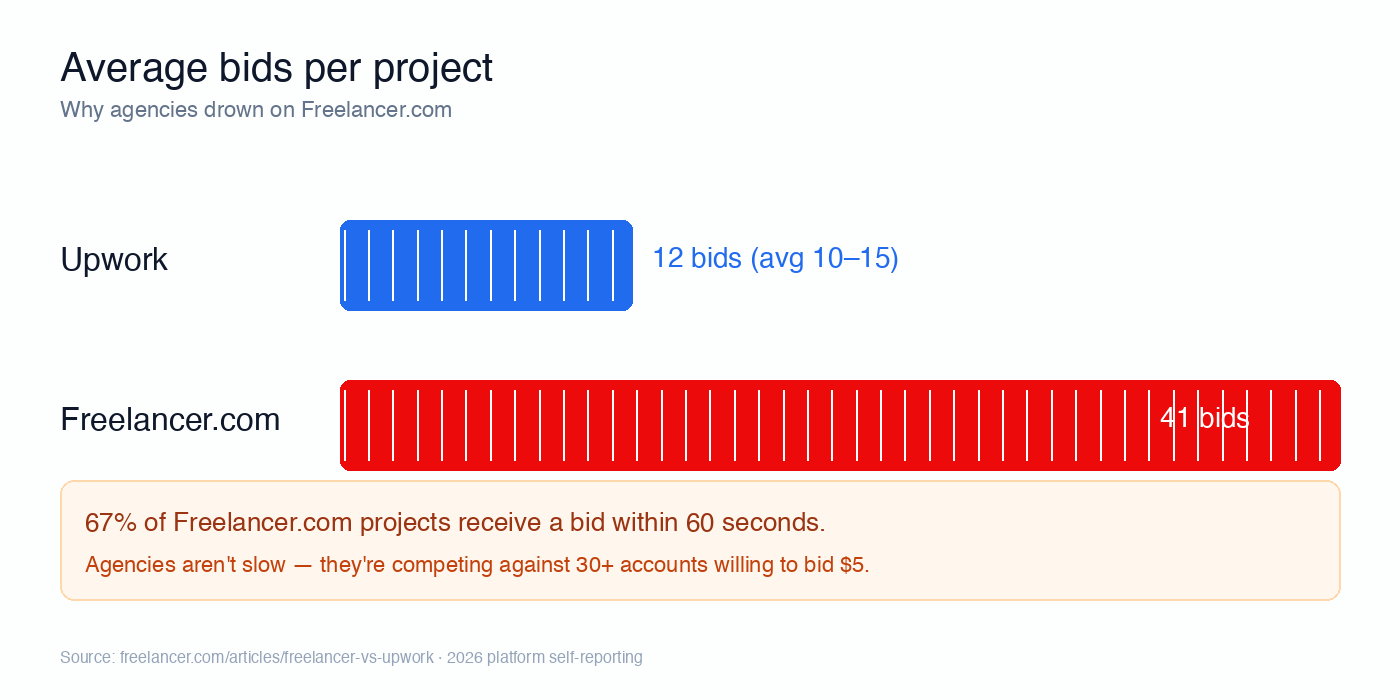
That ratio is not academic. Freelancer.com keeps the bid limit deliberately high. Premier members get 1,500 bids per month at one bid every 30 minutes. So the bidding queue fills with bids submitted by accounts whose business model is "spray every project, win 2%, work for whatever clears."
Your agency's $2,500 web build proposal lands in that queue next to bid #38 from an account offering the same scope for $300. The client cannot easily tell the difference at a glance. Even with a Highlighted Bid ($1 upgrade) or a paid membership tier, you're trying to win attention against 40 competing prices.
On Upwork, agencies report typical reply rates in the 8–18% range when proposals are well-targeted. Freelancer.com data isn't published, but the math of 41 bids per project implies floor-level reply rates for anyone not buying $1 Highlighted Bid upgrades on top of a Premier membership.
What "agency support" actually means on each platform
This is the part of the comparison that almost every other blog post glosses over. The two platforms have completely different concepts of what an agency is.
Upwork: a real agency product
Upwork has a dedicated Agency Plus membership ($19.99/month) that gives your agency:
- A shared agency profile clients can browse separately from individual freelancer profiles
- Pooled Connects across the team
- The ability to bid on new projects, accept invitations from non-Enterprise clients, and boost individual profiles
- An exclusivity model where you can mark freelancers as exclusive (agency-only) or non-exclusive
- The Business Manager role. A person inside your agency who handles bidding for the whole team without needing the freelancers' login credentials
Internal links: see our breakdowns of Upwork agency vs freelancer accounts and Upwork team management for hybrid teams for the operational details.
Freelancer.com: enterprise hiring, not agency selling
Freelancer.com has Freelancer Enterprise. But that's the buyer side. It's a managed service for companies wanting to hire freelancers at scale, not a multi-freelancer team account for agencies selling services.
On the seller side, Freelancer.com treats every account as an individual professional. There's a Corporate Member tier, but it's a single account with extra bids and branded badges. Not a multi-seat team product. You can be in the Preferred Freelancer Program, you can buy a Premier membership at $119.95/month, you can pile on Highlight and Featured upgrades. But there is no equivalent of Upwork's Agency Plus where five freelancers share one branded entity that clients hire.
For a service agency, this is the difference between operating as a company and pretending to be five separate independent contractors.
The actual fee math (it's not just the headline service fee)
Freelancer.com charges freelancers a flat 10% service fee. Upwork's is variable: 0% to 15%, set per contract and fixed for the life of that contract.
Headline rates are where every shallow blog post stops. The interesting cost lives in the proposal-submission layer.
Upwork: pay per proposal at $0.60
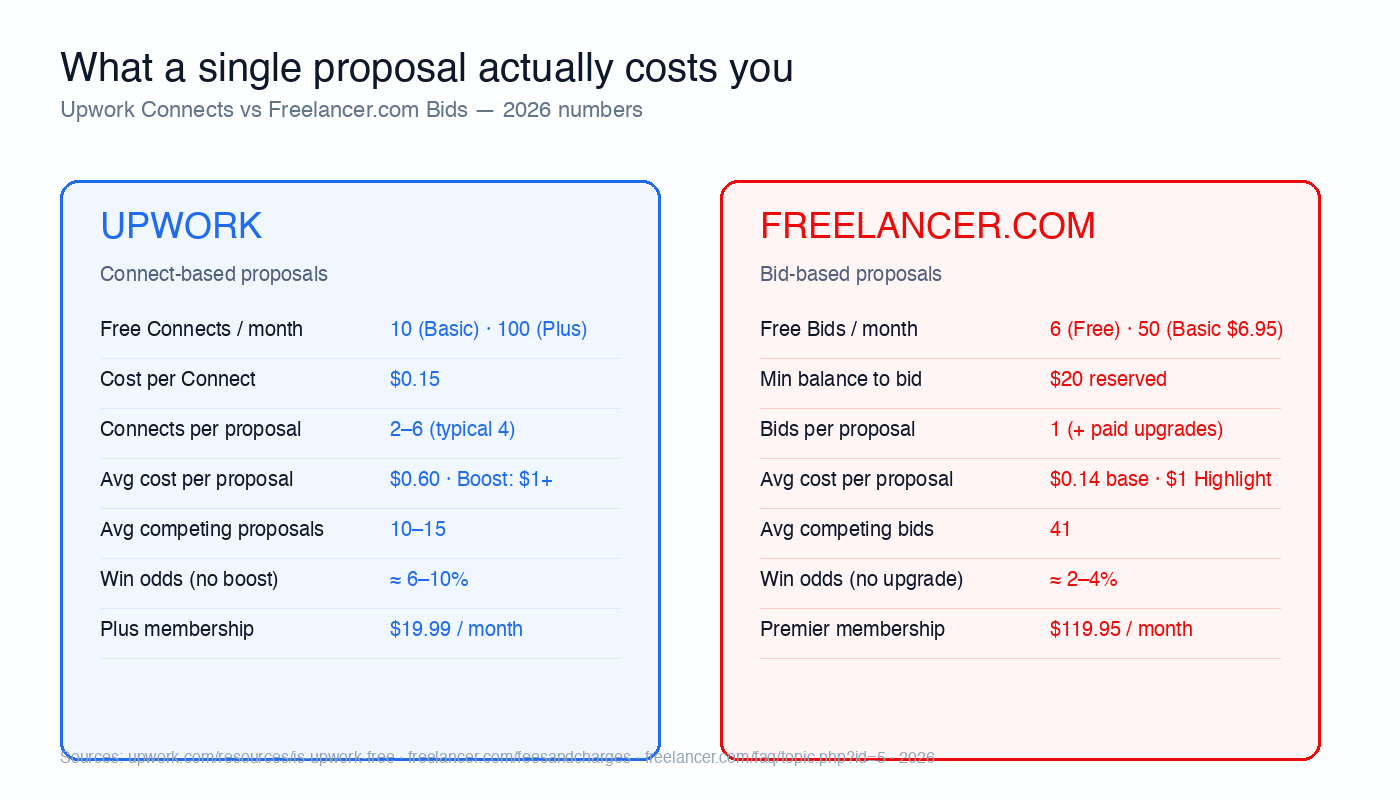
Upwork charges $0.15 per Connect. A normal proposal costs 2–6 Connects depending on the job's listed budget. A typical mid-sized project costs 4 Connects to apply, so the effective per-proposal cost is around $0.60. Free monthly allocation: 10 Connects on Basic, 100 on Plus.
Upwork's Boosted Proposals (the "promoted to the top of the client's list" feature) raise that to $1–$3+ in real terms, depending on the auction price. But the floor is $0.60.
Freelancer.com: cheaper per bid, more bids required to compete
Freelancer.com gives free members 6 bids per month, Basic members 50 bids ($6.95/month), all the way up to Premier with 1,500 bids ($119.95/month). At the Basic tier the effective per-bid cost is around $0.14. Cheaper than a Connect. But to consistently show up on competitive projects you need Highlighted Bid upgrades at $1 each, plus the Premier tier to qualify for Recruiter projects through the Preferred Freelancer Program.
The other cost: Freelancer.com requires a $20 minimum account balance reserved at all times just to be eligible to bid. Upwork doesn't.
Bottom line: $0.60 per Upwork proposal at the floor vs $1+ per competitive Freelancer.com bid at the realistic level. Plus monthly memberships up to $119.95 on Freelancer.com vs $19.99 on Upwork Agency Plus.
Where the real dollars are. Project size distribution
Upwork's mix skews higher. A 2026 industry analysis found roughly 32% of Upwork jobs are in the $1,000+ range (a figure consistent with what we see in GigRadar customer pipelines).
Freelancer.com's project mix skews to creative contests ($150–$500 typical prize pool, where only the winner is paid), one-off small projects, and price-anchored fixed bids. That's not a value judgement. It's the platform's design. The contest model is unique to Freelancer.com and works well for a logo or a tagline. It does not work for a $6,000 quarterly retainer.
What actually matters for agencies. The full comparison table
| Dimension | Upwork | Freelancer.com |
|---|---|---|
| Registered users | 18M+ freelancers | 86M+ registered |
| Active clients | ~850k active buyers | Larger total, less concentrated |
| Avg competing bids/project | 10–15 | 41 |
| % projects $1k+ | ~32% | Smaller share, contest-heavy |
| Agency account product | Agency Plus ($19.99/mo) | None. Individual accounts only |
| Freelancer fee | 0% to 15%, variable per contract | 10% or $5 min, whichever greater |
| Client fee | 5% + $4.95 per contract | 3% or $3 min |
| Per-proposal cost (typical) | $0.60 (4 Connects) | $0.14 + $1 Highlight to be visible |
| Monthly membership ceiling | $19.99 (Agency Plus) | $119.95 (Premier) |
| Minimum balance to bid | $0 | $20 reserved |
| Time-tracker / Work Diary | Yes (screenshots) | Lighter (banner + tracker) |
| Built-in AI assistant | Uma (GPT-4-powered) | AI-assisted bidding |
| Contest model | No | Yes (for crowdsourced creative) |
| Project Catalog | Yes | No |
| Payment protection | Escrow + Work Diary | Milestone Payment System |
Where Freelancer.com actually wins for agencies
The honest version, because contrarian-by-default is also lazy: there are real cases where Freelancer.com beats Upwork.
Need 30 logo concepts from 30 designers and pay only the winner? Freelancer.com's contest model exists for exactly this. Upwork has nothing equivalent.
Freelancer.com's 247-country footprint includes meaningful pockets where Upwork has thin client supply (parts of South Asia, Africa, the Middle East). If your agency targets non-US/EU buyers, Freelancer.com's geographic spread matters.
Freelancer.com lists 2,700+ skill categories vs Upwork's 125+. For long-tail trades (manufacturing intros, telecom configuration, niche translation), Freelancer.com has buyers Upwork doesn't.
If you (as an agency) need to hire a freelancer for a one-off task, Freelancer.com's 3% client fee is genuinely cheaper than Upwork's 5%+$4.95-per-contract. For a $300 job, that's $9 vs $19.95 in fees.
None of these say "build the bulk of your agency revenue on Freelancer.com." They say "Freelancer.com is a useful supplementary channel for specific jobs."
Free for Upwork agencies
The "41 bids per job" problem doesn't exist if you bid on the right Upwork jobs
GigRadar filters Upwork's firehose down to the 5–15% of jobs where your agency actually has a real chance. Payment-verified clients, budget signal matching your category, no race-to-the-bottom anchors. Our Business Manager submits proposals from inside Upwork's official invitation flow, supervised by our team.
Get Your Free Agency Audit →If you're choosing for an agency in 2026. The actual decision
The argument compresses to four points:
If your agency sells multi-month engagements, retainers, or $2k+ project work. Build on Upwork. If you sell one-off creative deliverables, contest-style work, or you need a buyer-side hiring tool for cheap subcontracting. Freelancer.com has parts of that better. Most agencies need the first thing.
The mistake I see most often: agencies see Freelancer.com's 86M users and assume "bigger pool = more opportunity." Bigger pool means more competing bids, more downward price pressure, and worse signal-to-noise. For a service agency, signal-to-noise is the only metric that matters.
For the bigger conversation about Upwork's place in your GTM stack, see our breakdowns of cold outreach reply rates by channel, why Upwork beats cold outreach for client acquisition, and using Upwork as your baseline channel.
The play if you have both accounts
This is where the retainer and $2k+ project work lives. Put 80% of your bidding effort here. Train your Business Manager (or a tool like GigRadar) to filter for payment-verified, $1k+ budget, real-history clients.
Don't pay $119.95 for Premier on day one. The Basic 50-bid tier is enough to test whether your category has clean signal on Freelancer.com. If 10 bids produce zero replies, the answer is no.
The platform's 3% client-side fee is genuinely competitive when you need to subcontract a quick task. Browse, post a project, hire. Pay $9 not $19.95.
The contest format works for a logo or a tagline. It does not work for any project where the client should be selecting a freelancer rather than a deliverable. Don't enter contests with your full proposal energy.
Hours bidding ÷ closed contract revenue. If Freelancer.com produces less than Upwork's CAC after 90 days, cut your time there to zero and reinvest in Upwork or in the related channels we cover in B2B outreach best practices.
One operational thing nobody tells you about Upwork agency mode
The default workflow when you upgrade to Agency Plus is that each freelancer on your team keeps their own login and bids individually under the agency banner. That works at 2–3 freelancers. It collapses at 10+.
The fix is the Business Manager (BM) role. A BM is a separate Upwork identity that gets invited into your agency through Upwork's official invitation flow. The same mechanism you'd use to onboard a hired bidder. The BM submits proposals on the team's behalf under their own login, supervised by you. Upwork-compliant, no shared credentials, no browser extensions, no scraping. More on how the Business Manager model works.
This is also why GigRadar exists. We operate a real Upwork Business Manager account. Your agency invites our BM through the standard invitation system. Proposals submit from our BM under our team's supervision. Your freelancer account is never touched. If Upwork ever reviews a submission, the review lands on our BM profile, not yours.
Freelancer.com has no equivalent infrastructure. Because Freelancer.com doesn't have an agency identity layer to build on top of. This is, again, what people miss when they compare these platforms by raw user count.