
Watch the full walkthrough of SEO agency retainer structures on Upwork
TL;DR
→ 64% of SEO agencies charge under $1,000/month for retainers. That's below the profitability floor. Real SEO retainer math starts at $3,500/month.
→ SEO is the highest-retention niche on Upwork because results compound monthly. One-off audits are commodities. Retainers are where margin lives.
→ The weekly fixed retainer on Upwork beats hourly and milestone-based billing on margin, client comfort, and churn prevention.
→ Scope creep is a contract design problem, not a client behavior problem. Write exclusions first, inclusions second.
→ Use the SEO Retainer Profitability Calculator below to model your margin at each tier before pitching.
According to SE Ranking's 2025 survey of 260 agencies, 64% of SEO agencies charge less than $1,000 per month for retainers. Another 30% charge under $500.
Those numbers should make you uncomfortable. At $500 to $1,000 per month, an SEO retainer is not a service. It's a reporting subscription with extra steps.
If you've been following how automation changes the proposal math, you already know: the real leverage in Upwork agencies isn't sending more bids. It's locking in recurring revenue so you stop selling every month.
The agencies building $5K to $20K per month SEO retainer books on Upwork are doing something structurally different. Not better proposals. Not more connects. Different contract architecture, different scope documents, and a completely different conversation about what "SEO retainer" means to the client.
This article breaks down the exact math, contract structures, and scope frameworks that separate an agency with two $800/month clients from one running six retainers at $7,500 each. If you're running an SEO agency on Upwork and your seo agency upwork retainers revenue isn't compounding month over month, the problem is structural.
Why 64% of SEO agencies price themselves into a margin trap
The data from multiple industry surveys paints a consistent picture. Most SEO agencies are charging too little to do the work properly, and it shows in their retention numbers.
Ahrefs survey, 350 professionals
SE Ranking, 260 agencies
SE Ranking, 260 agencies
Retainer Pricing Statistics 2026
Here's why this matters for Upwork agencies specifically. Upwork takes its fee on every transaction. If you're running a $1,000/month retainer and Upwork's service fee structure takes 10%, you're left with $900 before payroll, tools, and your own time.
At $900 net, a retainer that requires 15 hours of real work puts your effective rate at $60/hour. theStacc's 2026 analysis puts the minimum viable retainer floor at $1,500/month. Below that, the hours needed for meaningful SEO work push your effective rate below break-even.
What SEO retainers actually cost at each tier (2026 benchmarks)
The pricing data across DigitalApplied, Arc4, and theStacc converges on consistent tiers. The numbers below reflect what agencies are actually charging clients, not what they should charge.
| Tier | Monthly Range | Hours/Month | What's Included | Margin Target |
|---|---|---|---|---|
| Local / Starter | $1,500 - $3,000 | 15 - 25 | GBP optimization, local citations, basic on-page, monthly report | 45 - 50% |
| Growth / Mid-Market | $3,000 - $7,500 | 25 - 40 | Keyword strategy, 4-8 content pieces, technical SEO, link outreach, bi-weekly calls | 50 - 55% |
| Advanced / National | $7,500 - $15,000 | 40 - 60 | Full content engine, 15-25 links/month, competitor monitoring, CRO experiments | 55 - 60% |
| Enterprise | $15,000 - $50,000+ | 60 - 120+ | Dedicated team (3-5 specialists), multi-market strategy, weekly executive reporting, digital PR | 50 - 55% |
Notice the margin column. Growth-tier retainers ($3,000 to $7,500) tend to have the best margin because you're past the onboarding overhead but not yet staffing a dedicated pod. This is why the retainer math in our contract guide centers on the middle tier: six clients at $7,500 per month at 55% gross margin generates roughly $297,000 in annual gross profit.
Enterprise retainers can actually have lower margins than mid-market because dedicated teams require salaried staff, not contractors. Don't chase enterprise pricing until your operations can support the headcount.
For context on how Upwork's fee structure interacts with retainer pricing at each tier, see our breakdown. The math changes materially at the $10K+ billing threshold.
The SEO retainer profitability calculator
Before you pitch a retainer tier, model the margin. This calculator shows whether your retainer price covers your real costs with room to grow.
SEO Retainer Profitability Calculator
Adjust the inputs above. Results update live. Tool costs and overhead not included in cost rate.
The scope document that kills scope creep (write exclusions first)
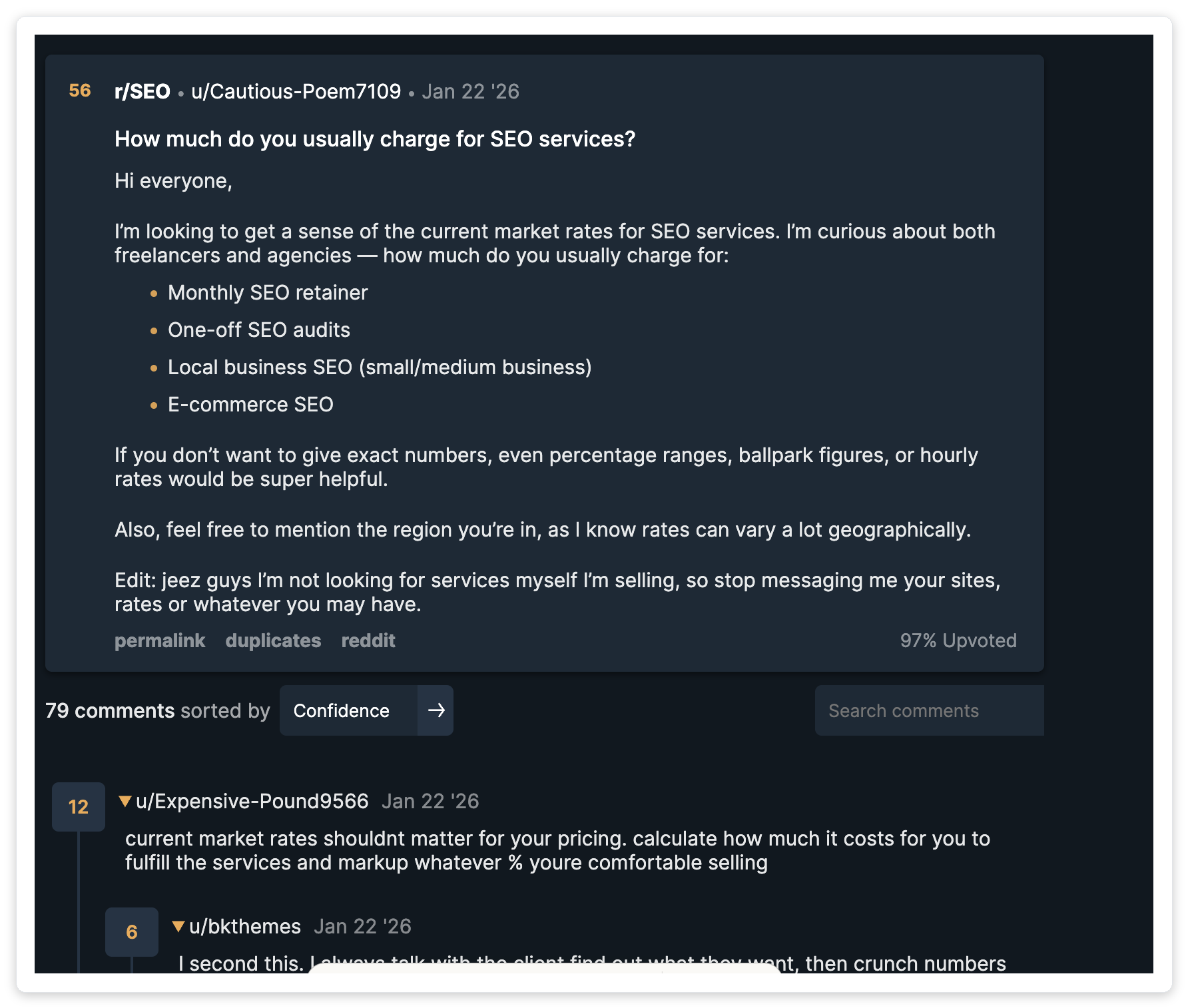
Retainer pricing research from 2026 shows scope creep as the top profitability challenge for 59 out of 115 agencies surveyed. But scope creep is not a client behavior problem. It's a contract design failure.
Most agency owners write their scope document by listing what's included. That's backwards. The exclusions list is where margin protection lives. A retainer without explicit exclusions is an invitation for the client to treat it as a general marketing budget.
Here's the scope document framework that works for Upwork retainer conversions. Copy and modify it for your SEO niche:
Proving ROI in month 1 when rankings take 6 months
This is the paradox every SEO agency on Upwork faces. Rankings compound over 6 to 12 months, but clients evaluate their retainer spend monthly. If your first report is "we fixed 14 meta descriptions and submitted a disavow file," you'll lose the contract by month 3.
The fix is framing. JVG Labs' reporting framework puts it well: stop reporting inputs (what you did) and start reporting outcomes (what changed). The monthly report needs to answer one question: "What's different in my business because of this retainer?"
Full technical audit, fix critical crawl errors, set up rank tracking. Quick wins: fix title tags on top 20 pages, add schema markup, improve Core Web Vitals. Report: "Here's what was broken. Here's what we fixed. Here are the pages that will move first."
Publish first batch of optimized content. Start link outreach. Report: "4 new pages indexed. 12 keywords moved from page 3 to page 2. Here's the pipeline of pages about to break into page 1."
First real organic traffic gains visible. Connect traffic to leads or revenue. Report: "Organic traffic up 18%. 3 new inbound leads traced to blog content we published. Projected monthly lead value: $X."
Rankings, traffic, and leads are all trending. The retainer justifies itself in numbers. Report: "YTD organic leads: X. Average lead value: $Y. SEO ROI: Z%. Here's the expansion roadmap."
The key insight from The Admin Bar's retainer guide: tie every report to commercial KPIs, not vanity metrics. "Non-brand organic clicks increased 23%" beats "we built 15 backlinks" every time. Clients renew retainers that produce leads, not retainers that produce activity reports.
The Upwork contract type most SEO agencies pick wrong
Upwork has four billing mechanics that function as retainers. Most SEO agencies default to hourly with a weekly cap because it feels safe. It's structurally the worst option for retainer work.
As we cover in our Upwork retainer contracts breakdown, hourly retainers fail by week 6 because the client gets a Sunday invoice that looks expensive. The sticker shock is structural, not motivational.
| Contract Type | How It Bills | Margin Profile | Best For | Risk |
|---|---|---|---|---|
| Weekly Fixed Retainer ✓ | Fixed weekly amount, billed in advance, no tracker | Highest | SEO retainers, content production, advisory | Scope creep if not tightly defined |
| Hourly with Weekly Cap | Tracked hours, billed weekly via Work Diary | Medium-High | Variable scope, ad management | Sunday invoice sticker shock |
| Monthly Fixed-Price Milestones | Recurring milestone, manually issued monthly | High | Predictable monthly outputs | Manual renewal = churn friction point |
| Project Catalog (Recurring) | Pre-packaged tiers, client selects | Medium | Productized services, quick starts | Less flexibility, harder to customize |
The weekly fixed retainer wins for SEO specifically because it bills in advance and has no time tracker. Your client pays for outcomes, not hours. That framing difference changes the entire retainer conversation from "how many hours did you work?" to "what results did you deliver?"
One more thing about Upwork economics. Upwork's Conversion Fee is 13.5% of your hourly rate multiplied by 2,080 hours. For most retainers under 24 months, staying on-platform is cheaper than paying the buyout. Run that math before moving any retainer off Upwork. The agency pricing playbook covers the full fee structure.
Free for Upwork agencies
Stop bidding manually while your retainer clients wait
GigRadar's Business Manager submits proposals on your behalf through Upwork's official invitation system. Your account stays untouched. Focus on retainer delivery while the pipeline fills itself.
Get Your Free Agency Audit →Three tiers that anchor the right conversation
The three-tier structure isn't just pricing psychology. It's architecture for how the client self-selects and how you protect margin at each level.
Maintain
- Technical health monitoring + fixes
- 4 optimized content pieces/month
- On-page optimization (10 pages)
- Basic link outreach (5-8 links)
- Monthly report + 30-min call
- Response SLA: 1 business day
Best for: Solo founders, single-location businesses starting SEO.
Operate
- Everything in Maintain
- 8-12 content pieces/month
- Advanced link building (15-20 links)
- Competitor monitoring + response
- Bi-weekly strategy calls
- Quarterly content strategy refresh
- CRO recommendations on top pages
Best for: Regional brands, ecommerce, competitive verticals.
Scale
- Everything in Operate
- Dedicated team (3+ specialists)
- 20+ content pieces/month
- Enterprise link acquisition + digital PR
- Weekly executive reporting
- Multi-market / multi-language strategy
- Custom dashboards + API integrations
Best for: National brands, Fortune 1000, multi-location.
The middle tier wins most often. Our retainer contract analysis found the $5K to $10K range has the best combination of margin and renewability. The bottom tier exists so "no" lands on a smaller yes, not a lost relationship. The top tier exists so the middle tier looks reasonable.
Build your tiers around the weekly fixed retainer. Weekly billing of $875 (Maintain), $1,875 (Operate), and $3,750 (Scale) per week is more digestible than $3,500/$7,500/$15,000 per month in the client's mind. Same money, different framing.
The 12-month retainer roadmap that compounds results
SEO results compound. That's the structural advantage of retainer-based SEO over every other Upwork service category. A retainer client in month 12 is receiving compounded value from every piece of content, every link, and every technical fix from months 1 through 11.
Here's what Optimatio's retainer renewal research recommends: give each quarter a theme tied to business goals. "This quarter we're doing X so next quarter we can do Y" makes long-term SEO feel structured rather than endless.
Deep audit, crawl fixes, Core Web Vitals, schema markup. First content batch targeting low-competition long-tails. Goal: prove technical competence and show first ranking movements. This is the 90-day churn danger zone. Report aggressively.
Scale content production to full velocity. Launch link outreach campaigns. Target commercial keywords alongside informational. Goal: organic traffic growth visible in analytics, first leads attributable to SEO content.
Refresh and expand top-performing content. Attack competitor keywords where you've closed the gap. Start content hub/pillar strategies. Goal: page 1 rankings for 3-5 primary commercial terms.
Convert ranking wins into conversion optimization. Technical debt cleanup before year 2. Build the case for renewal with full-year ROI narrative. Goal: clear dollar-value ROI that justifies the next 12 months.
This roadmap is the single most effective retention tool in SEO retainer management. A visible plan turns monthly reports from "here's what we did" into "here's where we are on the plan we agreed on together." That reframe, according to Optimatio, keeps more clients than any dashboard ever will.
The math that makes SEO retainers the highest-value Upwork niche
Let's close with the revenue equation every SEO agency owner on Upwork should pin to the wall. This math comes directly from our retainer revenue analysis.
Six retainer clients at $7,500 per month produces the same revenue as closing 40+ one-off projects annually. The difference: one requires constant proposal volume and sales effort, the other requires delivering results to clients who are already paying.
SEO is uniquely suited to this model because the work never "finishes." Technical maintenance is ongoing. Content needs to be refreshed. Link profiles decay and algorithm updates require adaptation. Unlike a website redesign or a logo project, SEO retainers have a natural renewal argument built into the service itself.
The agencies building $5K to $20K per month SEO retainer books on Upwork aren't doing anything magical. They're structuring scope documents with clear exclusions, using the weekly fixed retainer billing mechanic, reporting on commercial outcomes instead of activity, and running a 12-month roadmap that makes renewal the obvious decision. The contract architecture does the selling. You just have to build it once.
If your current Upwork SEO retainers are stuck in the sub-$2,000 range, go back to the profitability calculator above and model what happens when you raise the floor to $3,500. Then rewrite your scope document. Then book a free agency audit so the proposal pipeline keeps filling while you focus on delivering retainer results.