
SaaS Marketing Agency: How to Position, Price, and Win SaaS Clients in 2026
🎬 SaaS Marketing Agency: How to Position & Price in 2026. Covers the retainer bands by ARR stage, the four-service stack SaaS buyers pay for, and the cover-letter words that win (and kill) replies on Upwork. Watch on YouTube
TL;DR
- "B2B marketing agency" is now a losing position. The SaaS firms with budget hire agencies that name a SaaS sub-segment (vertical vs horizontal, PLG vs sales-led, a single ARR band) and speak in pipeline and net-new ARR, not impressions.
- SaaS retainers in 2026 run roughly $3K–$8K/mo under $1M ARR, $8K–$20K/mo at $1M–$5M, $15K–$30K/mo at $5M–$20M, and $30K–$75K+/mo at enterprise. Use the estimator below to place your offer.
- The four services SaaS buyers actually pay for: content/SEO, paid acquisition, lifecycle/email, and RevOps/attribution. Most agencies oversell paid and undersell RevOps.
- GigRadar pipeline data (25,058 Sales & Marketing proposals): the words "ROI", "revenue", "Klaviyo", and "retention" each drop reply rate 2–4 points on Upwork. "SaaS", "pipeline", "scale", and "grow" lift it. The pitch everyone teaches is the one getting ignored.
- SaaS buyers post fractional-CMO and retainer briefs on Upwork weekly. Sales & Marketing is the second-largest category in our pipeline. That is a live inbound channel most agencies ignore.
A SaaS company at $10M ARR runs marketing on roughly 8% of revenue. That is about $800K a year, and only a slice of it ever reaches an outside agency once headcount and tools are paid (SaaS Capital, 2025).
The agencies that win that slice are not "full-service digital marketing" shops. They are firms that picked a SaaS sub-segment, built a repeatable playbook for it, and can talk about CAC payback and net revenue retention without flinching.
This is the positioning, pricing, and pitch playbook for becoming that firm, written for the SaaS-marketing angle specifically.
If you do Shopify or dev work for software companies, the Shopify development agency playbook covers that side instead.
Why "B2B marketing agency" is a losing position in 2026
SaaS growth has decelerated. Median customer acquisition cost now sits near $2 of spend for every $1 of new ARR, up 14% since 2023, and boards scrutinize CAC payback and LTV:CAC on every budget line (Benchmarkit 2025).
That kills the generalist pitch. A VP of Marketing under payback pressure does not want "a marketing partner." They want someone who has already solved their exact motion and can prove it in a 20-minute call.
The median MQL-to-SQL conversion rate is about 13%, so an agency that floods a SaaS sales team with low-intent leads depresses conversion and burns trust fast. "We generate leads" is now a liability claim, not a selling point.
The buyers feel this too. SaaS founders are openly saying their old outbound stopped working, which is why they turn to inbound channels and marketplaces to find help:
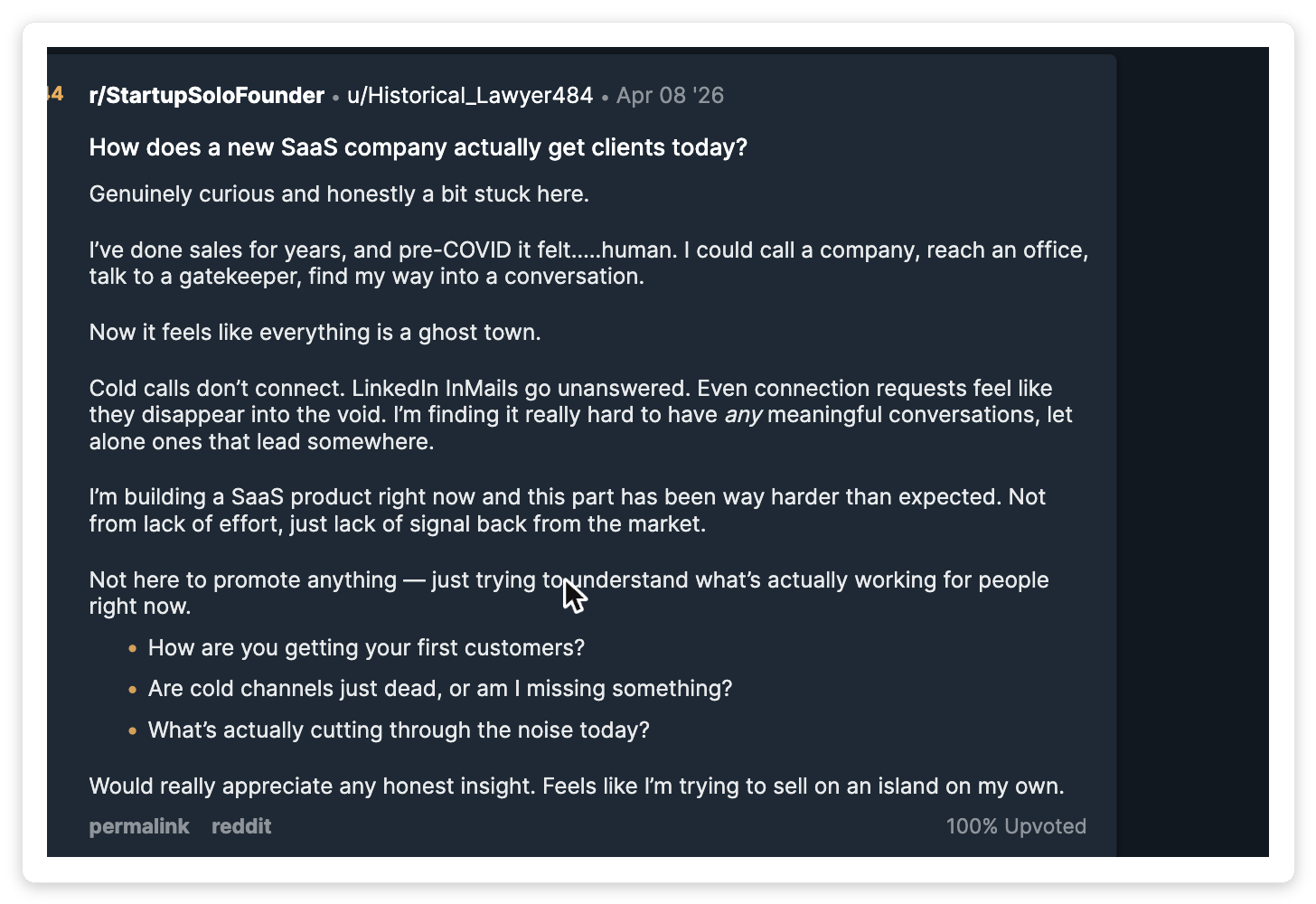
That broken-outbound moment is your opening. The SaaS firm that just gave up on cold calls is the one posting a marketing brief next week.
SaaS buyers push agencies to specialize along three axes. Pick a position on each before you write a single proposal.
Vertical vs horizontal SaaS
Vertical SaaS (dental, construction, legal practice software) concentrates buyers in industry associations, trade media, and review sites. An agency here wins on niche channel knowledge and standardized packages.
Horizontal SaaS (CRM, project management, comms tools) competes across many sectors. Agencies here win on category positioning and competitive-comparison content against incumbents.
PLG vs sales-led
Product-led companies invest a median 13% of revenue in marketing, versus 9% for sales-led and 10% for hybrid (SaaS Barometer / Benchmarkit).
PLG work is activation rate, time-to-value, and self-serve funnel optimization. Sales-led work is ABM, pipeline creation, and sales enablement.
SMB vs enterprise
SMB SaaS needs efficient, repeatable acquisition at low CAC. Enterprise SaaS needs multi-region programs and embedded strategy.
The retainer math between them differs by 5–10x, so do not straddle both.
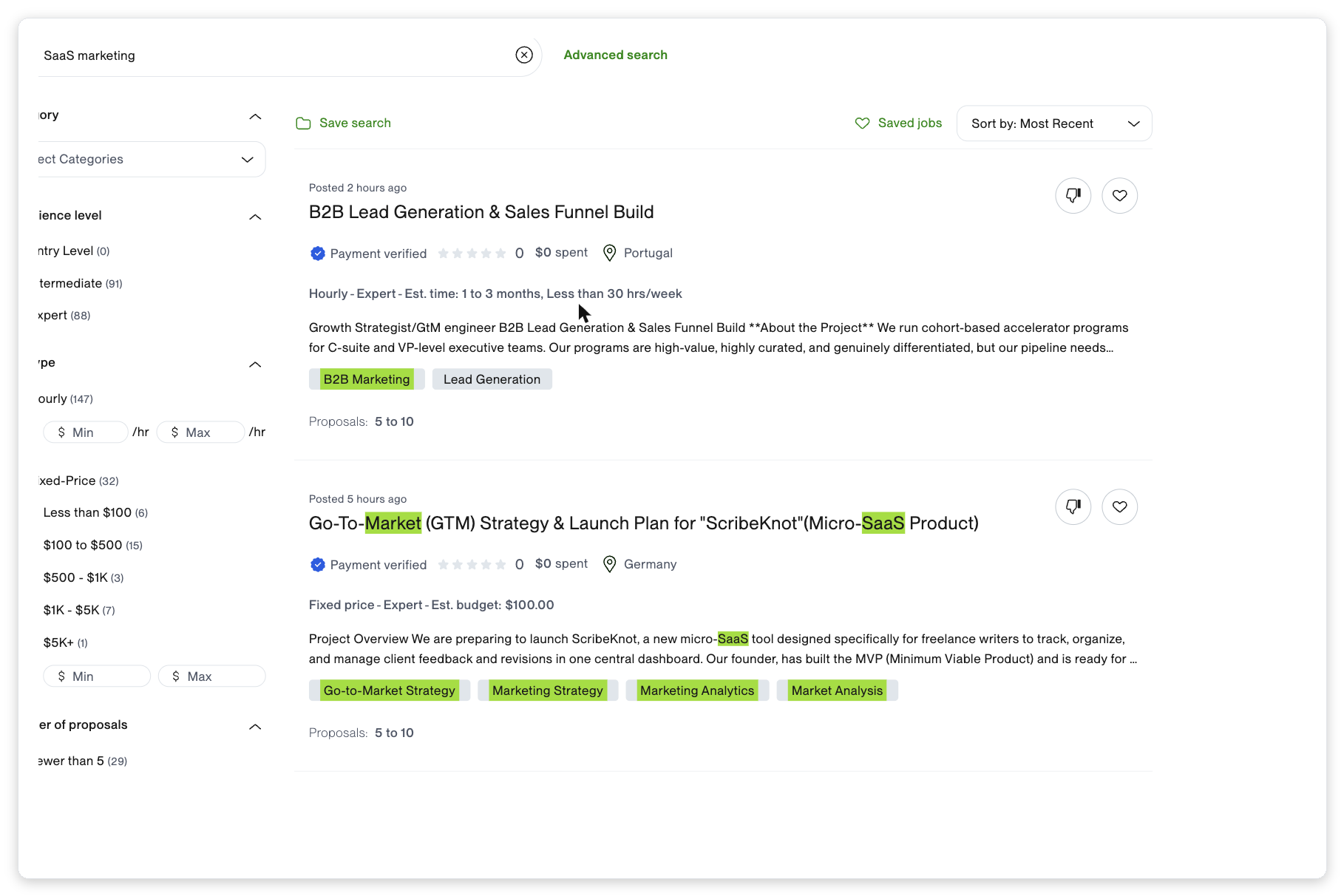
Here is what live SaaS demand looks like. This is a real Upwork search for SaaS marketing roles, the kind a VP posts when in-house is underwater:
Place your offer: the SaaS retainer estimator
Before the pricing breakdown, see where your offer should land. Pick a stage, motion, and the services you actually deliver, and the estimator places you against 2026 benchmark bands.
Interactive Tool
Where your monthly retainer should sit, by client ARR stage and scope.
Services in scope
What SaaS marketing agency retainers actually cost in 2026
Pricing tracks ARR stage, channel count, and scope depth. Flat retainers have largely beaten percentage-of-ad-spend, because SaaS buyers under CAC pressure distrust a model that pays the agency more when they spend more.
| Client ARR stage | Monthly retainer | Typical scope |
|---|---|---|
| Pre-revenue – $1M | $3K – $8K | One or two channels, basic tracking, foundational demand gen |
| $1M – $5M | $8K – $20K | Multi-channel, content engine, early attribution |
| $5M – $20M | $15K – $30K | Full-funnel, lifecycle programs, robust attribution |
| $50M+ (enterprise) | $30K – $75K+ | Multi-region, embedded strategy, RevOps integration, 12-month terms |
Ranges synthesized from SaaS Hero and GrowthLane 2026 pricing studies.
The model matters as much as the number. Here is how the four common structures actually behave with SaaS clients.
| Model | How it works | SaaS verdict |
|---|---|---|
| Flat retainer | Fixed monthly fee for a defined scope | ✅ Default |
| % of ad spend | 10–25% of media budget | ❌ Distrusted |
| Hybrid base + bonus | Base retainer plus $150–$400 per qualified meeting | ✅ Strong |
| Pure performance | Pay per closed-won or % of revenue | ⚠️ Rare |
Defending that number in the call is its own skill. The "Win price talks" lesson in our Agency Success course walks through holding a retainer when a buyer anchors low:
🎥 From GigRadar's Agency Success Course: Win price talks.
For the full rate-setting methodology, the Upwork agency pricing playbook goes deeper than this section can. And if you are converting one-off projects into monthly contracts, read how to win retainers from Upwork projects.
The four-service stack SaaS buyers actually pay for
SaaS firms do not buy "marketing." They buy four jobs, and they weight them by motion. Most agencies oversell paid media and quietly skip the one that locks in renewals: RevOps.
Organic keeps producing pipeline after the spend stops, unlike paid. This is the compounding engine SaaS founders underrate early and overpay for late, especially as budgets tighten to a median 8% of ARR (SimpleTiger).
LinkedIn and high-intent search for sales-led; performance and landing-page work for PLG sign-ups. The fastest lever, and the one buyers scrutinize hardest on CAC.
Net revenue retention sits near 100% at the median, so expansion and renewal carry much of SaaS growth (Benchmarkit 2025). Lifecycle is where you defend the renewal, not just win the acquisition.
The service that makes the other three defensible, and your renewal insurance. If you can map spend to pipeline to net-new ARR in the client's own dashboards, you stop being a cost line and become an investment.
Lead the proposal with RevOps, not paid. Every competitor opens with "we'll run your ads." Opening with "we'll show your board the pipeline-to-ARR math" is the differentiator that survives a budget review.
The pitch vocabulary that wins SaaS clients (and the words killing your reply rate)
Here is where first-party data beats every positioning blog. We looked at 25,058 Sales & Marketing proposals from GigRadar's pipeline (Dec 2025–Feb 2026) and measured which words in a cover letter moved reply rate.
The result is uncomfortable for anyone running the standard SaaS-agency script. The exact vocabulary every agency leads with is the vocabulary that gets ignored.
"Retention" is the single worst word in the category at a 3.88-point drag, and "Klaviyo" is close behind. Every email-marketing agency leads with both, so both now read as noise.
The winning vocabulary is fresher: "pipeline", "SaaS", "grow", "scale". Same kind of claim, different framing, and it is not yet burned out.
Steal this opener. It strips the burned-out vocabulary, leads with confidence over credentials, and offers a Loom (a +2.7-point lift in this category):
For more openers tested against real reply data, see the proposal teardowns by niche. The same discipline applies in every category, but the winning words differ.
Free for Upwork agencies
SaaS clients are posting on Upwork right now
GigRadar scans Upwork for SaaS-vertical fractional-CMO and retainer briefs, scores fit, and drafts the proposal. Every submission runs through our supervised Business Manager account, so your own Upwork profile is never touched.
Get Your Free Agency Audit →How VP Marketing buyers actually evaluate your agency
SaaS marketing leaders now buy agencies the way they hire senior staff. They screen for stage-fit and for fluency in the metrics their board asks about.
Sources: Benchmarkit 2025, Lighter Capital 2025.
The S&M efficiency multiple halved from 6x in 2024 to about 3x in 2025. Every dollar buys half the revenue it used to, which is exactly why buyers reject the "more leads" pitch and reward agencies that talk payback.
Three things move a SaaS buyer from interested to signed:
- Stage-fit proof. A case study from a SaaS company at their ARR band, not a logo wall of mismatched industries.
- Metric fluency. You volunteer CAC payback and net revenue retention before they ask. It signals you have sat in their seat.
- Reporting rhythm that maps to ARR. Not impressions. Pipeline created, influenced ARR, and a path to the board deck.
If your agency markets itself broadly, the digital marketing agency lead generation guide and the breakdown of how marketing agencies make money show where SaaS specialization changes the economics.
The 30-day positioning sprint to land your first SaaS retainer
You do not need a rebrand. You need a narrow position, two proof assets, and a channel that already has SaaS demand, run over four weeks.
Week 1: Pick one position
Choose one cell of the matrix: vertical-or-horizontal, PLG-or-sales-led, one ARR band. Write the one-line position: "We help [PLG SaaS at $1M–$5M] turn [free signups] into [paid pipeline]."
Use the niche filter list to confirm there is live Upwork demand for that exact cell.
Week 2: Build two proof assets
One stage-fit case study (real numbers, ARR band named) and one teardown Loom of a prospect's funnel. These are your reply-rate multipliers.
No SaaS logo yet? Tear down a public SaaS funnel and publish the finding.
Week 3: Rewrite the outbound script
Strip "ROI", "revenue", "retention", and "Klaviyo" from every template. Lead with confidence, the named position, and a Loom offer.
Use the copy-paste opener above as your base.
Week 4: Run the channel with SaaS demand
Point your bidding at SaaS-vertical Sales & Marketing briefs on Upwork. Send 8–12 well-matched, hand-tuned proposals a day, not 30 scatter-shot ones.
Track reply rate by word and opener so you can keep cutting the dead vocabulary.
The position is the product
A SaaS marketing agency does not win because it runs better ads than the next shop. It wins because it picked a narrow SaaS position, proved stage-fit, and pitched in the buyer's metrics instead of the agency's vocabulary.
The pricing bands are public and the service stack is known. The edge left is positioning sharp enough that a VP under CAC pressure recognizes themselves in your first sentence, plus a channel that already has those buyers posting briefs.
Pick one SaaS cell, prove stage-fit, and strip the burned-out vocabulary from your pitch. Then point that pitch at the SaaS briefs already live on Upwork.