
Payback Period Calculator: Free Calculator + Benchmarks (2026)
🎬 Payback Period Calculator walkthrough – why payback beats LTV:CAC for survival, the revenue-vs-gross-margin trap, the churn "asymptote of death," 2026 benchmarks, and why Upwork is the fastest-payback channel for agencies. Watch on YouTube
TL;DR
- CAC payback period = how many months of gross margin it takes to earn back what you spent to win a client. It is a cash-flow metric, not a profitability one: the speed of your money, not the size of it.
- The formula is CAC ÷ (Monthly revenue per client × Gross margin %). Using revenue instead of gross margin is the single most common way the number gets faked.
- Good in 2026: under 12 months for SMB and services, 12–18 for mid-market, 18–24 at enterprise. Median B2B SaaS sits near 15 months (Optifai, 939 companies).
- Ignore churn and the naive number is a fantasy. If CAC is bigger than a client's total lifetime margin, payback never happens: the "asymptote of death."
- Run payback per channel, not blended. The calculator below returns naive payback, churn-adjusted "real" payback, and a benchmark verdict from your own numbers.
A 3:1 LTV:CAC ratio that takes 14 months to repay can still put you out of business. A 2:1 that repays in the first month funds your next hire.
That gap is the whole reason payback period exists, and it is the number almost every agency owner computes wrong on the first try.
The mistake is not the division. It is trusting a payback figure that assumes every client sticks around long enough to actually pay you back.
Add real churn and a "5-month payback" can quietly become never.
This guide gives you the exact formula, the churn-adjusted version that reveals when payback is impossible, 2026 benchmark bands by business type, and a calculator that scores your numbers in one pass. It pairs with the deeper CAC calculator if you want the full LTV:CAC picture.
Interactive Tool
Payback Period Calculator
Enter your acquisition cost, what a client is worth per month, your margin, and your churn. Get the naive payback, the churn-adjusted "real" payback, and a benchmark verdict.
Payback period measures the speed of your money, not the size of it
LTV:CAC tells you whether a client is worth winning eventually. Payback period tells you whether you survive long enough to collect.
Those are different questions, and cash-tight businesses live and die on the second one.
The metric comes straight from capital budgeting: how many periods until cumulative cash inflows repay the initial outlay. Swap "factory" for "a new client" and the acquisition spend is the investment, the monthly gross margin is the return.
Total value a client returns over their whole life, divided by cost to win them. Great for a pitch deck, but it leans on lifetime assumptions that may be years out.
How fast the cash you spent comes back so you can spend it again. It relies on far fewer assumptions and decides how fast you can grow without running out of money.
"LTV is for bidding. Payback is for survival. If you calculate payback period without discounting for churn, you are calculating a fantasy."
– Paul Levchuk, on LinkedIn
Investors and operators increasingly say the quiet part out loud. As VC Jim Hao argues, payback "relies on far fewer assumptions to calculate, and is a more important metric for scaling efficiently." Airtree's metrics guide puts it bluntly: LTV is an output, so focus on the inputs you control, namely CAC and retention.
The formula, and the one input that inflates every wrong answer
Every credible source, from Baremetrics to Stripe to the SaaS Metrics Standard Board, converges on one canonical formula.
The trap is the words "gross margin." Divide CAC by revenue and you get a flattering number that is simply wrong.
CAC of $1,200 and $200/mo revenue looks like a 6-month payback, but at 50% gross margin the real payback is 12 months. Scilla Studio calls using revenue instead of margin "the single most common way the number gets inflated," and for agencies, delivery salaries, subcontractors, and tools all come out before that margin is real.
Two honest variants matter. Accounting payback uses recognized revenue and gross margin, which is what investors and OpenView mean by the term.
Cash payback reflects billing terms: annual prepayment can collapse cash payback to near zero even when the underlying economics have not changed at all. Track the accounting version for decisions and the cash version for your runway.
What counts as a good payback period in 2026
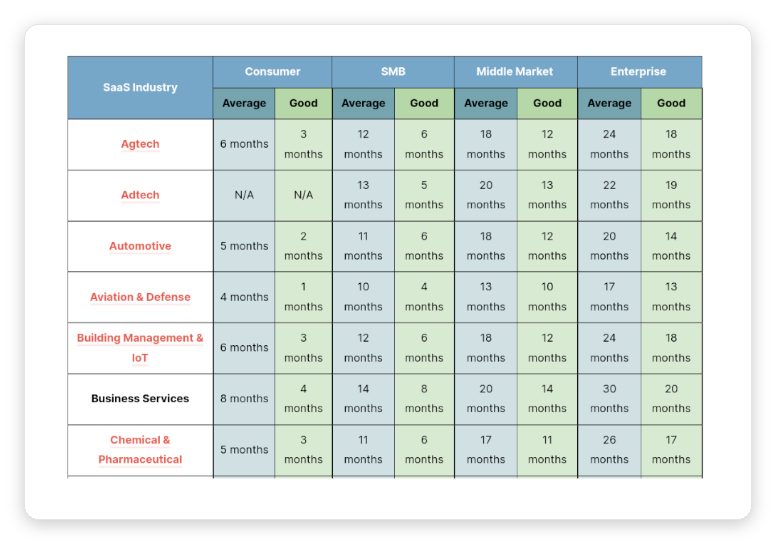
There is no universal "good," because acceptable payback scales with deal size, churn, and access to capital. The bands below synthesize the most-cited public benchmarks.
| Business type | Typical "good" payback | Source |
|---|---|---|
| Agencies & services | 6–12 months | GigRadar / PayProGlobal |
| SMB / self-serve SaaS | 6–12 months | Scilla / Optifai |
| Mid-market SaaS | 14–18 months | Optifai / Insight Partners |
| Enterprise SaaS | 18–24 months | Optifai / KeyBanc |
| Consumer / e-commerce | 1–6 months | Scilla / PayProGlobal |
Optifai's 2026 study of 939 B2B SaaS companies labels the bands cleanly: best-in-class under 12 months, good 12–18, concerning 18–24, and critical above 24. Bessemer treats payback as one of its five core cloud metrics for the same reason.
But every one of these bands assumes clients live long enough to reach payback, which is exactly where most calculations quietly break.
Churn is what turns a 5-month payback into "never"
The naive formula assumes a client pays you the same margin every month forever. Real clients leave.
Once you discount each future month by your churn rate, the payback clock slows down, and past a certain point it stops entirely.
There is a hard ceiling on what one client can repay: their monthly margin divided by your monthly churn. If your CAC is above that ceiling, no amount of patience gets your money back.
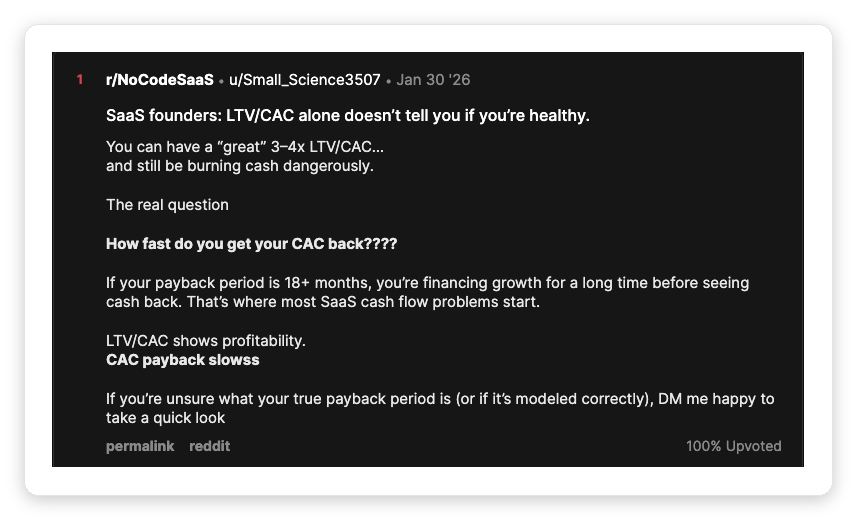
"Payback is survival math, not just a pleasant metric. A 10-month blended payback can mask a paid channel that actually takes 24 months once you include discounts, onboarding, and support."
– founder discussion, r/NoCodeSaaS
This is why the SaaS CFO and OpenView both insist on reading payback next to net revenue retention. If your average client lifespan is 18 months and payback lands at 16, you have two months of margin before churn eats the client.
For SMB-heavy agencies, where retention curves are shallow, that margin is the difference between compounding and bleeding.
Five ways the payback number gets faked
Every one of these produces a payback figure that looks healthier than reality. Run through them before you trust any number, including the one from the calculator above.
The most common error, and it halves the payback figure at 50% margins. Always divide by margin, never revenue.
Counting ad spend but not sales salaries, tools, or the founder's pitch time understates CAC by two to four times. Fully-loaded or it does not count.
A blended average lets a fast referral channel hide a paid channel that never pays back. Compute payback per channel and per service line.
The naive formula assumes clients never leave. Discount future months by churn, or your "5-month payback" may be mathematically impossible.
If your sales cycle is 90 days, this quarter's spend wins next quarter's clients. Lag CAC by the cycle length, or fast-growing spend will look like runaway payback.
Run payback by channel: why a marketplace beats paid ads on speed
The most useful thing an agency can do with this metric is compute it per acquisition channel. Fully-loaded CAC varies almost ninefold across channels, so the channel you pick sets your payback before margin or churn even enter the math.
| Channel | Fully-loaded CAC | Payback at $1,375 monthly margin |
|---|---|---|
| Email marketing | $510 | 0.4 mo |
| Thought-leadership SEO | $647 | 0.5 mo |
| Referrals & networking | $711 | 0.5 mo |
| Google Ads | $802 | 0.6 mo |
| LinkedIn Ads | $982 | 0.7 mo |
| Content marketing | $1,254 | 0.9 mo |
| Outbound SDRs | $1,980 | 1.4 mo |
| Account-based marketing | $4,664 | 3.4 mo |
Channel CAC figures: First Page Sage, 2026 (fully loaded, including salaries and tools).
Notice what is missing from that table: Upwork. A freelance marketplace behaves like a low-CAC channel with an unusual property.
The buyer arrives already looking to hire, so the intent is closer to inbound than to cold outbound, while the cost to win them sits near the bottom of the range.
That is the payback lens applied to channel choice: not "which client is worth the most," but "which channel gives me my money back soonest so I can win the next one." High-intent marketplace demand is one of the few channels where low CAC and fast payback come in the same package.
Getting proposals in front of that demand consistently is where a system for B2B lead generation on Upwork earns its keep, and it is worth tracking your cost per lead by channel alongside payback.
Free for Upwork agencies
Turn Upwork into your fastest-payback channel
GigRadar puts your agency in front of high-intent Upwork buyers at a fraction of paid-ads CAC, so acquisition spend comes back in weeks, not quarters. Get a free audit of your current cost-per-client.
Get Your Free Agency Audit →How to actually shorten your payback period
Once you have an honest number, there are only three levers, and you should pull them in this order.
Move budget from the $4,664 ABM channel toward the sub-$1,000 channels that pay back in under a month. This is the fastest lever because it changes the numerator directly.
Every margin point shortens payback. Tighten scope, productize delivery, and cut the tools that do not earn their seat before you reach for value-based pricing on the retainer.
Churn sets the lifetime margin ceiling, so if clients leave before payback, no CAC cut saves the channel. Pair this with client-retention work and onboarding that reaches value fast.
Payback period is not a metric you report once a quarter and forget. It is the number that tells you, this month, whether you can afford to win the next client.
Compute it honestly, per channel, with churn, and it becomes the most practical decision tool an agency owner has.