TL;DR
- A single Upwork proposal costs $2.40 in Connects at the 2026 baseline. Your real cost per hire is $60 to $240+ depending on reply rate and close rate.
- Agencies spending $200+/month on Connects with no CPH tracking are burning cash blind. Track CPH weekly or stop bidding.
- Cutting proposals from 30/week to 12 targeted bids (payment-verified, <5 proposals, budget floor) typically drops CPH by 40% or more.
- The interactive calculator below shows your exact CPH. If it's above 5% of your average contract value, your targeting is the problem.
A GigRadar agency running 120 proposals per month at 10 Connects each spends $180/month on Connects alone. That's the visible number. The invisible number: at a 6% reply rate, 94 of those proposals generate zero revenue. The Connects are gone. The time writing them is gone. The cost per hire on the remaining 6% is somewhere between $60 and $180, and most agencies have never calculated it.
This article is about that invisible number. Not how to buy Connects cheaper (you can't, $0.15 each is fixed). Not how to earn free ones (the activity reward gives 24/month max). How to make every Connect you spend return revenue.
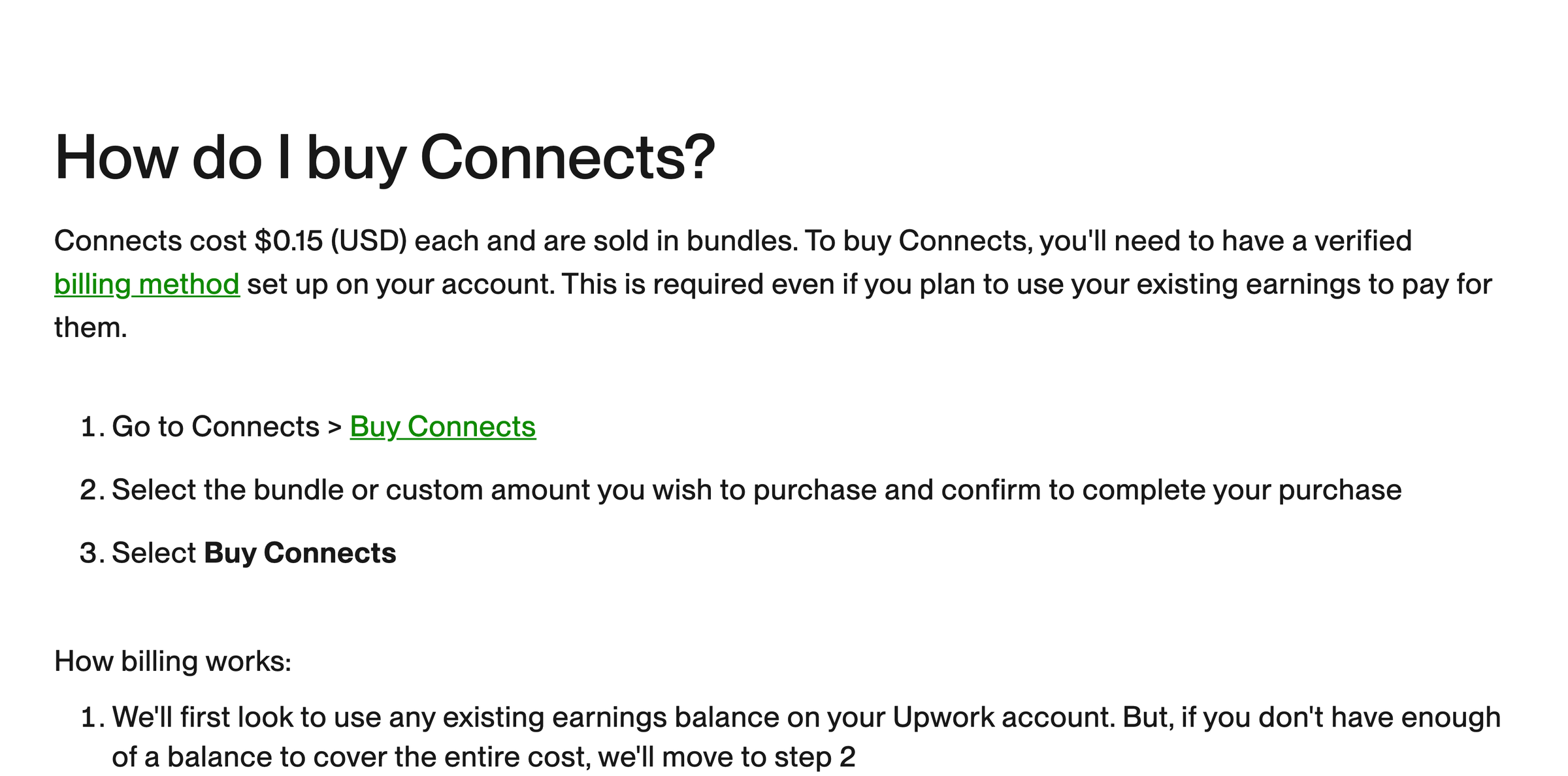
Upwork's own Help Center, checked August 2026: Connects cost $0.15 each and are sold in bundles. How many a single proposal costs is set per job, which is why your cost per hire moves even when the price never does. Source: Upwork Help Center.
The one metric agencies never track (and it costs them thousands)
Every Upwork agency tracks proposals sent. Some track reply rate. Almost none track Cost Per Hire: the total Connects spend required to land one signed contract.
The formula is direct:
Cost Per Hire Formula
CPH = (Connects × $0.15) ÷ (Reply Rate × Close Rate)
At 12 Connects per proposal, 10% reply rate, 30% close rate: CPH = $60
Change one variable. Drop reply rate to 5% (what happens when you bid outside your niche). CPH jumps to $120. Add a Boost on top (20 extra Connects at $3.00), and cost per hire exceeds $180 on $500 to $1,000 jobs. The math breaks before you notice it.
For agencies, this matters more than for solo freelancers. You're not sending 5 proposals a week. You're sending 20 to 40.
When you're running 160 proposals a month, a 2% difference in reply rate moves your monthly acquisition cost by hundreds of dollars. Getting Connects cheaper doesn't fix the math. Improving reply rate does.
Your agency's actual Connects cost per hire (free calculator)
Stop guessing. Plug in your real numbers and see what each contract actually costs you in Connects.
Interactive Tool
Connects Cost Per Hire Calculator
Adjust the sliders to match your agency's numbers.
Benchmark: if your CPH is above 5% of average contract value, your targeting is the problem. Our dedicated CPH calculator goes deeper with weekly tracking and connects budgeting, but the number above is your starting point.
What Upwork Connects actually cost in 2026 (it's not $0.15)
One Connect costs $0.15. That's the number Upwork shows you. It hasn't changed in 2025 or 2026. But the number of Connects per proposal has changed dramatically.
In 2022, most proposals cost 6 Connects ($0.90). In 2026, community data from r/Upwork threads puts the typical range at 14 to 25 Connects ($2.10 to $3.75), and a boosted bid on a contested job pushes a single application past 50 Connects ($7.50). High-demand categories hit 40+ Connects per proposal ($6.00+).
And then there's dynamic pricing. Upwork can increase the Connects requirement on a job while it's still posted, with no warning and no change to the listing. Upwork documents this itself: the number of Connects you need "varies per job and can change during the time the job is posted."
Agency Plus accounts have no free monthly Connects. You must purchase every one at $0.15 each. The 10 free/month only applies to Freelancer Basic. Agency Plus membership itself is required just to bid on new projects. Source: Upwork pricing page.
Where agencies actually lose money on Connects (it's not the price)
The Connects price is fixed. You can't negotiate it. What you can control is how many proposals it takes to land a contract. That ratio is where agencies hemorrhage cash.
Here's the community data on what agencies actually spend per month, pulled from Reddit threads where freelancers post their real Connects math:
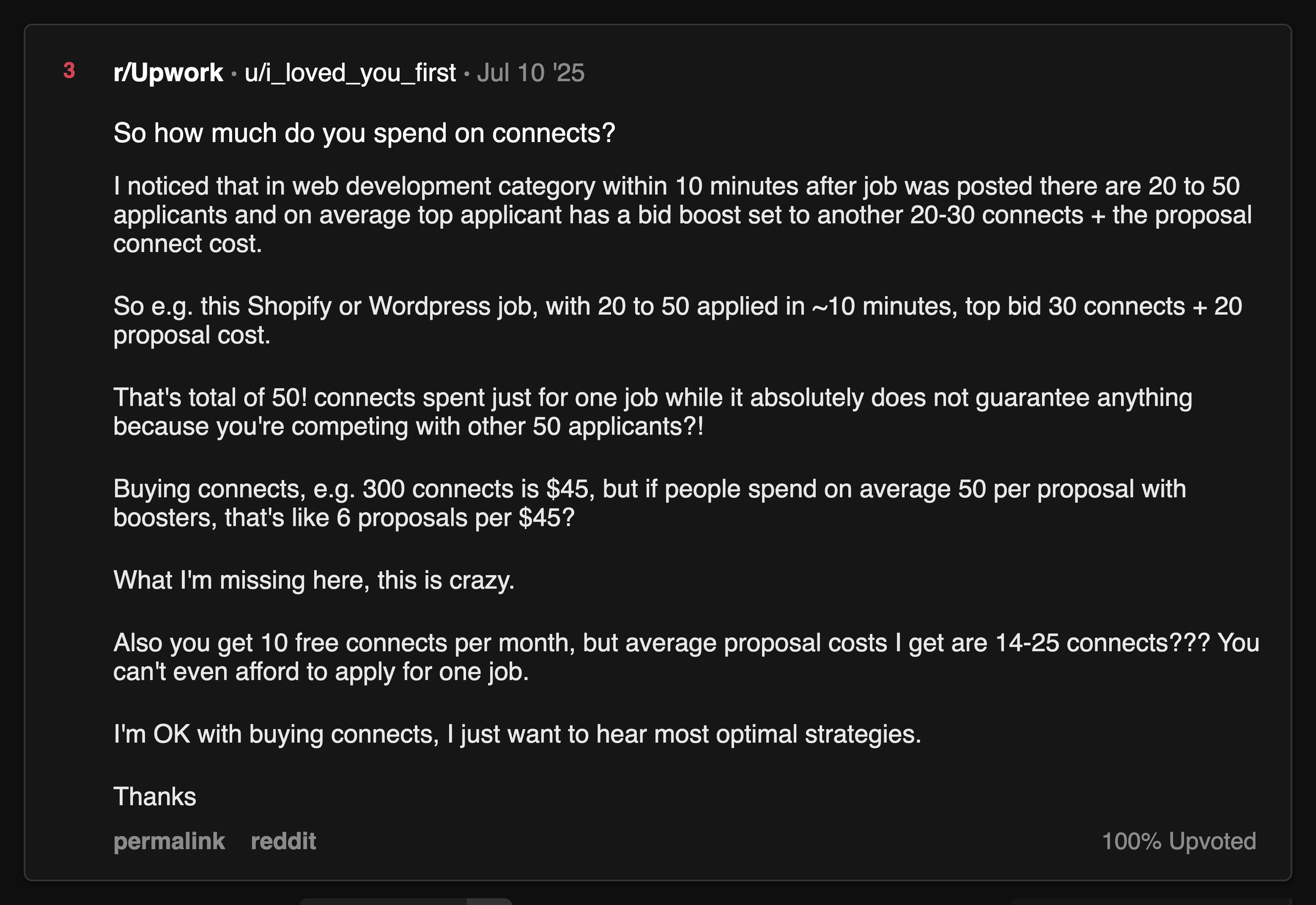
Real math from r/Upwork, July 2025: 300 Connects costs $45, but one boosted bid on a contested web development job burns 50 of them. That is six proposals per $45, against 10 free Connects a month. Source: r/Upwork.
The difference isn't Connects price. It's the same $0.15 for everyone. The difference is that filtered bidders send fewer proposals to better-matched jobs and get 2x to 3x the reply rate. Lower volume, higher conversion, lower CPH.
"I spent 300+ Connects, had 30 interviews, and the pattern was consistent: price shopping, free knowledge extraction, and ‘free audits.’"
u/GrandLifeguard6891, commenting in "I spent over 300 Connects on Upwork and had about 30 interviews", r/Upwork, 140 upvotes on the thread
300 Connects at $0.15 = $45 in direct costs. But 30 interviews with zero hires means the real cost was $45 in Connects plus 15+ hours of sales calls.
The Connects weren't the expensive part. The untargeted bidding was.
Three job filters that cut your Connects cost per hire in half
In GigRadar's agency growth course, Vadym walks through exactly how to separate view rate from reply rate and fix the right one. The diagnostic is simple: 30% views with 5% replies means your cover letter is weak. 10% views with 7% replies means your targeting is wrong. Both low means you're bidding on dead jobs.
🎥 From GigRadar's Agency Success Course: Low view/reply rate? Fix the right problem.
Here are the three filters that GigRadar agencies use to double their effective reply rate on the same Connects budget:
Only bid on clients with a verified payment method AND at least one previous hire. This single filter eliminates 40%+ of "dead" job posts: test listings, tire-kickers, and scam accounts. From GigRadar's internal data across 3,000+ agencies: proposals sent to payment-verified clients with at least one prior hire get replies at roughly double the rate of proposals sent to unverified or zero-history accounts.
Set a hard floor. If your agency can't profitably deliver under $1,000, don't bid on $500 jobs. The Connects cost is the same ($2.40) whether the job pays $500 or $5,000. But CPH as a percentage of contract value is 10x worse on the small job. Every sub-floor proposal is a Connects donation to Upwork.
Sort by newest. Prioritize posts with under 5 proposals. Freshness costs zero extra Connects but doubles effective reply rate on the same job quality. A well-matched proposal submitted within 30 minutes of posting beats a perfect proposal submitted 3 days late with 45 competitors.
The "interview count trick" from r/Upwork: skip jobs showing 1 to 2 interviews (the client has likely already shortlisted). Focus on 0 interviews (just posted) or 5+ interviews (client is actively reviewing all applicants). Multiple Reddit threads report significantly higher response rates on 0-interview and 5+ interview jobs vs. the 1-to-2 range where the client has already narrowed their list.
Why spending $200/month on Connects isn't the problem (not tracking CPH is)
Every few weeks, a thread blows up on r/Upwork: "Upwork is dead, I spent $200 on Connects and got nothing." The replies split into two camps. Camp one says Upwork is a scam. Camp two says improve your proposals.
Both are wrong. The problem is almost always untargeted bidding at scale with zero measurement.
Same $200/month. Two outcomes.
❌ Agency A: Spray
250 proposals/month
4% reply rate (10 replies)
20% close rate (2 hires)
CPH: $100
✅ Agency B: Target
60 proposals/month
15% reply rate (9 replies)
35% close rate (3 hires)
CPH: $67
Agency B gets 50% more hires at 33% lower CPH. Same budget. Fewer Connects.
One YouTube creator reported spending $400 to acquire a single $500/month social media client. At a 3-month average retention, that's $1,500 lifetime value on a $400 acquisition cost: a 3.75x return. Acceptable. But he only knew that because he tracked the full funnel.
The agencies who complain about Connects costs are almost always the ones who can't tell you their reply rate within 2 percentage points. If you can't answer "what's my cost per hire this month?" in under 10 seconds, the Connects aren't the problem.
Boosted proposals: the Connects multiplier most agencies ignore
Upwork's Boost system is an auction. You bid additional Connects on top of the base proposal cost. Your proposal gets a "Boosted" badge and lands in the top 4 visible slots. You pay just enough to beat the next-highest bidder.
For agencies, this is where Connects math gets dangerous fast.
A base proposal at 16 Connects ($2.40) with a 20-Connect Boost becomes $5.40 per proposal. If you're boosting 100 proposals a month, that's $540 in Connects alone.
The question isn't whether boosting "works." It's whether the incremental reply rate from boosting justifies the cost per hire increase.
From GigRadar data across 3,000+ agencies: profile optimization (JSS, PVR, niche positioning) moves reply rate 3x more than boosting does. An agency with a strong cover letter and niche profile at 0 Boost outperforms a generic agency boosting at 30 Connects per proposal.
The weekly CPH tracking template (copy this)
Most agencies estimate their Connects ROI. Estimates are always optimistic. This template forces real numbers. Run it every Friday for 4 weeks and you'll know exactly where your funnel leaks.
Track these numbers for 4 consecutive weeks. The pattern will tell you exactly which lever to pull: if reply rate is under 8%, your proposals need work. If close rate is under 20%, your sales process needs work. If both are fine but CPH is still high, you're spending too many Connects per proposal on boosts.
How agencies cut Connects waste without cutting volume
The conventional advice is "send fewer proposals." That's incomplete. Send the same number of proposals to better-matched jobs, faster.
GigRadar's scanner system does this automatically. You define your ideal client profile: minimum budget, payment verified, specific keywords, anti-keywords (to exclude garbage jobs). The scanner monitors Upwork's feed and sends proposals within minutes of posting.
No manual browsing. No wasted Connects on jobs you'd have skipped if you'd read the description.
Before: manual browsing
reply rate (unfocused targeting)
After: scanner + ICP filters
reply rate (payment-verified, budget floor)
Across 3,000+ agencies using GigRadar, filtering to jobs above minimum viable contract size with payment-verified clients produces 31% higher close rates on fewer bids. Better-fit jobs mean higher reply rate on the same Connects spend, which directly lowers CPH.
Free for Upwork agencies
Stop burning Connects on the wrong jobs
GigRadar scans Upwork in real-time, filters by your exact ICP, and sends proposals within minutes. Track CPH, reply rate, and close rate from one dashboard.
Get Your Free Agency Audit →Set a Connects budget ceiling (then hold it)
In GigRadar's agency course, one of the first exercises is: set a Connects budget ceiling for two weeks and log cost-per-reply daily. Most agencies have never done this. They buy Connects when they run out and never connect the spend to outcomes.
Here's the framework:
Baseline: measure current CPH
Bid normally. Track every proposal, reply, and hire. Calculate your CPH at end of week.
This is your "before" number. Most agencies are shocked.
Apply the 3 filters. Cut proposal volume by 50%.
Payment verified + hire history. Budget above your floor. Posted in last 24 hours with under 10 proposals.
You'll send half the proposals. Your reply rate will likely double.
Diagnose the gap. View rate vs. reply rate.
High views, low replies = cover letter problem. Low views, decent replies = profile or targeting problem.
Fix the specific bottleneck, not "everything."
Compare CPH. Set your permanent budget ceiling.
Week 4 CPH should be 30 to 50% lower than Week 1. If not, the issue is deeper: niche positioning or agency profile structure.
Set your weekly Connects ceiling at the Week 2/3 level. Hold it.
Can you actually get Upwork Connects for free? (sort of)
Upwork offers several paths to earn free Connects. For agencies, the math is underwhelming.
Activity Reward
36/mo
Send 3+ proposals, spend 54+ Connects = 18 free. 2x/month max.
Rising Talent Badge
30 (one-time)
Awarded once. Worth $4.50. Does not recur.
Interview with Top Client
Varies
Partial Connects refund when you get an interview with an established client.
At agency scale (100+ proposals/month), the 36 free monthly Connects cover roughly 2 proposals. That's a rounding error. The free Connects programs are designed for casual freelancers, not agencies running a pipeline. Don't optimize for free Connects. Optimize for reply rate.
The real Upwork cost per hire is bigger than just Connects
Connects are the visible line item. But your true cost per hire includes at least three more:
$0.15 x N
Connects cost: The only one agencies track. Typically $100 to $200/month.
$25/hr
Proposal labor: Time writing proposals. At 15 min each and 100/month = 25 hrs. At $25/hr = $625/month.
0-15%
Service fee: Variable 0-15% per contract since May 2025. Locked at contract start.
For a mid-size agency doing $20K/month: $165 in Connects + $625 in proposal labor + $2,400 in service fees + $20 Freelancer Plus = $3,210/month. That's 16% of gross revenue going to Upwork's ecosystem.
Our Upwork fees calculator breaks this down further. Cutting Connects waste by 30% saves $50/month. Cutting proposal labor waste (fewer, better proposals) saves $200/month. Both start with tracking CPH.
Start here: the one change that moves CPH the most
If there's a single operational change that moves CPH more than any other, it's setting a minimum budget floor in your job filters and holding it.
Payment-verified clients with hiring history reply more, close faster, and produce less acquisition waste. 10 to 15 targeted daily proposals consistently outperform 30 to 50 scattered ones.
Use the calculator above. If your CPH is over 5% of your average contract value, stop buying more Connects and start filtering harder. The Connects aren't expensive. Your targeting is.