🎬 QBR Template: The 8-Part Agenda That Keeps Clients. A 2-minute walkthrough of the retention-first Quarterly Business Review structure and the free builder. Watch on YouTube
TL;DR
- A QBR that spends 15+ minutes rehearsing last quarter's invoices is not a review. It is a quarterly invitation for the client to re-decide whether you are worth it.
- The template below flips the ratio: no more than 15 minutes on the past, the rest on the next 90 days and the specific momentum they would lose by pausing.
- Use the free QBR builder to generate a copy-paste agenda in 60 seconds, and the retention calculator to see what one saved client is actually worth.
- Under ~15 clients, a monthly async value recap beats a formal quarterly summit. Retention is won in the gaps between meetings.
- Reichheld's Bain research: lifting retention 5% raises profit 25% to 95%, and keeping a client costs 5 to 25 times less than winning a new one. Most agencies spend backwards.
The average agency Quarterly Business Review quietly re-sells the client on leaving. You book a formal meeting, silence your team for an hour, and hand the decision-maker sixty uninterrupted minutes to do the one calculation you never want them doing out loud: "was this worth it?"
A QBR built to surface value will, with the exact same efficiency, surface the absence of value.
That is why the strongest QBR template is not a prettier version of the status update you already send. It is a different meeting with a different center of gravity.
This guide gives you the eight-section template, the time budget for each part, a builder that generates your agenda, and the honest answer to a question most QBR articles skip: when running one at all is the wrong move.
Free Tool
Build your QBR agenda
Fill in the fields, hit generate, and copy a forward-weighted QBR agenda with the recommended time splits already built in. Nothing is stored.
A QBR is not a status update. It is a churn test you can fail in the room.
Sit a client down and say "let's review whether this is working," and you have framed the relationship as an open question. A client who was not thinking about churning now is.
Customer success teams see this every quarter.
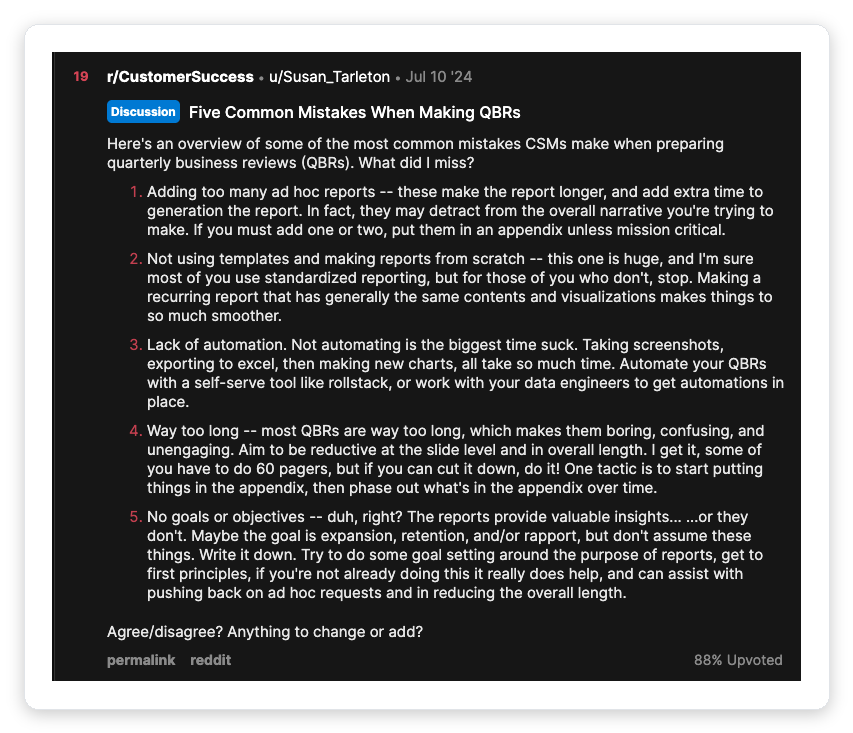
The most upvoted complaint in the r/CustomerSuccess thread on QBR mistakes is not "our data was wrong." It is that QBRs are too long, rebuilt from scratch every time, have no stated goal, and end up being about the vendor instead of the client.
Here is the tell most agencies miss. A QBR produces two signals, and everyone obsesses over the wrong one.
Your KPIs, your ROI slide, your polished deck. Necessary, but it only proves value when value exists to prove.
Did the decision-maker show up and engage with next quarter, or send a junior who rescheduled the call twice? That behavior forecasts renewal better than any chart.
A client who reschedules the QBR twice and sends an intern is 80% gone, whatever your numbers say. A client who argues with your roadmap is engaged and staying.
Read the room as churn data and the QBR becomes an early-warning radar that buys you 30 to 60 days to intervene. You already track reply rate on your outbound.
Track renewal-intent signals on your existing book with the same discipline, because that is where the revenue you already earned walks out the back door.
Pair the behavioral read with a hard number using our NPS calculator. Our client retention playbook goes deeper on the intervention side.
The retention math agencies ignore while chasing the next Upwork client
Most agencies pour their energy into the top of the funnel: outbound, Upwork proposals, cold email, the next logo. Then they treat the single highest-leverage retention touchpoint they own as an admin chore.
The economics say that is backwards. Frederick Reichheld's foundational Bain & Company research, first published in the 1990 Harvard Business Review article "Zero Defections" and expanded in later Bain work, found one number that should reframe how you spend your week.
Even the floor of that range, a 25% profit lift, beats what most paid acquisition campaigns return. And acquisition keeps getting more expensive: the same HBR analysis pegs winning a new customer at 5 to 25 times the cost of keeping one you already have.
Expansion revenue is cheaper still. Sales-efficiency benchmarks widely cited in SaaS put the cost of a dollar of expansion revenue near $0.61 versus roughly $1.78 for a dollar from a net-new customer.
The QBR is where that expansion conversation is supposed to happen, if you run it right.
Interactive Calculator
What is one saved client actually worth?
See your annual revenue at risk from churn, and what a QBR cadence that trims churn by 5 points puts back in your pocket.
Run your own numbers above. For most 2-to-20-person agencies, one prevented cancellation covers a year of QBR prep across the entire book.
That is the framing to carry into the template. Pair it with our customer lifetime value calculator to price the full relationship, not just the next invoice.
The eight sections every agency QBR template needs
Enterprise SaaS QBR decks run 40 slides because they have a customer success department to fill them. You do not need that.
A lean agency QBR is eight sections, and the order matters more than the polish.
The non-negotiable rule that separates a retention QBR from a status update: cap the past at 15 minutes and spend the majority of the meeting on the next 90 days. This structure is synthesized from Gainsight, AgencyAnalytics, and Salesforce, then stripped down for a services agency.
State the three things this meeting will decide. This is a contract for the hour, not throat-clearing.
One sentence on the quarter's single biggest result, then a plain verdict: strong, mixed, or hard, and why.
Five to seven KPIs, no more. Every metric earns a "so what" and a "what next," or it moves to an appendix.
Your best result, reframed in the client's revenue or pipeline. Not "we shipped 12 assets" but "those assets drove 22% more demos."
Name the biggest shortfall before the client does, and state the fix already in motion. Avoiding it is how trust dies.
Three priorities, each with an outcome, an owner, and the momentum lost if you pause. This is where a QBR earns its keep.
Renewal, expansion, or the decision you need approved. Frame around future value gained, never a settled-up ledger.
Every item gets an owner, a deadline, a deliverable. Book the next review before anyone leaves.
Sections 6 through 8 should eat more than half your clock. If your agenda has the past taking the biggest block, you have built a status update wearing a QBR costume.
The copy-paste QBR template you can use this week
Below is the same structure the builder generates, as a static fill-in template. Swap the bracketed prompts for your client's specifics.
Keep the time markers: they are the discipline that stops the meeting from drifting into the past.
| Section | Time | What goes here |
|---|---|---|
| Open + agenda | 5 min | The 3 decisions this meeting will make |
| Headline | 7 min | One-sentence result + honest verdict |
| Results vs goals | 8 min | 5–7 KPIs, each with so-what + what-next |
| Win, translated | 5 min | Best result in the client's revenue terms |
| Honest miss | 5 min | The shortfall + the fix already running |
| Next 90 days | 15 min | 3 priorities: outcome, owner, momentum-at-risk |
| Forward ask | 7 min | Renewal / expansion / decision needed |
| Action log | 3 min | Owner, deadline, deliverable + book next QBR |
Scroll back up to the builder to fill this in and export it in one click. For the relationship layer around it, our customer success plan template and account plan template plug straight into sections 6 and 7.
Free for Upwork agencies
A great QBR keeps the client. GigRadar keeps the pipeline full.
You defend the back door with retention while we keep the front door busy. GigRadar runs outbound Upwork proposals through our own supervised Business Manager, so your team spends its hours on the QBRs that actually renew.
Get Your Free Agency Audit →The five ways an agency QBR quietly loses the client
The mistakes are consistent across every source, from QBR example libraries to the customer success practitioners venting on Reddit. Here is the short list, translated for an agency book.
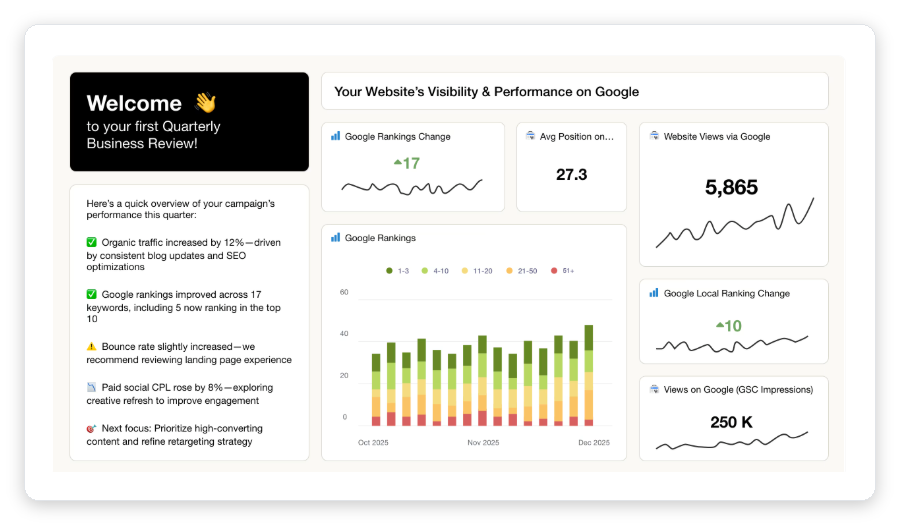
| Status-update QBR (loses clients) | Retention QBR (keeps them) |
|---|---|
| Rehashes everything already in the weekly emails | Caps the past at 15 minutes, spends the rest forward |
| Dumps 20+ metrics with no interpretation | 5–7 KPIs, each tied to a client business outcome |
| Generic deck rebuilt from a template every time | Opens with the client's own goals, in their words |
| Sugar-coats or hides the miss | Names the shortfall first, shows the fix in motion |
| Ends with "thanks, talk soon" | Ends with an action log and the next QBR booked |
Do not bundle "we did great" and "so pay us more" into the same breath. Pitch the expansion two to three weeks after a concrete win lands, when the value is fresh: stacked into the review, that same ask reads as a sales pitch and the client starts pricing the exit.
When you should skip the QBR entirely
Here is the take most QBR templates will never give you, because they are selling you on running more of them. Under roughly 15 clients, a formal 60-minute quarterly summit is often the wrong instrument.
A quarter is three invoices. If a $4,000-a-month relationship is quietly rotting, a quarterly cadence lets it rot for 89 days before anyone books a meeting to notice.
"We'll cover it at the QBR" becomes the excuse not to send the two-line message that actually saves the account in week six.
For a small book, run a monthly async value recap: a two-minute video plus a one-screen scoreboard the client reads in 90 seconds. Save the live meeting for the one moment it earns its keep, the renewal or expansion conversation, because retention is won in the gaps between meetings.
Run this gut-check before every review: could we survive our own QBR right now? If the honest quarterly number is "we sent 400 proposals and booked two calls, both of which ghosted," a polished deck will not save you.
Fix the delivery, then the QBR has something to stand on.
That is also the deeper point. Agencies that dread QBRs are often unconsciously protecting a thin relationship from the one format most likely to expose it.
The answer is not to skip the review forever. It is to make sure the client-facing version is never the first time you look at the number.
Frequently asked questions
What is a QBR in an agency context?
A Quarterly Business Review is a structured meeting, usually 60 minutes, where an agency and a retained client review results against goals and, more importantly, align on the next 90 days. Done well it is a retention and expansion tool, not a status report.
How long should a QBR be?
60 minutes for most agency relationships, 75 to 90 for larger accounts with more stakeholders. The hard rule is time allocation, not total length: no more than 15 minutes on the past, the majority on the forward plan.
Section 6 of the agenda is also the right place to invite structured feedback. Our guide on how to ask clients for feedback gives you the exact prompts that surface a churn risk before it hardens.
Who should attend a QBR?
On the client side, the budget holder or decision-maker plus the day-to-day champion. On your side, the account lead plus, when there is a real strategy or expansion decision, the person who can commit to it.
If the client sends only a junior and reschedules twice, treat that as a churn signal.
How often should a small agency run QBRs?
Quarterly is the default, but under about 15 clients a monthly async value recap plus a live meeting at renewal often retains better than a formal quarterly summit. Match the cadence to how fast a relationship can go sideways at your deal size.