LinkedIn Outreach for Agencies in 2026 — 2-minute walkthrough. The 100/week cap, the note throttle, real reply rates, and the 4-channel stack that books calls. Watch on YouTube
TL;DR
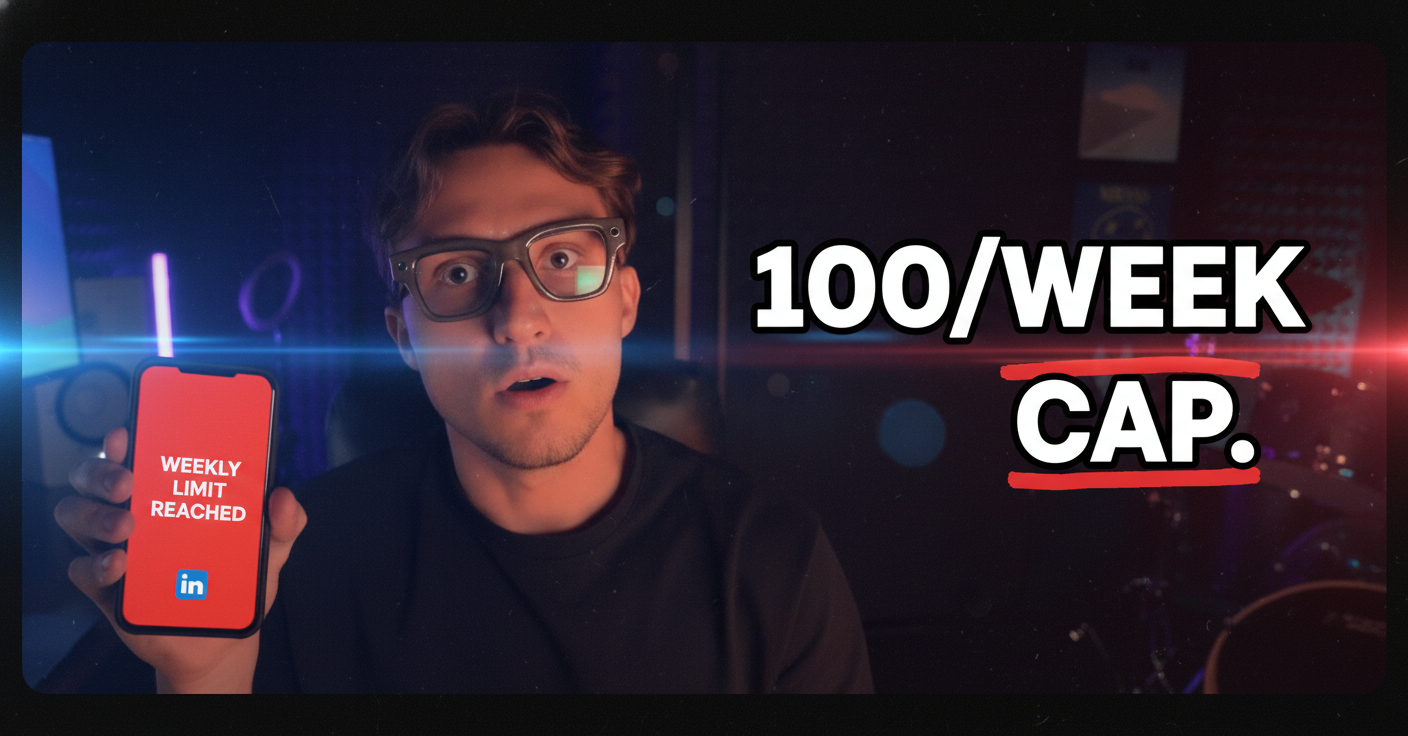
- Adding a personalized note to a free LinkedIn connection request quietly caps you at roughly 5 requests per week, not 100. The standard agency advice ("always add a note") will torpedo your weekly volume.
- LinkedIn rolled the connection cap from 100/day to 100/week in 2021, and 2025–2026 detection now bans accounts in days, not months. 25–45% of cloud-automation users hit restrictions within 6 months.
- Realistic reply benchmarks for B2B agencies: 10% average DM reply, 18–25% top-tier, vs ~5% on cold email. Acceptance rate below 30% triggers LinkedIn to tighten your invite ceiling on its own.
- The boring playbook that books calls: warm 5–7 days before connecting, hold daily invites under 15–20, skip the note on free accounts, and use Upwork client wins as social proof in the first DM.
- Use the calculator below to estimate your real safe weekly invite ceiling based on account age, SSI, and acceptance rate. Most agencies set this 3× too high.
If you run a B2B agency adding LinkedIn outreach to Upwork and your SDR sends 50 LinkedIn connection requests on Monday morning with a friendly note attached, LinkedIn will quietly stop sending them after the fifth one. LeadLoft's 2026 limit breakdown documents this clearly: free accounts that include connection notes get throttled to roughly 5 requests per week.
Every "best practice" article tells agencies to personalize every request. LinkedIn's spam algorithm uses note attachment on free accounts as a proxy for outreach tools, and the cap is brutal.
This is the first of about a dozen counterintuitive rules that decide whether your LinkedIn channel survives the next 90 days.
On a free LinkedIn account, sending requests without a note is safer for volume than personalizing them. On Premium and Sales Navigator the penalty disappears, notes are fine.
LinkedIn weekly outreach capacity calculator
Most agency LinkedIn campaigns blow up because the SDR or the agency owner is sending 3–5× the volume their account can actually handle. Plug in the four signals LinkedIn actually scores, and this calculator returns the safe weekly invite ceiling and the realistic reply volume that ceiling produces.
Interactive Tool
Safe Weekly Invite Estimator
Real ceiling based on account age, SSI, acceptance rate, plan, and whether you add notes.
Math behind the numbers: base ceilings sourced from LeadLoft, Konnector 2026, and LinkedAPI. Reply rate baseline of 10% from Expandi's H1 2026 report.
The 90-day death timeline: how a LinkedIn outreach account actually dies
LinkedIn restrictions are not binary. They escalate.
The MagicPost limitations ladder documents four enforcement stages that account-level activity progresses through when the trust score falls below threshold.
The window between the first warning and a permanent ban used to be measured in months. In 2025–2026 it compresses to days.
A May 2026 cohort survey from ConnectSafely found 38% of cold-outreach automation users hit Level 1 restrictions within three weeks of switching tools.
The single fastest path to Stage 3 is a Chrome extension that automates connect-and-message.
Konnector's detection breakdown explains why: extensions inject JavaScript into LinkedIn's own pages, and LinkedIn's front-end scripts see the DOM manipulation in real time. Cloud tools log in remotely with dedicated IPs and are harder to detect, but not invisible.
If you run an agency with multiple client LinkedIn accounts behind one data-center IP block, you've stacked the exact pattern that triggered the May 2026 enforcement wave. ConnectSafely's research documents LinkedIn banning infrastructure (proxy chains, automation vendors) rather than just individual accounts.
Realistic reply rate benchmarks: 10% average, 25% top-tier, 5% on email
The numbers most agency owners carry in their head are wrong. The 80%+ reply rate LinkedIn quotes is for messages between existing connections, not cold outreach.
Real cold benchmarks sit much lower.
SalesBread's multi-year analysis across B2B agency campaigns lands on 19.98% reply rate, with 48.14% of those replies positive.
Expandi's H1 2026 State of LinkedIn Outreach reports the platform-wide average at 10.3%. Sopro's 2026 outreach study independently lands at the same 10% LinkedIn vs 5% cold email split.
| Channel | Acceptance / open | Reply rate (cold) | Reply rate (top 10%) | Booked-call conversion |
|---|---|---|---|---|
| LinkedIn (personalized) | 45–60% | 15–20% | 20–25% | 6–10% of total sent |
| LinkedIn (average) | 25–40% | ~10% | 15–18% | 3–6% of total sent |
| Cold email (top performers) | 40–55% open | 8–12% | 15–18% | 2–4% of total sent |
| Cold email (average) | 25–35% open | ~5% | 7–10% | 1–2% of total sent |
| Upwork proposals (Business Manager model) | Job-dependent | 8–18% | 20%+ | 4–7% of total sent |
Sources: SalesBread, Expandi H1 2026, Sopro 2026, Belkins (via Expandi citation), and GigRadar's internal pipeline data on Upwork outreach. Upwork rates use our pipeline reply signal (chat opened or hiring-room assignment).
The boring playbook: warm 5–7 days before you ever click connect
The most reliable hack for doubling LinkedIn connection acceptance is also the least exciting.
GTMStack's 2026 outbound playbook documents the 5-3-1 routine: 5 profile views, 3 post engagements, 1 thoughtful comment per target. Run it for 5–7 days before the connect request.
Their data shows acceptance rates double and reply rates triple.
Most agencies refuse to run this because it sounds like a content marketing tactic dressed up as outreach. It is, kind of.
The trade is real: a few minutes of pre-engagement per prospect, in exchange for not getting throttled or banned by LinkedIn's behavior model.
The 7-day warm window does two things at once: it pushes your acceptance rate above 45% (which unlocks higher weekly invite caps), and it gives you something specific to reference in the first DM. Generic "saw your profile and thought you'd be a great connection" templates are exactly what LinkedIn's spam algorithm scores against you.
Why Upwork inbound is the unfair advantage most agencies waste on LinkedIn
Pure cold LinkedIn outreach is hard because you have to manufacture credibility from nothing.
The agency owners who consistently book calls on LinkedIn aren't doing pure cold. They're using Upwork inbound as a credibility engine and LinkedIn as the warm follow-up channel.
The mechanic is straightforward: an Upwork client hires you, the work goes well, you ask them to leave feedback.
You take that feedback (anonymized to avoid Upwork ToS issues) and use it as the opening line for similar prospects on LinkedIn. The line "we just shipped X for a Shopify agency in your space, here's what we learned" lands very differently than "I help agencies scale revenue."
Vadym walks through this trade-off in the GigRadar Agency Success course lesson on diversifying beyond Upwork.
The short version: Upwork is a channel, not a home. Treat it as one of three or four outbound channels and the reply rates compound.
From GigRadar's Agency Success Course: the "Getting over Upwork" lesson on building diversified outbound. The instructor walks through real case studies of agencies that moved 60% of clients off-platform.
The course lesson covers an underappreciated point: the agencies that lose Upwork entirely (suspension, ban, market shift) are the ones that never built a LinkedIn or email muscle while Upwork was working.
Our outbound playbook goes deeper on the channel-mix math. The boring conclusion is that Upwork-only agencies are one ban away from zero pipeline, and LinkedIn is the cheapest insurance policy.
The first-DM template that uses Upwork wins as proof (without violating ToS)
Hold off the pitch in the first DM. The goal of message one is to earn a reply, not a meeting.
Reference something specific you observed about their profile or company, attach a concrete proof-of-work (an Upwork client win works perfectly), and ask one tight question.
Saw your post on {{specificTopic}} last week. Your point about {{specificDetail}} matched something we just hit with a {{vertical}} client.
Quick context on us: we run {{serviceLine}} for {{N}} agencies in {{vertical}}. The last engagement (a {{clientSize}} {{vertical}} agency) moved their {{metric}} from {{before}} to {{after}} in 6 weeks.
Question for you: how are you currently handling {{specificPain}}? Curious whether the same play would map.
{{yourName}}
Never name the Upwork client by company name in your LinkedIn message: Upwork's ToS treats that as taking work off-platform, so reference vertical and engagement shape only ("a Shopify agency in our pipeline") and not the client's name. Our agency profile review guide covers the ToS boundaries in more detail.
The three banned patterns that get agencies restricted in 90 days
Three behaviors account for almost every agency LinkedIn restriction we see, in approximate order of frequency:
- Chrome extension automation. Konnector's detection analysis documents the DOM-injection signature LinkedIn looks for. Browser extensions are the highest-risk category and the cheapest tools fall in this bucket. Cloud-based tools with dedicated IPs are lower risk but still violate LinkedIn's Professional Community Policies.
- Identical message templates across hundreds of prospects. LinkedIn's semantic analysis catches near-identical messaging. The "personalized {{firstName}}" trick fools no one. The rest of the message is identical. GetSales' 2026 safety guide ties this directly to "I don't know this person" reports.
- Volume spikes on new accounts. An account that goes from 5 invites in the first month to 80 invites/week in the second month trips the spike detector. The fix is gradual ramp-up: 10/day in month 1, 15/day in month 2, 20–25/day from month 3.
The 4-channel outreach stack that actually compounds
Treating LinkedIn as a standalone channel is what makes it expensive. The pattern that works for B2B agencies in 2026 layers four channels in sequence.
Upwork is the one most agencies overlook as a channel, not a destination.
- Upwork (Business Manager model). Highest reply rate per dollar of investment. Generates the case studies that fuel the other three channels. GigRadar runs this through our own Upwork BM, so your agency's own freelancer account is never touched. The compliance pattern is the same role you'd use to invite a hired bidder. More on how this works.
- LinkedIn warm + cold. Use Upwork case studies as social proof. The 5-3-1 routine doubles acceptance, the post-acceptance DM uses vertical-specific Upwork wins.
- Cold email. The acceleration layer. Volume channel for net-new prospects. Reply rates 2× lower than LinkedIn, but volume 5× higher. Match each cold email sender to a single vertical. The B2B outreach best-practices guide covers the deliverability mechanics.
- Phone follow-up. Only on accounts that engaged on at least one of the prior three channels. Apollo's cadence research shows warm-call success at ~40% vs 2% pure cold.
The acceleration math: a typical agency targeting 1,000 prospects in a quarter via LinkedIn-only would book roughly 30–50 calls. The same prospect list run through the 4-channel stack books 80–120 calls, per Danish Lead Co's multi-channel benchmark showing 3× response rates and a 40% lift in meeting bookings.
For the cost-side math (CPL by channel, blended CAC), our cost-per-lead breakdown shows why Upwork bidding wins on raw $/reply, and why LinkedIn earns its place in the stack despite higher cost-per-touch.
What we see in GigRadar pipeline data
One pattern shows up consistently across GigRadar customers who run LinkedIn alongside Upwork: agencies that send Upwork proposals with named first-line client references reply at 14–18%, vs 8–11% for generic "we help agencies scale" openers. The same pattern holds on LinkedIn: specificity wins.
Source: GigRadar pipeline data, Q1 2026 sample of 59,339 fixed-price proposals from GigRadar's customer pipeline.
For Upwork agencies running outbound
Stop bleeding Connects on bad-fit jobs
GigRadar runs your Upwork bidding through our own Business Manager: we filter, draft, and submit while your agency account is never touched. Pipeline data flows into your CRM so you can feed Upwork wins back into LinkedIn outreach.
Get a Free Agency Audit →FAQ
How many connection requests can an agency safely send on LinkedIn per week in 2026?
For an established free account, plan around 80–100 per week. Premium accounts with strong SSI (70+) and high acceptance rate (45%+) can safely push 150/week.
Sales Navigator users with the same signals can reach 200–250/week. New accounts under 3 months should stay under 50/week regardless of plan.
Does adding a personalized note really cap free accounts at 5 per week?
Yes, per LeadLoft's 2026 limit breakdown. The penalty applies specifically to free accounts.
On Premium and Sales Navigator the throttle disappears and personalized notes are encouraged.
Are Chrome extension LinkedIn automation tools safe in 2026?
No. Browser extensions inject JavaScript directly into LinkedIn's pages, which the platform's front-end detection scripts can observe in real time.
Cloud-based tools with dedicated IPs are lower risk but still violate the LinkedIn User Agreement. The 2026 enforcement trend bans infrastructure, not just individual accounts.
What's the realistic reply rate for cold LinkedIn outreach by B2B agencies?
Platform-wide averages sit around 10% (Expandi H1 2026). Well-targeted agency campaigns reach 15–20%.
Top-tier campaigns with strong personalization and warm sequencing hit 20–25%. Anything below 10% indicates a targeting or messaging problem, not a volume problem.
Should LinkedIn replace Upwork for B2B agency outbound?
No, they're complementary. Upwork generates higher inbound reply rates and the case studies that fuel LinkedIn proof points.
LinkedIn extends reach to prospects who don't post jobs. The 4-channel stack (Upwork inbound, LinkedIn warm/cold, email volume, phone follow-up) is the dominant 2026 pattern.
How long should a new LinkedIn account warm up before doing outbound?
Minimum 30 days of profile completion, real connections (10–30 colleagues/friends), and content engagement before any cold outreach.
Volume ramp: 10/day in month 1, 15/day in month 2, 20–25/day from month 3. Skipping the warmup is the single fastest way to a Stage 3 hard block.