
Client Referral Program for Agencies — 2-minute walkthrough on why most agency referral programs fail at the asking stage, plus the timing fix that actually works. Watch on YouTube
TL;DR
- → 84% of B2B sales start with a referral, but only 30% of agencies have a formal program. That gap IS the channel.
- → The fee benchmark is 5–10% of first-year revenue, capped at 12 months. Below 5% feels insulting on a five-figure retainer; above 10% pushes cost-of-sales past 20% and breaks margins.
- → The single highest-leverage change is timing: ask after a milestone exceeds expectations, not at engagement end. Asks decay with every week of delay.
- → Most agency programs die from the "black hole effect". Referrers send a name, hear nothing back for 6 weeks, stop referring forever.
- → Use the Reward-Rate Calculator below to set a fee that fits your margin, then run it for 12 months before you judge it. Referral channels take a year to compound.
Most agencies I talk to have a "referral program" that is, in practice, one sentence on the bottom of an invoice. Nobody clicks it.
Nobody talks about it. And the founder still tells me "60% of our work comes from referrals" as if that proves the program is working.
It isn't. The 60% is happening despite the program, not because of it.
Which means it's fragile, founder-dependent, and one departing rainmaker away from a pipeline crisis.
This article is the deliberate version. The benchmarks, reward rates, asking scripts, attribution rules, and tracking infrastructure that turn ad-hoc word-of-mouth into a channel that reliably produces 20–40% of new MRR.
There's a free Reward-Rate Calculator a third of the way down so you can size your own fee against your own margins.
Before you build a referral program, plug the leaky bucket
The single biggest mistake agency owners make is treating referrals as an acquisition problem. They are downstream of retention.
A client who churns in month four does not refer you. A client who stays three years refers you four times.
u/cursedboy328's r/agency post of 4 December 2025 framed this better than any consultant ever has. The "front door, back door" problem most agencies ignore:
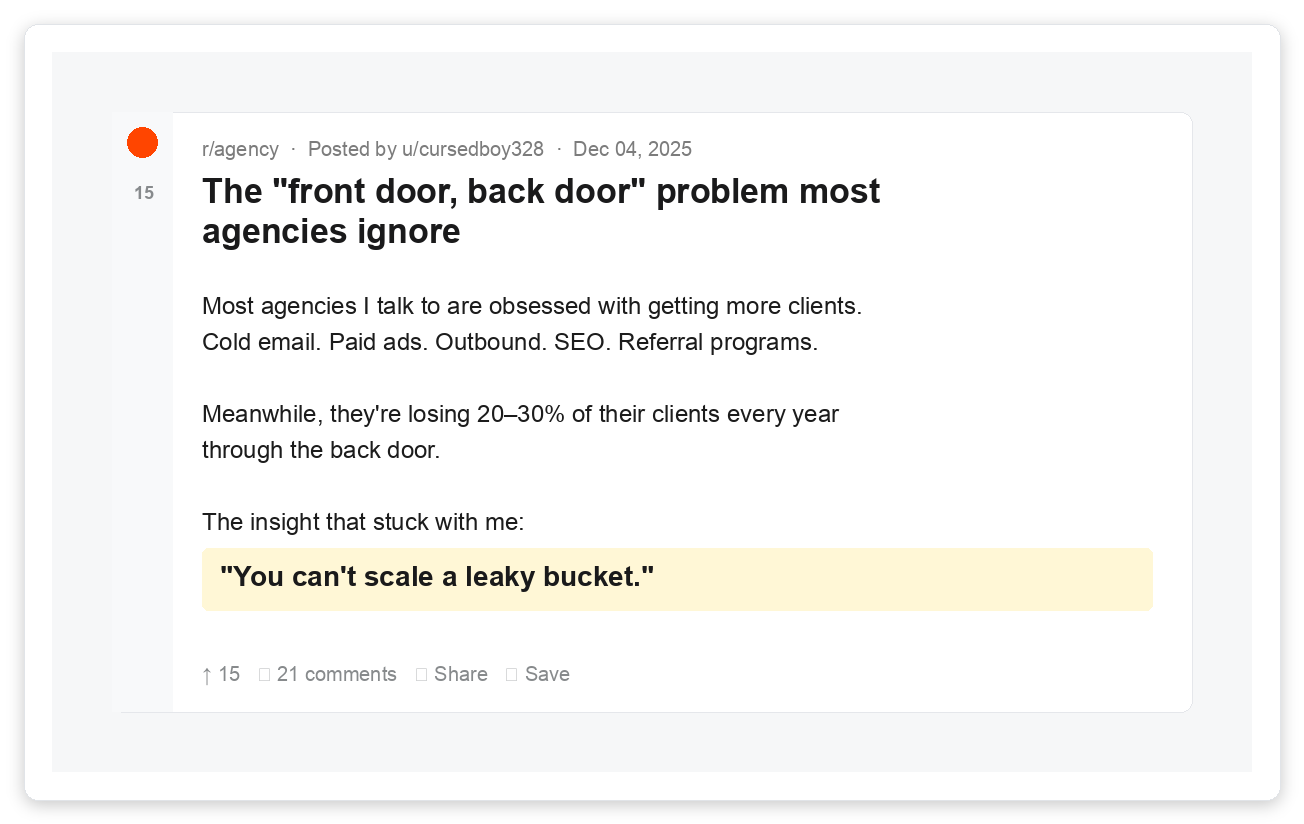
The math is brutal. An agency that closes 15 new clients per year and loses 9 through churn nets six clients.
The same agency that closes 15 and loses 3 nets twelve. The acquisition spend is identical.
The second agency just stopped leaking. If you are about to design a referral program and your gross retention is below 80%, fix that first.
Otherwise you're recruiting referrers who will quietly stop being clients.
If your last 12 months of gross revenue retention is under 80%, run a churn diagnostic before you launch any referral program. Use a structured client-acquisition framework like the one in our digital agency client acquisition piece to find the upstream leaks first.
The economics: what a real B2B agency referral channel can produce
CustomerGauge's B2B referral marketing analysis found referrals account for at least 28% of new B2B sales per month on average. The same study found referred deals close in 20 days versus 100 days for non-referred (a 5× reduction in sales cycle).
A 5× reduction in sales cycle.
The Schmitt, Skiera, and Van den Bulte field study at Wharton followed 10,000 customers for three years and found referred customers had at least 16% higher long-term value than demographically identical non-referred customers, and retained at significantly higher rates. For agencies on recurring retainers, that LTV premium compounds across the entire relationship.
Hinge Research surveyed 523 professional-services firms and found that while referrals are the #1 source of new business for most of them, very few have any formal process to harvest them. CustomerGauge puts a number on it: 84% of B2B sales start with a referral, but 63% of B2B brands don't track referrals at all.
That is the entire opportunity. Not generating MORE referrals, but capturing the ones that are already happening.
Reward-Rate Calculator: size your fee against your actual margin
The most common reward-design failure is starting from "what feels generous" instead of "what fits our margin." Use this calculator to set a fee that respects your unit economics. Inputs are your average annual deal size, your gross margin, and your target cost-of-sales.
All numbers you should already know.
Interactive Calculator
Reward-Rate Calculator
Computes a recommended referral fee based on your margin envelope. Aligns with the 5–10% agency benchmark from Sakas & Company.
Sakas & Company tracked agency cost-of-sales and found that anything above 20% of revenue (counting base sales comp, ads, and referral fees) starts eroding profit faster than the referrals grow the business. SaaS referral percentages (20–30% recurring) do not transfer to services.
Reward structures: what to actually offer (and what to skip)
There are five reward shapes in common use across B2B agencies. The 5–10% of first-year revenue benchmark from Sakas & Company covers the majority of agency programs.
Most others are variations on it.
| Reward type | Typical level for agencies | Duration | When to use it |
|---|---|---|---|
| Cash commission, % of revenue | 5–10% of revenue received | First 12 months | Default for external referrers and other agencies. Step-down structure (10% year 1, 5% year 2) extends the relationship. |
| % of first month retainer | 10–20% one-time | Single payment | Tight margins or shorter engagements. Concentrates the fee upfront, eliminates long-tail tracking. |
| Retainer credit (invoice discount) | 5–10% of year-1 revenue | First 6–12 months | Existing clients in regulated industries where personal commissions trigger procurement policy issues. |
| Flat fee per closed engagement | $250–$1,500 | One-time | Productized services or fixed-scope projects where revenue is predictable. Easier to administer. |
| Non-cash gift (gift card) | $50–$250 value | One-time | Token of appreciation when monetary rewards are inappropriate. Will not move the needle on referral volume alone. |
Cash, credit, or gift card?
Cash is universally fungible and feels more generous than equivalent-value credits. The drawback is that some client organizations forbid employees from accepting personal commissions related to vendor selection.
Particularly in financial services, healthcare, and government.
Retainer credits sidestep that policy issue because the benefit accrues to the client organization, not the individual. If your referrers are mostly other clients with strict compliance rules, default to credits.
If they are other agencies or independent consultants, default to cash.
✓ Cash works when
- Referrer is an outside agency, consultant, or freelancer
- Client's industry has no kickback restrictions
- You want the fee to feel meaningful and salient
- Administration cost matters (cash is one transaction)
✗ Cash backfires when
- Referrer's employer has gift/commission policy ($50+ threshold)
- Referrer is in financial services, healthcare, or public sector
- You haven't documented the program in writing (which makes any payment feel like a kickback)
- You can't reliably pay within 30 days of first invoice
Double-sided rewards: the margin-trap warning
Dual-sided programs (referrer AND referred client both get something) increase participation by roughly 29%, according to Rivo's 2026 referral data, and 86% of programs use them. The catch for services with thin gross margins: naive double-sided structures double the explicit incentive cost per converted referral and quietly destroy unit economics.
The fix is asymmetry. Make the referrer's reward recurring (e.g., 5% for 12 months) and the referred client's reward one-time (e.g., a waived onboarding fee or one free strategy session).
That keeps the program psychologically dual-sided without inflating the long-tail cost.
Ask sooner: timing is the highest-leverage variable
Most agency owners ask for referrals at the end of an engagement. That is the single most common timing mistake.
By the time the engagement is over, the client's attention has moved on, the emotional intensity of the win has faded, and your ask now sounds like a goodbye favor instead of a peer recommendation made in the middle of demonstrable success.
The right time is the first time a milestone exceeds expectations. The morning after a launch.
The afternoon a campaign hits a number you both bet on. The week the client gets internal credit for something you delivered.
Whoever wrote them on Slack to congratulate them. That's the moment to insert a referral conversation, not three months later when you're trying to renew the contract.
The NPS-trigger pattern
The simplest activation infrastructure is an NPS survey after every major delivery moment. Anyone who scores you 9 or 10 (a "promoter" in the Bain framework) gets a templated personal email within 48 hours that says: "Glad you're seeing results.
Who in your network is dealing with the same problem?" Detractors get routed to your success team for issue resolution. Passives get nothing.
Three asking scripts that work in B2B, drawn from Totango's referral playbook and Myerhoff Consulting's B2B asking guidance:
"We loved working with you on [specific outcome]. I'm curious: how do we find more leaders like you?"
Opens the door without asking for anything specific."Thinking about the [campaign / launch / migration] we just shipped, who else in your network is dealing with a similar problem? I'd love to send them a no-pitch intro doc."
Anchored to the recent win, framed as helping their peers."Quick favor: if you know one person who'd benefit from what we just built together, can I draft the intro email and you decide whether to forward it?"
Lowest friction. Removes the writing burden from the client.Asks from panic land differently. Clients can smell desperation, and a referral request from a struggling agency is the fastest way to damage the relationship that earned the referral opportunity in the first place.
Ask from a position of strength, when you don't strictly need the deal.
Why most agency referral programs fail
I've audited dozens of agency programs that quietly underperform. The failure modes cluster into five categories, each of which has a specific fix.
The black hole effect
Referrer sends a name, hears nothing, never refers again. Impartner calls this the #1 killer of partner programs.
Fix: automated status emails at three points (received, in conversation, closed/lost).
Nobody knows it exists
A line in the email footer is not promotion. Mention the program in onboarding decks, quarterly reviews, project kickoffs, and the website navigation.
Train every account manager to bring it up at peak-satisfaction moments.
Insulting reward, big deal
A $50 gift card on a $100K annual contract reads as "we don't take you seriously." Use the Reward-Rate Calculator above. The fee should feel commensurate with the value being introduced.
Spreadsheet rot
Referrals get entered, the spreadsheet gets messy, leads slip through, rewards get late, trust erodes. Either put it in your CRM with a tagged source field or use a dedicated tool.
Manual tracking past ~20 referrals/year fails predictably.
No executive sponsor
Founder announces the program in a Slack post. Hands it off to a junior account manager.
Never mentions it again. Programs without sustained leadership reinforcement get treated as optional and die within two quarters.
Tracking infrastructure: the three-tier choice
You have three realistic options for tracking referrals. The decision is mostly a function of program size and how many referral partners you expect to manage.
(The same build-vs-buy logic applies to the broader sales function: see our breakdown of outsourcing agency sales for the cost ranges.)
CRM-native (the right answer for most agencies)
Add three custom fields to every deal in HubSpot, Pipedrive, or Salesforce: referral_source (the referrer's name or company), referral_date (when the intro happened), fee_owed (calculated). Build one view filtered to referral_source IS NOT NULL.
Send referrers a monthly status email built from that view. Total setup: half a day.
Marginal cost: zero. Handles up to ~50 referrals/year without breaking.
Dedicated B2B referral platform
Tools like Referral Rock, GrowSurf, PartnerStack, or Impact.com handle multiple partner types (clients, agencies, affiliates), automatic reward calculation, partner-facing dashboards, and CRM sync. GrowSurf reports customer referral channels averaging 30% of new leads and 15% of ARR.
Worth the spend if you're running structured partner programs with 5+ active referral partners.
Consumer-style referral app
ReferralCandy and similar tools work for agencies with productized services or fixed-fee packages sold online. They generate unique referral links, track conversions automatically, and send reward emails.
Less well-suited to consultative sales cycles where the lead is qualified manually and the deal is negotiated.
What every tracking setup must capture
Regardless of which tier you pick, your system needs these five fields at minimum, or you'll lose attribution within months:
- Referrer identity. Full name, company, contact details, relationship to your agency (client, partner, ex-employee, etc.)
- Referred prospect. Name, company, contact, date of introduction
- Trigger event. What counts as a "successful" referral. Most programs use "first invoice paid" rather than "contract signed," to avoid disputes over non-payment.
- Reward amount and structure. The % or flat fee, the duration, the payment cadence (monthly vs lump sum)
- Status. Received, in conversation, qualified, won, lost, paid. Drive automated status emails off this field.
Attribution edge cases nobody talks about
Three scenarios catch agencies off-guard. Decide your rule before you need it, write it into the program docs, and apply it consistently.
The referrer leaves their company
A client champion who introduced you to ten of your best accounts quits and joins a competitor. Do you keep paying her referral fees for the deals she opened?
Or does the fee transfer to her former employer? Or does it stop entirely?
Get this in writing before it happens. The cleanest default: fees follow the person for as long as the program duration runs (typically 12 months) and stop entirely after that.
Multiple referrers, one deal
Two of your clients both introduced you to the same prospect. Whoever wrote the introduction email closer to the deal close gets the fee.
Last-touch attribution. Or alternatively, split 50/50.
Pick one rule and document it.
Long-tail leads
A prospect heard about you through a referrer 18 months ago, finally signed a contract last week. Does the referrer still get a fee?
Most agency referral agreements include a 6–12 month "freshness" clause. After that window, the introduction expires.
This protects you from open-ended liability while still rewarding the genuine introductions.
If you're advising a client on which vendor to hire and a vendor pays you a referral fee for that recommendation, disclose it or refuse it.
The consulting industry has learned this lesson the hard way. Apply the same rule to your agency: never accept referral fees from partners whose products you actively recommend to clients, unless the fee is fully disclosed.
For Upwork agencies
When referrals plateau, here's your next channel
Even with a perfectly tuned referral program, the math eventually caps out. You can only have so many delighted clients with active networks.
GigRadar adds a second predictable channel: managed outbound on Upwork, where 50,000+ B2B buyers post fresh briefs every week. Run by our Business Manager team on your behalf.
Book a Free Agency Audit →The 30-day rollout plan
You can launch a defensible v1 of an agency referral program in four weeks. Don't try to ship the perfect version.
Ship the basic version, measure for six months, iterate.
Decide structure and document it
Run the Reward-Rate Calculator. Pick one structure (e.g., 8% of first-year revenue, paid monthly as the client pays, capped at 12 months).
Write a one-page program doc covering eligibility, trigger event, payment cadence, and edge cases. Have your lawyer or accountant sign off if your jurisdiction requires it.
Build the tracking. CRM custom fields
Add three custom fields to your CRM deal record: referral_source, referral_date, referral_status. Create a saved view filtered to deals with referral_source populated.
Build a simple report: count of referrals by referrer, dollar value paid out, conversion rate from intro to close.
Write the asking infrastructure
Draft three asking-script templates (Slack DM, email, post-NPS-survey trigger). Update your client onboarding deck to include a slide on the program.
Add a one-line mention to your quarterly business review template. Train every account manager on when and how to ask.
Launch with your 10 best clients
Send a personalized email to the 10 clients most likely to refer (highest satisfaction, largest networks, longest tenure). Explain the program in 4 sentences.
Make the first ask. Then announce broadly via newsletter, website, and product onboarding.
Track every introduction in your CRM from day one.
Hold the line and measure
Most programs die in the first quarter because the founder loses interest. Don't.
Send every referrer a monthly status email even if there's nothing to report. Add the referral count to your weekly leadership review.
After six months, you'll have enough data to decide whether to scale the program or rebuild it.
The bottom line
A working agency referral program is not a clever incentive structure. It is a system for capturing referrals that are already happening, paying the people who make them, and asking systematically at the moments clients are most willing to help.
Get the timing right, write the policy down, plug the tracking into your CRM, and run it for a full year before judging it.
The agencies that compound this for three to five years end up with referrals as a stable 30%+ slice of new MRR. The ones that launch a half-built version, never reinforce it, and let referrers fall into a black hole end up exactly where they started.
Telling themselves "our referrals are working" while the founder still does all the rainmaking.
For the broader retention and acquisition picture, see our digital agency client acquisition framework. If you're an Upwork agency specifically, the referral channel complements managed outbound.
See our notes on scaling an Upwork agency, the Upwork agency account mechanics, and our outbound sales strategy playbook for the full operational stack.