
Sales Plan Template walkthrough — how to turn a revenue goal into a weekly proposal quota with pipeline math. Watch on YouTube
TL;DR
- A sales plan template is not a vision document. It is pipeline math with a deadline and an owner attached to every line.
- 91% of companies miss 80%+ of their quota, and the usual reason is a revenue number that was never divided down into a weekly activity quota (QuotaPath).
- The one formula that matters: required pipeline = revenue target ÷ win rate. Most agencies need 3x to 5x pipeline coverage, not the lazy 3x rule (Anders CPA).
- Use the calculator below to turn your revenue goal into the exact number of proposals or calls you need per week.
- For agencies selling on Upwork, reply rate sits around 6-7% (GigRadar pipeline data), so a $30k/month goal can quietly require 200+ proposals a week. The plan is the thing that surfaces that before you commit to it.
Most agency sales plans are a single number at the top of a slide and a list of nice intentions below it. That structure is exactly why 91% of companies fail to hit even 80% of their quota target (QuotaPath's 2024 survey).
A revenue target with no math behind it is a wish. A sales plan template is what forces the math: it converts "grow 30% this year" into "close 6 deals a month, which needs 24 qualified calls, which needs roughly 200 proposals a week." When you see that last number, you either staff for it or you change the goal. That single act of division is the whole point.
A sales plan template is pipeline math with a deadline attached
Strip away the formatting and every credible sales plan from HubSpot, Zendesk, Pipedrive, and Salesforce answers the same five questions: how much, from whom, through which channel, by when, and measured how. Everything else is decoration.
The trap is treating the template as a fill-in-the-blank essay. A template you copy without doing the arithmetic underneath it is worse than no plan, because it gives you the confidence of a plan with none of the constraint.
A forecast describes what is likely to happen given your current pipeline. A plan describes what you will deliberately cause to happen through specific, owned actions. If your "sales plan" only predicts, it is a forecast wearing a costume.
The non-obvious part for a small agency: the sections that feel important (mission, positioning, a paragraph about your culture) are the ones that change nothing on a Tuesday. The sections that actually run the business are the quota math, the weekly activity floor, and the name next to each task.
The free sales plan calculator: turn a revenue goal into a weekly quota
Enter your numbers and watch the goal divide itself down into the weekly activity it actually requires. The "feasibility" verdict at the bottom is the number most plans never compute.
Interactive Tool
Sales Plan Pipeline Calculator
Bottom-up math: target → deals → opportunities → weekly proposals or calls.
If your channel is outbound / Upwork
Why most agency sales plans miss before they start
The failure is rarely effort. It is a plan that sets a target and skips the four checks that decide whether the target is even reachable with the team you have.
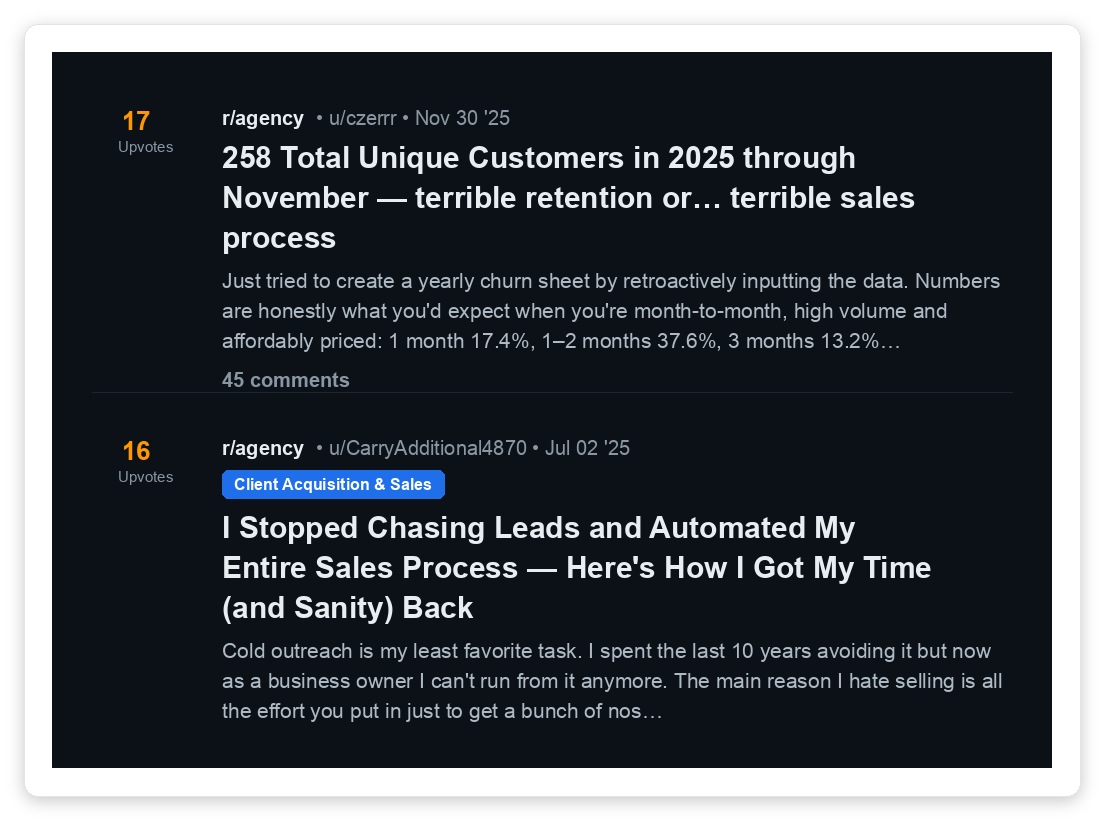
Agency owners on r/agency openly admit the gap: client count without a sales process, and retention they can't explain.
Four recurring mistakes explain almost every missed plan I have watched agencies make:
A round number ("double revenue") chosen because it sounds ambitious, not because the pipeline math supports it.
The plan tracks closed revenue (a lagging metric you see too late) but not proposals sent, reply rate, or calls booked, which is where you can still intervene (HubSpot on B2B leading indicators).
"Follow up faster" is nobody's job, so it loses to delivery work every single week. A task without a name and a time slot does not happen.
Lifting a SaaS sales plan that assumes a rep per channel, then wondering why one founder running five channels at once converts on none of them.
For a 2-20 person agency, "diversify your channels" is how you end up mediocre at all of them. Pick one channel, saturate it until it is genuinely capacity-constrained, then add a second. A founder split across cold email, LinkedIn, Upwork, and referrals never gets the rep volume to learn what actually converts on any of them.
The pipeline math that turns a target into a weekly number
This is the core of any usable sales plan template. Start from the goal and divide backwards until you reach a number a human does on Monday morning.
The anchor formula, per Anders CPA's agency pipeline guidance, is deliberately simple:
Required pipeline = Revenue target ÷ Win rate
Worked example. You want $360,000 in new revenue. Your average deal is $6,000, so you need 60 deals. At a 25% win rate, that means 240 qualified opportunities, and a required pipeline value of $1.44M (that is 4x coverage on your target).
Now layer in the channel. StepChange, citing Implisit data, puts the cross-B2B baseline at roughly 13% of leads becoming opportunities and about 6% of opportunities becoming deals. Your own channel rates matter more than any average, which is why the calculator above takes yours as inputs.
Win rate is not one number: it is one per channel
Applying a single blended win rate is the quiet killer. A 35% win rate on referrals and a 15% win rate on cold outbound are different businesses, and a uniform 3x coverage ratio across both will over-invest in the weaker one.
Typical win rate by source
Directional B2B services pattern, not a guarantee. Measure your own.
Pattern synthesized from HubSpot and StepChange guidance. Your numbers will differ; that is the point of measuring.
The 3x pipeline rule is a starting point, not a law. As Gary Smith Partnership notes, agencies with lower win rates or longer cycles often need 4x or 5x coverage, while a referral-heavy shop with a 35% close rate can run leaner.
What goes in the sales plan template: the 9 sections
Here is the structure I would hand a small agency. Nine sections, ordered so each one feeds the next. The first three are strategy, the next three are math, the last three are execution.
Three sentences: the revenue goal, the one channel that gets it, the single biggest risk.
The exact niche, deal size band, and the signal that says "this one will close." Not a persona poster.
Your one primary channel and the stages a deal moves through. Name the sales motion you actually run.
Split retainer, project, and expansion revenue. Blended targets hide which engine is actually working.
The output of the calculator above: deals, opportunities, coverage, and the weekly activity number.
Who sells, how many hours they actually have after delivery, and the tooling spend that supports the volume.
A short list of leading indicators, reviewed weekly. Proposals sent, reply rate, calls booked, win rate by source.
A weekly activity floor that survives your busiest delivery weeks, plus monthly checkpoints.
Every recurring task has a name and a time slot. This is the section that separates a plan from a hope.
The one-page sales plan template, ready to copy
Skip the 20-page document. This one-pager holds everything that changes behavior. Copy it, fill the brackets, and it is a working plan.
Sales plan vs business plan vs marketing plan
These three get blended into one bloated document, and the sales plan loses. They answer different questions over different time horizons, per Highspot and the U.S. Small Business Administration.
| Dimension | Business plan | Marketing plan | Sales plan |
|---|---|---|---|
| Question | Should this company exist and how? | How do we create demand and awareness? | How do we convert demand into revenue? |
| Horizon | 1-3 years | Quarter to year | Week to quarter |
| Core metric | Profit, runway, market share | Pipeline contribution, brand reach | Closed revenue, win rate, quota |
| Owner at a small agency | Founder | Founder or marketing lead | Founder or first BDR |
Synthesized from Highspot, Wolters Kluwer, and the SBA.
The 30/60/90 sales plan, with a weekly heartbeat
The 30/60/90 day plan is the standard format (Zendesk), and it is fine as a milestone map. It is the wrong unit for the thing that actually kills agencies: the feast-famine cycle.
The classic story is two big projects landing, everyone dropping sales to deliver, and a revenue cliff 60 days later that a quarterly review is structurally blind to. The fix is a weekly minimum activity floor underneath the 30/60/90 structure.
Measure your real reply rate and win rate by source. Set the weekly proposal or call floor from the calculator. Most agencies discover their assumed win rate was optimistic by half.
This is the make-or-break window. The weekly activity floor holds even when delivery is on fire. Assign response speed as an owned, time-boxed task, because late proposals lose.
Recompute coverage with real numbers. If one source converts 2x better, shift effort there. Only consider a second channel once the first is genuinely capacity-constrained.
Your single most important leading indicator is not lead volume. It is whether the weekly activity floor ever hit zero during a busy week. If it did, the famine is already scheduled.
Free for Upwork agencies
Hit your weekly proposal floor without burning your team out
If your plan needs 200 proposals a week on Upwork, no founder can do that by hand. GigRadar runs the volume through a supervised Upwork Business Manager so your weekly floor never hits zero.
Get Your Free Agency Audit →Where agencies that sell on Upwork plug the sales plan in
For agencies whose primary channel is Upwork, the sales plan has one extra reality: the math demands proposal volume that a single founder cannot physically produce. This is where the weekly floor stops being a spreadsheet and becomes an operations problem.
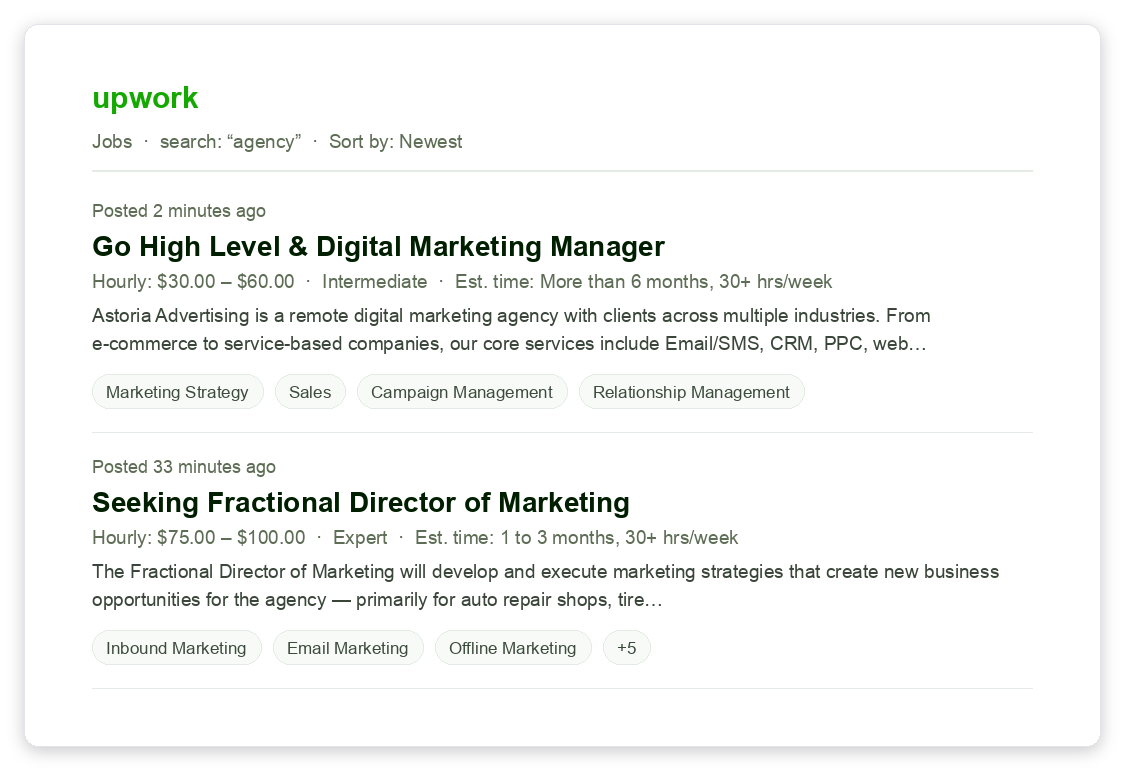
Upwork is the rare channel where buyers arrive with budget and intent already declared, which is why it belongs at the top of many agency sales plans.
Here is the number that breaks naive plans. GigRadar pipeline data (133,872 outbound proposals, December 2025 to February 2026) shows reply rate stabilizing around 6-7% once an agency is past its first 50 proposals. At a 6.5% reply rate, a goal that needs 240 qualified opportunities can require well over 3,000 proposals across the period, which is 60+ a week before you account for the replies that never convert to calls.
Two compliant ways to actually produce that volume exist. The first is filter-and-draft, where a tool surfaces matching jobs and the freelancer clicks Submit themselves. The second is the Business Manager model, which is how GigRadar works.
We operate a real Upwork Business Manager account. Your agency invites our BM through Upwork's official invitation system, the same role you would use to onboard a hired bidder. Proposals submit from our BM under our team's supervision, your own freelancer account is never touched, and if Upwork ever reviews a submission, that review lands on our BM profile.
The point for your sales plan is simple. The weekly floor only protects you if it actually gets hit, and on Upwork that means deciding upfront whether the volume your math demands is something your team produces by hand or something you systematize.
If Upwork is your channel, a few of our deeper guides pair directly with this plan: B2B lead generation on Upwork, tracking win rate and response rate, and the proposal templates that actually convert. For the economics underneath the targets, see how marketing agencies actually make money and how digital agencies find clients. If you are still deciding on structure, agency vs freelancer on Upwork covers the tradeoffs.
Build the plan that survives your busiest week
A sales plan template is only worth the time if it changes what someone does on Monday. That happens when the revenue goal has been divided all the way down to a weekly number, every recurring task has an owner, and the activity floor is sacred even in delivery crunch.
Run your numbers through the calculator, copy the one-page template, and put names next to the weekly floor. The agencies that hit plan are not the ones with the most ambitious targets. They are the ones whose targets survived contact with the math.
- Have I divided the revenue goal down to a weekly proposal or call number?
- Does every recurring sales task have a name and a time slot next to it?
- Will the weekly floor still get hit during my busiest delivery week?
If any answer is no, you have a forecast, not a plan.