
🎬 Sales Methodology in 2026: What 133,872 Proposals Prove — a 2-minute walkthrough of why MEDDIC, SPIN and Challenger assume a discovery call you won't get on Upwork, and the crowding number that predicts replies better than any framework. Watch on YouTube
TL;DR
- → Every major sales methodology (MEDDIC, SPIN, Challenger, Sandler, BANT) is a mid-funnel instrument that assumes a live discovery call and a buying committee. On Upwork you get one written proposal and one person.
- → The industry's own headline evidence is weaker than it looks. The most-cited study is self-reported and correlational, and the Challenger research drew a peer-reviewed critique calling its limitations "fatal flaws".
- → In GigRadar pipeline data, one of the strongest levers on whether a client replies is how contested the job already is. Reply rate runs 9.44% on jobs only one GigRadar customer bid, and 2.11% where 11 or more did.
- → That means the decision that actually decides your quarter happens before any methodology switches on: which job you bid at all.
- → Use the fit finder below to see which methodology matches your real deal shape, and the scorecard to qualify the opportunity instead of the buyer.
A 1985 meta-analysis in the Journal of Marketing Research pooled 1,653 correlations on what actually predicts salesperson performance. The average correlation was r = .188, meaning any single predictor explains under 4% of the variance in how well a seller does.
Forty years later the sales methodology industry sells you the opposite promise: adopt this six-letter framework and your win rate moves 17 points. I want to show you what the evidence actually supports, and then show you the number from our own pipeline that matters more than any of it.
Every methodology on the list was built for a deal you are not running
Here are the ten frameworks that dominate this category, with the thing the listicles leave out: what each one silently assumes about your deal.
One honest caveat before the table. With the exception of the MEDDIC family, the creators of these methodologies never published deal-size or cycle-length specifications, so the fit ranges below are practitioner consensus rather than spec.
| Methodology | Origin | What it stands for | Where practitioners put it | Documented failure mode |
|---|---|---|---|---|
| MEDDIC | Dunkel & Napoli at PTC, 1996 | Metrics, Economic Buyer, Decision Criteria, Decision Process, Identify Pain, Champion | $25k+ deals, 60+ day cycles | Becomes a form reps fill in after the fact. It inspects deals, it does not create them. |
| MEDDPICC | Popularized by Andy Whyte, 2020 | MEDDIC plus Paper Process and Competition | $250k+ enterprise | Overhead exceeds value below roughly $50k ARR. |
| SPIN Selling | Neil Rackham, 1988 | Situation, Problem, Implication, Need-payoff | Complex B2B, roughly $25k+ | Situation questions read as interrogation to a buyer who already did the research. |
| Challenger Sale | Dixon & Adamson, CEB, 2011 | Teach, Tailor, Take Control (not an acronym) | Complex multi-stakeholder deals | Reps mistake challenging for arguing. Also the most academically contested model here. |
| Sandler | David Sandler, 1967 | Seven compartments: Bonding, Up-Front Contract, Pain, Budget, Decision, Fulfillment, Post-Sell | Founder-led and SMB. The best fit on this list for an agency. | The early budget gate disqualifies deals that have not matured yet. |
| BANT | IBM, mid-century (IBM's own doc) | Budget, Authority, Need, Timeframe | Inbound triage, sub-30-day cycles | Seller-centric. Asks buyers for certainty they do not have yet. |
| GAP Selling | Keenan, 2018 | Current State → Gap → Future State | Any deal size, discovery-heavy | Demands diagnostic skill but ships no question checklist. |
| Solution Selling | Mike Bosworth, mid-1980s | Latent pain → vision → pain sheet | Enterprise | Declared obsolete by the Challenger authors. Process-heavy. |
| NEAT | Harris Consulting Group, 2016 | Need, Economic impact, Access to authority, Timeline | Modern SaaS, explicit BANT replacement | Thinly documented outside its own vendor. |
| Consultative Selling | Mack Hanan, 1970 | Sell profit improvement, not product | High-margin, executive-level | A category label more than a method. More talked about than performed. |
Read the "where practitioners put it" column again. Nine of the ten assume a deal worth more than most agency contracts and a cycle longer than most agency projects.
Meanwhile the actual failure mode on a marketplace has nothing to do with how you run a deal. It is that the deal never starts.
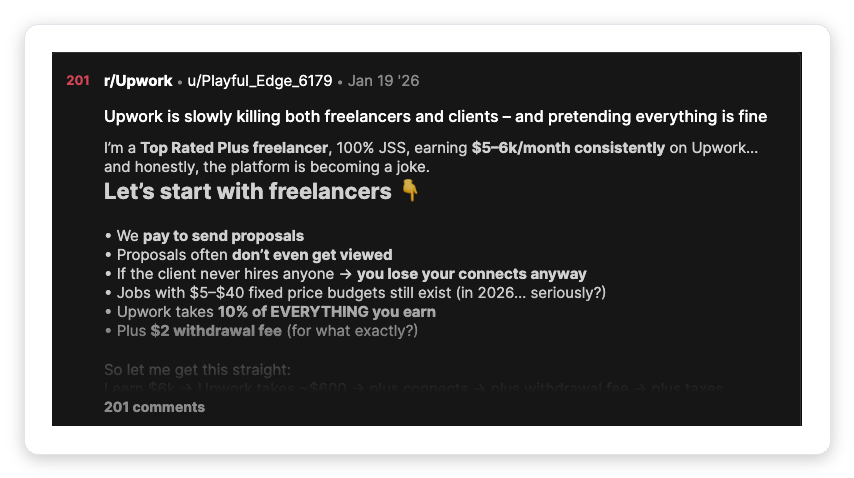
No amount of Decision Criteria mapping fixes a proposal nobody opened.
Four of MEDDIC's six letters (Economic Buyer, Decision Criteria, Decision Process, Champion) exist to navigate a buying committee, and Gartner puts the enterprise buying group at 5 to 11 stakeholders. Your Upwork client is one person who posted a job and will click Hire, so those four letters collapse into the same human.
Which methodology actually fits your deal shape?
Answer five questions about how you really sell. The finder scores all ten frameworks against your deal shape and tells you which one earns its overhead, and when the honest answer is "none of them yet."
Interactive Tool
Five questions. No email required.
The evidence for sales methodology is thinner than the industry admits
The number everyone quotes comes from the CSO Insights 5th Annual Sales Enablement Study, which surveyed 918 respondents. It looks decisive.
| Process + methodology adoption | Win rate (forecast deals) | Quota attainment |
|---|---|---|
| Under 25% | 40.4% | 49.4% |
| 76% to 90% | 54.1% | 64.0% |
| Over 90% | 57.8% | 72.4% |
| Study average | 46.4% | 60.0% |
Now the part the vendor decks skip. That study is self-reported, cross-sectional and correlational.
Respondents rated their own adoption and reported their own win rates. There is no control group and no temporal ordering, so "well-run companies do both" explains the pattern exactly as well as "methodology causes wins."
The Challenger research has a peer-reviewed problem
This is the citation that never appears in the listicles. In 2014, four researchers published a formal critique of the Challenger model in the Journal of Personal Selling & Sales Management.
"While the Challenger Sales Model does not offer any new or novel insight, it is also subject to inherent empirical and conceptual limitations that actually represent fatal flaws."
Source: Rapp, Bachrach, Panagopoulos & Ogilvie (2014), JPSSM 34(4). The paper won the 2015 Marvin Jolson Award.
A separate methodological review found that only 25 of 44 variables were disclosed, no holdout validation was run, and star performer status was assigned by managers' subjective judgment rather than by the actual sales-versus-quota data the authors had collected.
Rank these frameworks by evidence quality instead of popularity and the order inverts. Rackham's SPIN research observed 35,000 live sales calls directly, whereas Challenger's rested on an after-the-fact survey with no control group.
The famous "54% of high performers are Challengers" figure is the subset for high-complexity sales only, and across all sales it was roughly 40%. Most pages citing it drop the qualifier.
On a marketplace, the deal is decided before anyone talks
Here is where our data disagrees with the entire category, and I want to be precise about what it does and does not show.
We looked at 133,872 outbound proposals from GigRadar's pipeline between December 2025 and February 2026. Within the 59,339 we could join to job-level records (January and February 2026), one of the strongest levers on whether a client replies was not the client's budget, rating, or history.
It was how contested the job already was.
Be careful about how much weight that chart carries. The high-density bins are not the same jobs as the low-density bins, they are the visible, well-budgeted, keyword-obvious posts that many scanners surface at once.
So some of the gradient is competition and some is simply which jobs attract crowds. What it does establish is that the crowded end of the market converts far worse, and that crowding is observable before you bid.
A second finding points the same direction. When we ranked opportunities by how well they matched a customer's own scanner criteria, the best-matching jobs replied worst.
Source: GigRadar pipeline data, January to February 2026. n = 59,339 proposals across 30,964 distinct Upwork jobs.
If a job looks perfect to your filters, it looks perfect to everyone else's too. Match score is a measure of competition density, not deal quality.
That reframes what a bidding strategy is for. It is not a filter for quality, it is a search for uncontested ground.
Reply rate is a conversation metric, not a revenue metric. These proposals were not randomly assigned to jobs, so bid quality and job selection are tangled together.
A 9% reply on a $2k project can still lose on expected value to a 4% reply on a $25k one. Treat this as a targeting signal, not a pricing strategy.
The lesson agencies usually learn backwards
The instinct when reply rates drop is to tighten the filter and chase better clients. The data says tightening the filter marches you into the most crowded auction on the platform.
🎥 The "Can't find matching jobs?" lesson from GigRadar's Agency Success Course walks through widening a search without lowering standards.
Qualify the opportunity, not the buyer
Every framework in the canon qualifies the buyer. On a marketplace the buyer is mostly unknowable before contact, while the job post is fully observable.
And Upwork's own interface makes the argument for me. Open the job search filters and the population counts are right there.
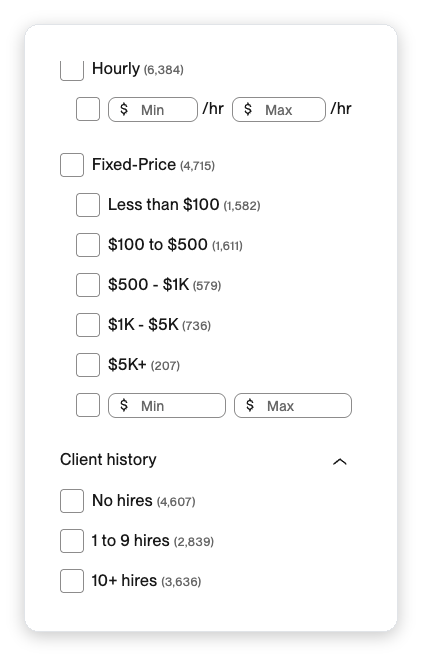
Filter to $5,000-plus budgets and 207 jobs remain. Stay in the $100 to $500 band and there are 1,611.
Look at the client history counts too. The single largest bucket is "No hires," which is precisely the cohort every qualification listicle tells you to screen out.
Qualifying up by budget shrinks your addressable pool by roughly 8x on this search. If your close rate does not improve by more than 8x to compensate, you have made your pipeline smaller and called it discipline.
So flip the object. Below is the qualification stack that actually maps to how these deals are won, scored before you spend a single Connect.
Tick what is true about the job post in front of you. Five checks, one verdict.
Tick the boxes above to get a verdict.
Notice what is absent: authority, need, and timeline. On a marketplace those are either given (the poster decides) or unknowable until someone replies.
This is also why the standard sales qualified lead definition does not transfer cleanly. There is no lead to qualify until the client answers, so the qualification has to happen against the post.
What the classics still get right
I am not arguing the canon is wrong. BANT never said "bigger budget is better," it said "confirm a budget exists," and that holds perfectly well here.
MEDDIC's Economic Buyer criterion is arguably confirmed by marketplace selling rather than refuted, because the poster is the person who signs. The quarrel is with the listicles that turn qualification into a size filter, not with Bosworth, Rackham or Dixon.
Redefining "better-fit" so it actually shortens the cycle
Everyone in this market says the goal is better-fit leads. The word usually means higher-scoring: bigger budget, better rating, tighter keyword match.
Our data says that definition is the expensive one. Here is the version that survives contact with a marketplace.
| "Better fit" usually means | What it should mean | Effect on cycle length |
|---|---|---|
| Highest scanner match score | Least contested post you can still deliver well | Replies arrive in days instead of never, because you are not buried in the pile |
| Biggest available budget | Budget you can scope in one message | Removes the multi-call scoping round trip entirely |
| Most established buyer | Buyer who is actually reading proposals | Cuts the dead weeks spent waiting on someone who already has a supplier |
That is the whole argument for sourcing compressed into one table. A shorter agency sales cycle does not come from running a tighter framework on the deals you have, it comes from starting fewer conversations that were never going to close.
This is also what we built GigRadar to do. We surface the posts your competitors' filters are not converging on, and our Upwork Business Manager submits the proposal on your behalf, so the sourcing decision and the submission both happen before the auction fills up.
Free for Upwork agencies
Stop bidding the same jobs as everyone else
We run proposal submission through our own Upwork Business Manager account, and we can show you which of your scanners are fishing the most crowded ponds. Book a free audit and we will walk your pipeline with you.
Get Your Free Agency Audit →What to actually run if you sell $3k to $30k projects
The best-fitting named framework for agency selling is not on most listicles' podium. Blair Enns built the Four Conversations model specifically for selling expertise, because the techniques for selling products do not transfer.
Enns also gives the only agency-specific benchmark I trust enough to repeat. He puts the typical agency close rate at around 25%, calls 40% "the threshold of respectability," and says you should be pushing past 50%.
That model assumes the founder is still the closer, which for most agencies at this size is true. If that describes you, the mechanics of founder-led sales matter more than any acronym.
| Stage | What decides it | Borrow from |
|---|---|---|
| Which job you bid | Competition density, post age, niche overlap | Nothing. No framework covers this. Use the scorecard above. |
| The written first touch | Whether you name their problem before pitching | GAP Selling, in writing. Current state, gap, future state, in three lines. |
| The first call | Whether you set terms before presenting | Sandler's up-front contract. Agree what happens at the end of the call, at the start of it. |
| Scoping and pricing | Whether you anchor or get anchored | SPIN's implication questions, then a deliberate pricing position. |
| The close | Whether you have a smaller offer in your back pocket | Sandler again, plus a fallback scope you decided in advance. |
🎥 The "Always Close the Deal" lesson from the Agency Success Course covers back-pocket offers and handling scope pushback.
The market is moving against the discovery call anyway
Gartner surveyed 632 B2B buyers and found 61% prefer a rep-free buying experience. The next annual wave of that survey put it at 67%.
Every methodology in the canon is a conversation technology. Buyers are steadily opting out of the conversation.
And the squeeze lands hardest on exactly your deal size. RepVue's Q2 2025 Cloud Sales Index shows sellers working sub-$10k deals saw quota attainment fall about 7% year over year to just above 40%, while $200k+ sellers held at 46.70%.
The response most agencies pick is to move upmarket. The response our data supports is cheaper: keep your deal size, and stop competing in the auctions everyone else already found.
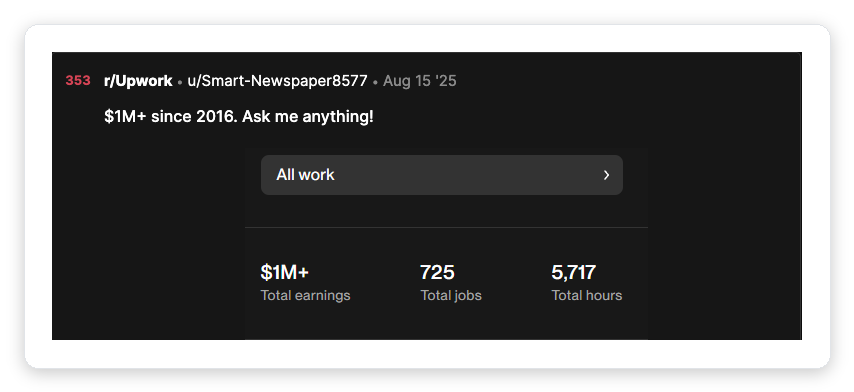
725 jobs to a million dollars. That is roughly $1,400 per contract, built by the exact small-deal motion every enterprise framework would tell you to abandon.
The same poster notes their first 100 proposals produced one reply, and their first two contracts came in at $25 an hour. Nobody qualified their way to that number, they selected their way to it.
Frequently asked questions
What is a sales methodology, exactly?
A sales methodology is a repeatable system for how you run a deal: what you ask, in what order, and what has to be true before you advance. It is distinct from a sales process, which describes the stages a deal moves through rather than the behaviour inside them.
Which sales methodology is best for a small agency?
Sandler fits founder-led selling best, because the up-front contract and early budget conversation stop you burning weeks on deals that were never real. Blair Enns' Four Conversations is the closest thing to a purpose-built agency framework.
Does adopting a sales methodology actually increase win rates?
The correlation is real but the causal evidence is weak. The most-cited study is self-reported and has no control group, and the peer-reviewed meta-analysis on salesperson performance found no individual predictor explaining more than about 4% of variance.
What is the difference between MEDDIC and BANT?
BANT is a four-point triage check run early to decide whether a lead is worth pursuing. MEDDIC is a six-point deal inspection run repeatedly through a long enterprise cycle, and it assumes a buying committee that BANT does not.
Can I use a sales methodology on Upwork?
Partially. The frameworks apply once a client replies and a conversation starts, but none of them govern the decision that matters most on a marketplace, which is which job you bid in the first place.