
how to get clients for a marketing agency without a sales team
TL;DR
- A full-time SDR for a marketing agency costs $100K fully loaded (base + commissions + tools + onboarding). Most sub-10-person agencies cannot afford one and the ones that hire one see 70% burn out in 90 days selling a generalist offer to a saturated ICP.
- The cheapest path to replace a sales team is not a tactic. It is a channel stack that uses one demand-capture source (Upwork), one inbound warm loop (referrals with a system), and one content flywheel that compounds. Every other channel is cosmetic.
- A December 2025 r/agency thread shows the trap in one exchange. An SEO agency owner posted his entire outbound stack and asked 178 commenters how to get clients, and the highest-voted reply (20+ upvotes) simply asked why a lead gen agency cannot run its own method on itself. That is the breaking point for most agencies.
- The full channel cost breakdown, 3 course-sourced case studies, and a copy-paste 90-day rollout are below, including an interactive calculator that tells you how much a sales team would actually cost your agency this year.
On 5 December 2025, an SEO agency owner posted on r/agency under the title "How do you get clients for your marketing agency?" He was not a beginner: he had real client results, a following on LinkedIn, and a daily outbound routine he ran himself.
The thread pulled 178 comments. One of the highest-voted replies was a single sentence, and it was not a tactic.
"If you run a lead gen agency, how can yo not use the method you use for your clients to get clients yourself?"
u/SeniorFox · r/agency · 5 December 2025 · 20+ upvotes
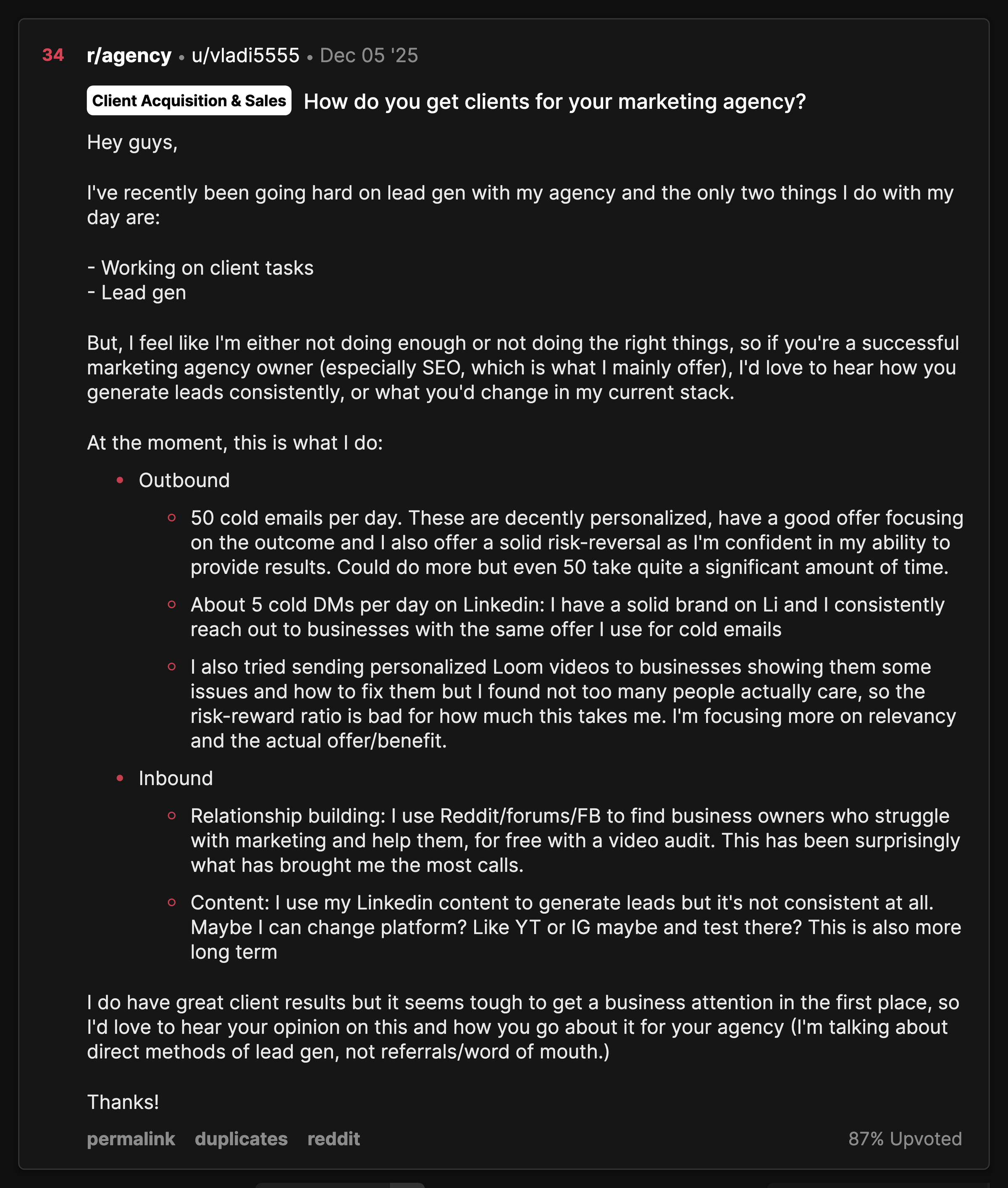
An SEO agency owner running 50 cold emails and 5 LinkedIn DMs every day, asking 178 commenters what he is doing wrong. Source: r/agency, December 2025.
That is the whole problem in one line. An agency can be very good at manufacturing demand for a client and still have no repeatable way to manufacture its own.
Most owners in that spot fall back on referrals. Referrals are not a channel, they are a side effect of doing good work for a closed set of people.
When that set stops growing, the channel stops. The question is what replaces it.
The default answer agencies reach for is: "I need a sales team." That answer is wrong for roughly 80% of agencies under 10 people.
Here is what actually works, grounded in live 2026 cost data and three real GigRadar agency case studies.
Why hiring a sales team is the wrong first move for sub-10-person agencies
Put a number on the dream. A full-time SDR in the US, hired into a marketing agency, costs roughly $70K base + commissions + tools + onboarding = $100K fully loaded in year one.
Hiring two (the minimum for meaningful coverage) clears $200K before you close a single additional client. That math is brutal for a $30K/month agency.
It is merely ugly for a $60K/month one. And it still assumes the SDR can actually sell what you built.
70% turnover
Average SDR role at a small marketing agency lasts under 18 months. Most leave at 90 days because they cannot sell a generalist "full-service digital marketing" offer to a saturated ICP (source: Bridge Group SDR benchmarks).
The deeper problem is not cost. It is that hiring a salesperson forces you to admit three things your offer is probably missing: a sharp ICP, a real differentiator, and a channel that produces inbound qualified conversations.
Without those, a human SDR burns through 400 dials and quits.
A sales team is a finishing tool. It closes qualified opportunities that a system already produced.
If your agency does not have the producing system, hiring the finisher first is a very expensive way to learn that lesson.
The channels most agencies try, and what they actually cost in 2026
Before picking what replaces your sales team, price every alternative accurately.
Below is the 2026 channel cost stack for a US-based marketing agency, drawn from Sopro's 2025 B2B lead gen benchmark, First Page Sage 2026 CAC data, and GigRadar's own pipeline data across 3,000+ agency accounts.
Sources: First Page Sage 2026, Sopro 2025, GigRadar lead gen benchmarks.
Three things jump out. Referrals look free on paper but are the one channel you cannot scale on command.
Paid channels above $200 CPL require a closer to be profitable (which is the sales team you were trying to avoid). Upwork is the only channel with sub-$100 CPL, 1-to-3-week time-to-close, and no SDR dependency.
That does not mean Upwork is the whole answer. It means Upwork is the demand-capture layer.
You still need a warm loop and a compounding layer for the system to hold. More on that below.
The real cost of doing sales yourself (the founder-as-SDR tax)
The reason agency owners keep the "no sales team, I do it all" setup for too long is that the cost of their own time looks invisible. It is not.
The founder-as-SDR tax
$117K / year
burned on owner prospecting time alone
15 hours/week × $150 billable rate × 50 weeks. That is the opportunity cost of an agency owner running cold email, LinkedIn DMs, and discovery calls instead of servicing clients or improving the offer.
An owner billing at $150/hour who spends 15 hours a week on prospecting is not "saving money on sales."
They are paying themselves less, delivering less to clients, and producing a pipeline that collapses the moment they take a vacation.
One agency owner put it this way on r/agency:
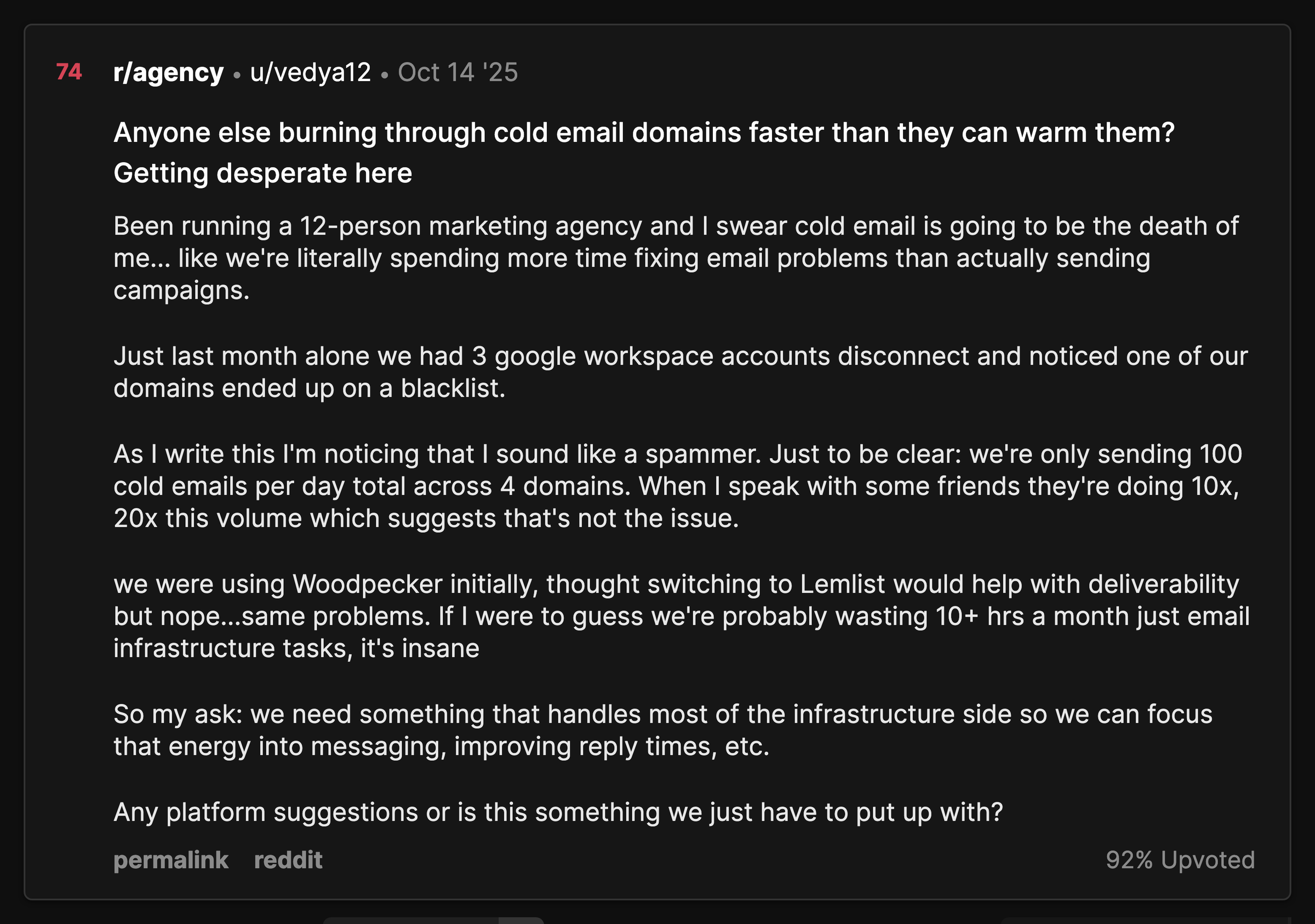
r/agency thread, where a 12-person agency was burning through sending domains. Three Google Workspace disconnects and a blacklist in one month at only 100 emails/day across 4 domains. Source: r/agency, October 2025.
"We tried cold email. First guy we hired had a 'guarantee.' Never booked a single call. We got a refund, but wasted six months. Hired another guy. Still nothing. Wasted thousands."
u/Mattrapbeats · r/agency · 16 September 2025 · 280+ upvotes
This is not an anti-cold-email argument. Cold email works when it is built right.
It is a warning that the "hire a guarantor" shortcut fails more than it succeeds, and you pay in months, not dollars.
The three-channel stack that actually replaces a sales team
Here is the setup that lets a 3-to-10-person marketing agency run a predictable pipeline without hiring an SDR. It is not novel, just disciplined.
Pick one channel from each tier.
The no-sales-team channel stack
Layer 1: demand capture on Upwork
Most agency owners have a mental image of Upwork as "a place for cheap individual freelancers." That image is out of date.
In 2026, Upwork publishes more than 800,000 active job posts at any given moment, and its payment-verified enterprise segment grew 34% year over year.
The reason Upwork produces the lowest CPL in the table above is simple buyer intent. Every job post is a purchase order waiting for a vendor, and the buyer already:
- Set a budget range
- Wrote a scope
- Defined a timeline
- Added a credit card to the platform
That is four qualifying signals before you send a single word. Cold email has zero.
LinkedIn ads have one (they clicked), trade shows have one (they showed up), and Upwork has all four on every listing.
For a marketing agency, the viable categories are "Digital Marketing," "Sales & Marketing," "Content Writing," and the specialist subcategories (SEO, PPC, Email, CRO).
Filter for payment-verified, $5K+ budget, and clients with a 90%+ hire rate, and the quality of the feed is closer to a private deal room than a gig marketplace.
Layer 2: systematize the referral loop
The r/agency owner whose thread opens this article ruled referrals out of his question entirely. That is the more common mistake: treating word of mouth as something that either happens or does not, instead of something you build.
A 2024 study of 204 B2B marketing services firms showed 68% still rely on referrals as their primary channel, but the same study flagged that fewer than 20% have an explicit partner agreement or incentive.
That gap is the easiest win in this whole article. Turn "we hope people refer us" into "3 to 6 adjacent agencies have a written, reciprocal agreement with us to exchange briefs quarterly."
A specific example: a Toronto brand strategist referred three leads to a WordPress dev shop in one quarter, which produced a $6K website build. That was not luck, it was a standing call and a shared Notion doc.
Layer 3: pick one content lane and own it
Content on its own will not rescue a referral-dependent agency in 90 days. But it compounds, and without it the first two layers lose the air cover that makes them close faster.
The rule is one lane, not twelve.
One lane means one channel (blog or LinkedIn or YouTube), one format (how-to or case study or teardown), and one reader (your ICP, not "marketers in general"). Posting four things on four platforms is how agencies go invisible.
Three real agency cases: what replacing a sales team looked like in practice
I run GigRadar, which is the product layer agencies use to operate Layer 1 without hiring. But the lesson below is not product-specific.
It is what I have watched repeat across roughly 50 agency rollouts. Three specific cases follow, named where we have permission, numbers verified.
Case 1: Grandz. $21K in 3 weeks, no new hires
Agency: Grandz (Shopify & digital marketing, 8 people)
Before: Revenue plateaued, referrals flat for 4 months. Owner personally prospecting 12 hrs/week.
Change: Systematic bidding on Upwork, sharper service packaging, no sales hire.
Result: $21K in new contracts in 3 weeks, 250% growth over next 6 months, owner back to servicing work.
The rebuild was not magic. They stopped bidding on anything they saw and started bidding on a narrow slice (Shopify theme development + CRO) where their portfolio closed fastest.
Reply rate climbed from 6% to 18% inside a month.
Case 2: CodeIT.pro. Pipeline under a structured bid routine
CodeIT.pro (Ukrainian custom software agency, ~15 people) had the opposite problem: strong delivery, decent referrals, but no predictable month-to-month pipeline. When a single anchor client ended a project, revenue dropped 30% overnight.
The change was a 20-bid-per-day ritual on Upwork, tightly filtered. Within 8 weeks they had replaced the lost revenue and added $14K/month of stable, smaller retainers, with no SDR and the same 15 people.
Case 3: Ezops Cloud. 15 to 20 deals a month on marketplace volume
Ezops Cloud is a DevOps + cloud consulting agency running on Upwork discipline. They closed 15 to 20 new projects a month at an average of $3K to $8K per project, with the owner running zero cold outreach personally.
The pattern was a tight ICP (AWS cost optimization), an absurdly specific offer ("audit your AWS bill, guarantee 20% savings or free"), and a proposal template customized only in the first two sentences. Every other case study agency I have watched scale past $40K/month has some version of that same pattern: a narrow offer, a demand-capture channel, and a proposal process that does not depend on the owner's heroics.
Video · 12 min
Top 3 mistakes pro agencies make when scaling without a sales team
From the GigRadar Success Course. The exact frame we use with Grandz, CodeIT, and Ezops before they rebuilt pipeline.
Watch the case study walkthrough →Interactive: what would hiring a sales team actually cost you?
Before you commit to hiring, run your own numbers. This calculator compares the full-loaded cost of a marketing agency sales team to the channel stack above, based on your current revenue and close rate.
Free Calculator
Sales team vs channel stack ROI calculator
Enter your numbers. The tool shows what a sales hire would cost you this year and what the no-sales-team channel stack would cost for the same pipeline target.
Your agency
Sales team assumptions
The 90-day rollout plan: from referral-dependent to predictable pipeline
Here is the exact sequence I have watched Grandz, CodeIT, and five other agencies run. Copy it.
Week 1: narrow the offer
Pick one service and one ICP. Write the one-sentence version of both.
Kill every website page that does not align. Most agencies have 12 services listed, but you need 2 to 3.
Benchmark your current referral CPL and your owner prospecting hours. You need a starting line.
Weeks 2-4: stand up Layer 1 (Upwork)
Upgrade your Upwork agency profile to match the narrowed offer. 60-second Loom intro, 4 to 6 portfolio pieces, skill-tested specialists.
Build a saved search with filters: payment-verified, $5K+ budget, English-native client region, 90%+ hire rate.
Start a 10-bid-per-day ritual, aiming for 15% reply rate by end of week 4. If you are below 8%, the offer is still too broad.
Weeks 5-8: stand up Layer 2 (referral system)
Identify 10 adjacent-but-not-competing agencies. Example pairings: SEO shop + PPC shop, brand studio + WordPress dev, email agency + CRM consultant.
Reach out with a written 2-way agreement: 10% commission on closed deals, quarterly check-in, shared lead tracker.
Goal by end of W8: 3 signed partner agreements sending at least 1 warm brief per month each.
Weeks 9-12: start Layer 3 (content flywheel)
Pick one channel (LinkedIn or blog) and commit to one post per week for 12 weeks. No second channel until week 12.
Content topic = the specific client pain your narrowed offer solves. Not "5 SEO tips." More like "Why your Shopify store's checkout conversion is 1.4% and what to test first."
Review the numbers end of W12. By now, Upwork should be the majority of new revenue, partners fill the predictable middle, and content is compounding in the background.
Copy-paste: the no-sales-team outreach framework
Most agency outreach fails because it sounds like an SDR script. The framework below is what I hand agency owners when they are replying to Upwork job posts or writing the 3-line partner intro note.
Nothing in it is clever. It is disciplined.
Three rules embedded in the template: observation before compliment, specific outcome before generic pitch, concrete ask before "let's jump on a call." If any of those are missing, it reads like a script.
Buyers on Upwork and partners on a warm intro both see the same pattern in week two.
The honest counterargument: when you do need a sales hire
I am not claiming no agency should ever hire a salesperson. I am claiming most agencies under 10 people hire too early and for the wrong reason.
The honest cutoff is roughly this:
You are doing $80K+/month consistently
Below this, a $100K SDR eats too much of the gross margin to pay itself back in year one.
You have a repeatable inbound funnel that produces more leads than the owner can close
Hire a closer when the leaks are on the bottom of the funnel, not the top.
Your ICP and offer are already narrow enough to train someone on in 2 weeks
If you cannot write the 30-minute training doc, the SDR will fail regardless of skill.
If all three are true, hire. If any is false, build the channel stack first and revisit in 6 months.
You will either have outgrown the need (because the stack scales) or met the criteria (because the offer sharpened in the process).
Where GigRadar fits (so I can be honest about it)
GigRadar is the piece of infrastructure most agencies use to run Layer 1 without the owner becoming a full-time bidder. We track pipeline data across 3,000+ Upwork agencies, and we operate with a dedicated business manager model (no login credential sharing, no scraping, no extensions).
The agencies in the case studies above used GigRadar to turn the 10-bid-per-day ritual from an owner task into a managed process.
But the point of this article is not GigRadar. The point is that "I need a sales team" is almost always the wrong response to a referral cliff.
The right response is a three-layer channel stack and a 90-day rollout. Whether you run Layer 1 with us or build it internally is a second-order question.
Free for Upwork agencies
Replace your sales team with a system that runs while you sleep
GigRadar handles Layer 1 of the channel stack for 3,000+ agencies, with human review on every proposal, a dedicated business manager, and no credentials shared. Get a free audit of your current pipeline.
Get your free agency audit →Frequently asked questions
How long does it actually take to get clients for a marketing agency without a sales team?
1 to 3 weeks for the first Upwork-sourced client if your profile and offer are narrow, 8 to 12 weeks for the referral partner system to produce steady volume, and 6 to 12 months for organic content to compound into a predictable pipeline layer.
The full 3-layer stack reaches "SDR-replacing" output in 90 days for most sub-10-person agencies.
Is Upwork really a good channel for a marketing agency, or is it just for freelancers?
Upwork enterprise-segment revenue grew 34% year over year in 2024, and the platform posts more than 800,000 active jobs at any time. For a marketing agency, the viable segments are payment-verified clients with $5K+ budgets and a 90%+ hire rate.
Average CPL ranges $30 to $100 with reply rates of 20% to 35% on targeted bids, which is roughly 5x cheaper than any outbound alternative.
Can I really get marketing clients from referrals alone?
You can, but not indefinitely. A 2024 study of 204 B2B services firms showed 68% rely on referrals as their primary channel, and the same study showed referral volume plateaus for most agencies between years 3 and 5 as the initial network caps out.
The fix is a systematized referral layer (3 to 6 written partner agreements) plus a demand-capture channel, not pure passive referral hope.
How much does it cost to hire a sales team for a marketing agency?
A US-based SDR costs roughly $70K base + $15K to $30K in commissions and tools + 90 days of ramp time = $100K fully loaded in year one. A two-person sales team clears $200K.
For agencies below $80K/month in revenue, that spend typically cannot pay itself back in year one, which is why the three-layer channel stack is the lower-risk move first.
What is the fastest channel to get clients for a marketing agency without paid ads?
Upwork with a narrowed ICP and a 60-second Loom intro. Time to first client averages 1 to 3 weeks.
The structural advantage is that every posted job is a buyer who already set budget, scope, timeline, and payment, which is four qualifying signals before you write a single proposal. No cold email stack or content library compounds that fast.
What's the best outreach framework when I do not have a sales team?
A three-line structure: one specific observation about the prospect's situation, one specific outcome you produced for a named-enough client, and one concrete next step (usually a 4-minute Loom audit, not a discovery call). Copy the exact template from the framework section above and adapt lines 1 and 2 per buyer.